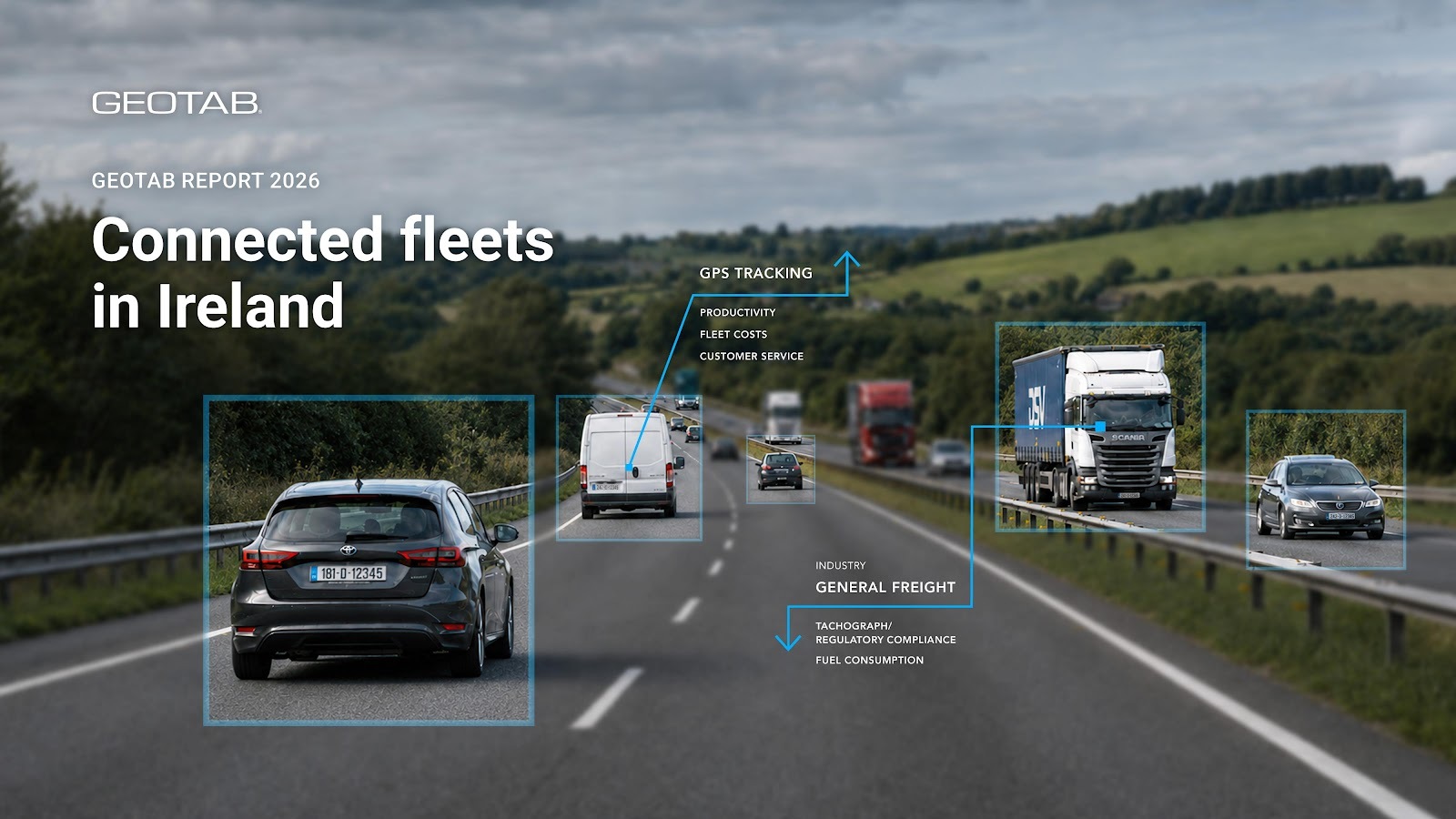
Geotab launches the report Connected fleets in Ireland
Managing an expanding transport layout requires navigating volatile resource markets. New insights from the Geotab Report 2026: Connected Fleets in Ireland confirm that transitioning toward unified data infrastructure empowers operators to secure long-term operational viability.

By Geotab Team
Sep 2, 2026
Key Insights
- 78% of commercial vehicle operations in Ireland leverage advanced location telemetry frameworks.
- Irish data-led vehicle deployments achieve a 52% reduction in variable fuel expenditures.
- Integrating automated visual sensors empowers logistics firms by mitigating 69% of false insurance claims.
Managing an expanding transport layout requires navigating volatile resource markets. New insights from the Geotab Report 2026: Connected Fleets in Ireland confirm that transitioning toward unified data infrastructure empowers operators to secure long-term operational viability.
Overcoming fleet scaling complexity
Accelerated organisational growth frequently exposes the operational boundaries of manual transit coordination. As a commercial asset deployment expands from a localised footprint into a regional multi-site framework, managers face a clear lack of centralised visibility. Gaining an accurate understanding of vehicle availability across separate yards typically demands a manual sequence of calling around various field offices, a setup that causes administrative delays and communication bottlenecks.
Empirical research from the latest market census demonstrates that automated data streams have become the baseline standard for expanding businesses. In Ireland, 75% of operations categorise digital vehicle tracking as exceptionally beneficial for supervising daily fleet movements.
Within the local landscape, deployment metrics show distinct variations by business size: adoption stands at 71% for small fleets, rises to 79% across mid-sized organisations, and hits 77% within enterprise operations. This baseline transition establishes a clear corporate standard, removing administrative guesswork and optimising daily asset deployment.
Download the Geotab 2026 report: Connected fleets in Ireland
Real-time urban last-mile visibility
The final mile of urban delivery remains the most volatile segment of the modern supply chain. Fleet operations have traditionally relied on retrospective driver logs or delayed updates to track execution progress, an arrangement that establishes a significant latency between planned schedules and actual road performance. When a delivery vehicle encounters unexpected city gridlock or localised roadworks, the back office remains entirely unaware until the customer fulfilment window has already expired.
This structural blind spot carries immense financial exposure within the hyper-competitive logistics market, where meeting customer demands stands as the single highest operational hurdle at 73%.
Missing a tight delivery window at a regional distribution centre (RDC) triggers an expensive cascade of rebooks, vehicle reloads, and compliance penalties. To safeguard execution, the integration of artificial intelligence within routing workflows enables a total collapse of the last-mile bottleneck. Automated route optimisation allows 72% of Irish operators to shrink last-mile transit times while empowering 76% to elevate their on-time delivery metrics, neutralising urban congestion and stabilising contract service level agreements (SLAs).
Download the Geotab 2026 report: Connected fleets in Ireland
Preventative safety and liability protection
Commercial vehicle operators navigate intense daily road stress, a variable that directly compromises driver well-being and elevates collision exposure. Meeting aggressive scheduling metrics can occasionally introduce safety hazards, placing both human capital and corporate reputation at risk. When a roadside collision occurs, an organisation lacking verifiable field data sits in a highly vulnerable position, frequently bearing unfair financial outlays for claims simply due to an absence of immediate proof.
Implementing automated video telematics directly shields the business baseline from these exposures. Currently, 55% of Irish fleets utilise dual-facing camera systems, and 82% of cross-industry users classify in-cab video as a critical management asset. The financial return on this safety culture is definitive: the implementation of visual data infrastructure reduces total accident expenditures by 38% and successfully mitigates false insurance claims for 69% of operators by delivering high-definition certainty to underwriters. Furthermore, 81% of connected Irish businesses secure a fully positive investment return on their video solution in one year or less.
Download the Geotab 2026 report: Connected fleets in Ireland
Supply chain and asset integrity protection
A major portion of logistics capital is tied up in unpowered mobile assets, including shipping trailers, cargo containers and high-value site machinery. Because these shared resources lack an internal motor, tracking their positioning between various equipment yards has historically depended on inaccurate manual inventory logs. It remains a frequent operational challenge for a field team to arrive at a job site to retrieve a specific generator, only to discover another crew hauled that exact asset to a separate zone the previous afternoon.
Deploying dedicated asset tracking sensors provides an absolute defence against capital misallocation and site disruptions. The 2026 dataset reveals that automated sensor tracking enhances unpowered asset security by 67%, amplifies trailer utilisation by 71%, and successfully drives down equipment theft by 71%. While unpowered asset tracking exhibits a unique capital recovery timeline—with 57% of cross-industry operators achieving a positive return on investment within the first 12 months—the primary advantage lies in maximising resource availability and preserving total project timeline integrity.
Download the Geotab 2026 report: Connected fleets in Ireland
Navigating wholesale cost volatility
Fluctuating energy values and high fuel expenditures represent a continuous threat to corporate profit margins. Operational analysis indicates that fuel consumption represents a massive 36% of the total Irish fleet operating budget, standing as the single largest variable line item ahead of driver salaries, which command 28% of total outlays. With the Central Bank of Ireland revising inflation expectations upward to 2.9% due to sustained energy-driven pressures, traditional transport operations must adapt their processes to protect their variable margins.
The application of advanced telemetry serves as an indispensable inflation hedge. The Geotab Report 2026: Connected Fleets in Ireland confirms that 60% of businesses achieve a distinct reduction in fuel consumption by embedding tracking software into their workflows. This expenditure control is highly effective across all asset tiers: small fleets reduce fuel consumption by 55%, mid-sized operations achieve a 47% reduction, and enterprise deployments secure an impressive 72% optimisation by suppressing unbillable engine idling and harsh driving patterns.
Download the Geotab 2026 report: Connected fleets in Ireland
Combating fleet workforce fatigue
The severe lack of qualified transport professionals has elevated driver retention to a critical corporate benchmark, with 53% of managers identifying the driver shortage as a top daily disruption. Driver well-being data highlights a profound operational challenge, as driver fatigue and safety ranks as a top-tier stressor for 66% of operators. When driver stress is left unmanaged, it directly impairs on-road execution and drives up chronic employee turnover outlays.
Building an enduring operation requires shifting away from punitive driver surveillance toward a supportive development model. Fleet executives are increasingly deploying automated performance analytics to provide objective, transparent feedback. This coaching mindset aligns perfectly with workforce preferences; real-world data proves that the proactive use of in-cab visual tools allows 36% of Irish firms to successfully reduce driver fatigue by ranges of 41% to 60%, transforming technical oversight into an active safety shield for the crew.
Download the Geotab 2026 report: Connected fleets in Ireland
Shifting to a proactive maintenance model
Relying on a reactive "break-fix" approach introduces severe operational unpredictability, extensive vehicle downtime, and unexpected financial outlays. Managing vehicle health via manual spreadsheets means that early internal warnings—such as subtle battery voltage fluctuations or engine oil pressure abnormalities—remain completely invisible until they trigger a major mechanical breakdown on the road. A single roadside breakdown disrupts delivery schedules and incurs expensive emergency recovery outlays.
Transitioning to a proactive maintenance model replaces spreadsheet estimation with automated vehicle diagnostics. Telematics hardware reads vehicle data streams continuously, capturing diagnostic trouble codes (DTC) the exact second a subsystem error occurs. In practice, this predictive transparency enables maintenance teams to address minor technical anomalies during routine servicing, driving down overall vehicle maintenance outlays by 28% across Irish operations.
Download the Geotab 2026 report: Connected fleets in Ireland
Verifiable evidence over commercial claims
Modern corporate procurement requires absolute empirical validation. When financial controllers and board committees evaluate capital investments in fleet technology, they demand clear proof of value over aggressive commercial sales promises. In an environment defined by cautious capital allocation, technology must demonstrate a swift, predictable return on investment to justify its position on the balance sheet.
The empirical data from the Geotab Report 2026: Connected Fleets in Ireland provides that exact financial assurance. A clear 57% of businesses achieve a positive return on investment within less than 12 months of telematics deployment. An additional 32% secure full capital recovery within one to three years, proving that digital data infrastructure functions as a self-funding operational asset. When choosing a software partner, 67% of businesses confirm a definitive reduction in their total fleet costs, establishing data intelligence as the ultimate multiplier for lean corporate frameworks.
Download the Geotab 2026 report: Connected fleets in Ireland
Frequently Asked Questions
Capital recovery is exceptionally rapid, with 57.0% of Irish connected businesses achieving a positive return on investment within less than 12 months, and a further 32.0% securing full recovery within one to three years.
Fleet operators in Ireland record a verified 28.0% reduction in vehicle maintenance outlays through proactive diagnostics, alongside a 38.0% reduction in total accident expenditures via integrated video telematics.
Yes, deploying tracking sensors onto unpowered assets improves equipment security by 67.0% and utilisation by 71.0%, with 57.0% of businesses achieving positive capital recovery within the first 12 months.
Implementing AI route optimisation allows 56.0% of connected operations to decrease their fuel expenditures, while 72.0% confirm a verified reduction in last-mile delivery times.
The Geotab Team write about company news.
Related posts

Flipping the switch on overhead: the real cost savings of fleet telematics
October 21, 2026
2 minute read

How small businesses use telematics to slash operational costs
October 19, 2026
2 minute read

The 5 most common digital tachograph penalties in EMEA (and how SMBs can avoid them)
October 9, 2026
2 minute read

Beyond van tracking: turning fleet data into bottom-line growth
October 9, 2026
3 minute read

How small construction fleets use asset tracking to halt site theft
September 9, 2026
2 minute read

Is fleet telematics worth the money? Calculating your Irish fleet ROI
September 9, 2026
2 minute read