Fuel price volatility and fleet resilience
Commentary by Edward Kulperger, Senior Vice President EMEA at Geotab
April 21, 2026
•3 minute read

Geopolitical instability has always found its way onto the fleet manager's spreadsheet — just not always through the same line item.
When the situation in Ukraine escalated in 2022, electricity prices across Europe surged. Operators who had started their electrification journey found themselves paying more to run EVs than diesel or gas in some markets. Four years later, the current situation in the Middle East has moved the needle the other way. European diesel prices have risen by 37% since January 2026. While we were averaging €1.545 per litre at the beginning of the year, we're now at €2.115*. For more than half of EU member states, prices are even up by more than a third. Petrol prices have also climbed, up 17% since January, but diesel's 37% surge is disproportionately hitting the operators who can least afford to switch.
For mixed fleets, and for every operator still running on diesel, the question stays the same: what can you actually control when the market keeps moving?
New Geotab data** drawn from a sample of European-domiciled commercial vehicles, finds the median European truck idles 53 minutes per operating day; that’s about 14.6% of engine-on time. At current prices, that's roughly 67 litres burned per truck each month while stationary: around €142 per vehicle, up from roughly €104 in January. An increase of €38 per truck in under three months.
While we see a lot of attention on how this is affecting the average consumer, we can’t forget how strongly these costs scale for fleet operators – especially when we consider how much of Europe is made up of small and medium businesses. A 20-truck fleet is now spending approximately €2,840 per month on idle fuel alone, up from around €2,080 at the start of the year. A 1,000-truck fleet would be looking at roughly €142,000 per month. And that’s just where we’re at right now. Costs are moving with oil prices and will continue to do so.
Now, not all of that idle time is avoidable.
Refrigeration units, hydraulic equipment, and in-cab climate control all draw on engine power while stationary. What telematics does is make the distinction possible: which idling has a reason and which doesn’t. Driver behaviour also sits on the same platform. Route Efficiency, acceleration patterns, and speed patterns all carry fuel cost, and all feed back into the same view.
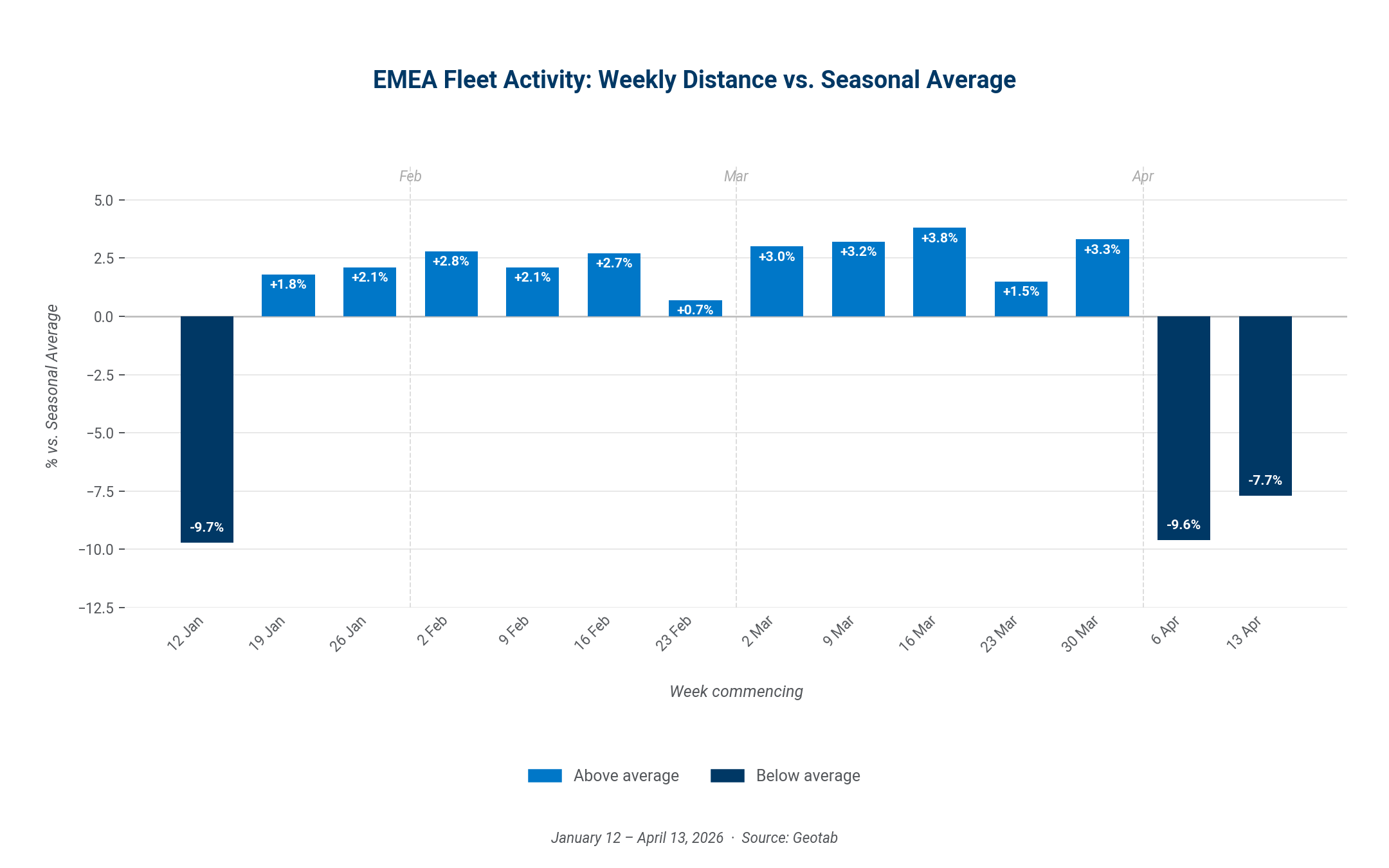
The data tells the same story. Across Europe, distance driven stayed consistently above seasonal averages from January through late March, despite the rising cost of every kilometre. In April the data is showing a dip. In the week of 6 April, EMEA-wide vehicle movement fell by almost 10% below the full-quarter average; the first dip of the year, coinciding directly with prices reaching a new peak. Not every kilometre cut will be fuel-driven, but the correlation is hard to ignore. Germany and Ireland saw the steepest single-week drops, both down around 16%.*** What we’re seeing is that fleets are leveraging data insights for resiliency: consolidating routes, improving efficiency, and scrutinising every journey before it runs.
If pressures keep rising, the impact will only hit fleets harder. At €3.00 per litre, a fleet of 100 trucks would burn up €20,100 per month in idle fuel alone – nearly double the January figure.
Fuel and electricity prices move. Emissions zone restrictions, CO2 targets, and sustainability commitments hold.
The fleets that weather this best will be the ones that go straight to their data: Which vehicles are idling beyond operational need? Where are routes carrying dead kilometres that consolidation could remove? What is driver behaviour adding to the fuel bill, and how much of that is fixable without restructuring anything? Which vehicles in a mixed fleet should electrify now, and which still need a diesel case for another cycle?
Every vehicle that moves to electricity stops being a price-taker and starts becoming an energy manager. Slower adoption doesn't preserve flexibility. It preserves dependence. At current prices, these are questions every fleet manager should be asking themselves right now. That's how fleets stay ahead, regardless of what comes next.
Polycrises may shift. The physics of profitability do not.
*European Commission, Weekly Oil Bulletin, 9 APRIL 2026 - Price developments 2005 onwards
**Geotab vehicle data covering Europe-domiciled commercial vehicles, March 2025–February 2026. Idling figures reflect median daily engine-on time for heavy-duty trucks. Fuel burn calculated at EU27 weighted average diesel price of €2.115/litre (EU weekly oil bulletin, 9 April 2026 data).
***Distance figures drawn from Geotab vehicle data covering Europe-domiciled commercial vehicles, measuring weekly kilometres driven against each country's own average for the period January 5–April 13, 2026.
Media Contact
pr@geotab.com
About Geotab
Geotab is a global leader in connected operations, video telematics and AI-powered insights. Trusted by more than 100,000 customers — from small and mid-size fleets to Fortune 500 enterprises and public-sector organisations, including the U.S. federal government, Geotab connects approximately 6 million vehicles and assets and processes 100 billion data points daily. With ISO/IEC 27001:2022, SOC2, FIPS 140-3 and FedRAMP authorisations, Geotab’s open platform and 700+ partner ecosystem unify safety, compliance and operations in a single system. Our mission: a safer, more efficient, and more sustainable world in motion. Learn more at www.geotab.com/ie and follow us on LinkedIn or visit our blog.
GEOTAB and GEOTAB MARKETPLACE are registered trademarks of Geotab Inc. in Canada, the United States and/or other countries.
Related News
.png)
Clearly Goes Live on the Geotab Marketplace Across Five Markets
October 5, 2026
2 minute read

Geotab launches Investigations and new safety capabilities to help fleets make every journey safer
September 14, 2026
3 minute read

Dublin trucks outperform passenger vehicles on urban road efficiency, Geotab data reveals
September 8, 2026
3 minute read

Europe's congestion is costing fleets millions in wasted fuel, new Geotab data reveals
July 14, 2026
3 minute read