Euro 7 emission standard: business impact and what SMBs must know
The Euro 7 standard introduces stricter emission limits for vehicles across the EU, rolling out between 2026 and 2029. Unlike previous standards, it targets not only exhaust fumes but also particles from brakes and tires, affecting cars, vans, and heavy-duty vehicles.

By Geotab Team
May 12, 2026
Key Insights
- Euro 7 starts applying in November 2026 for cars and vans, and May 2028 for HGVs and buses. Fleet decisions made today will determine compliance for the next decade.
- The regulation goes beyond exhaust emissions, introducing brake particle limits, tyre abrasion standards, battery durability requirements, and real-world monitoring.
- This is not just an environmental update — it is a lifecycle compliance framework, affecting procurement, maintenance, financing, and resale values.
For small and medium-sized enterprises across the European Union, Euro 7 is both a regulatory shift and a strategic planning milestone.
What is Euro 7?
Euro 7 replaces Euro 6 (light-duty vehicles) and Euro VI (heavy-duty vehicles) under a single, unified regulation.
It sets limits on:
- Nitrogen oxides (NOx)
- Carbon monoxide (CO)
- Hydrocarbons
- Particle emissions (including smaller PN10 particles)
- Nitrous oxide (N₂O) for heavy-duty vehicles
- Brake particle emissions
- Tyre abrasion
- Battery durability for electric and hybrid vehicles
Unlike previous standards, Euro 7 focuses heavily on real-world emissions performance across the vehicle's lifetime, not just laboratory testing.
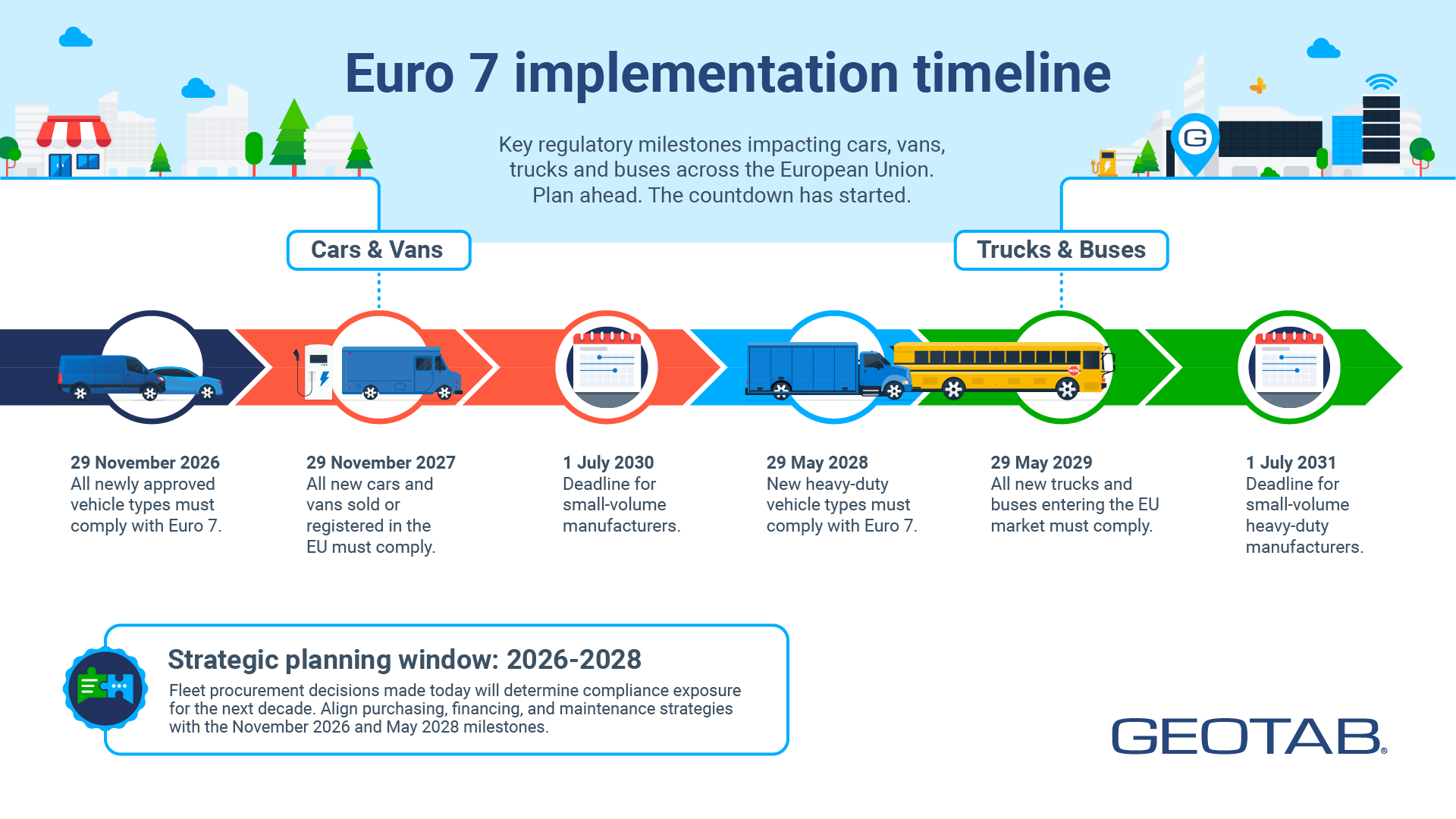
The Euro 7 timeline: exact dates that matter
The regulation has been formally adopted by the European Union, and the implementation calendar is fixed.
Cars & Vans (M1 and N1)
- 29 November 2026 → Applies to new vehicle types
- 29 November 2027 → Applies to all new vehicles sold or registered
- 1 July 2030 → Deadline for small-volume manufacturers
What “new types” means:
Manufacturers launching a brand-new model after November 2026 must ensure it complies with Euro 7 before approval.
What “all new vehicles” means:
From 29 November 2027, no new car or van can be sold or registered in the EU unless it meets Euro 7.
HGVs & Buses (M2, M3, N2, N3)
- 29 May 2028 → Applies to new vehicle types
- 29 May 2029 → Applies to all new heavy-duty vehicles
- 1 July 2031 → Deadline for small-volume manufacturers
Heavy-duty vehicles are given an additional 18 months compared to light vehicles, recognizing their engineering complexity.
The countdown has started
This is where it becomes strategic for SMBs.
Cars & Vans: November 2026 – November 2027
Starting 29 November 2026, manufacturers cannot introduce new models that do not meet Euro 7.
By 29 November 2027, every new car or van entering the EU market must comply.
For SMB fleets, this means:
- Orders placed in 2026 may involve model transitions.
- Leasing contracts signed today could overlap with the regulatory shift.
- Vehicle prices may gradually adjust as manufacturers integrate new technology.
- Residual values of late Euro 6 vehicles may fluctuate depending on market perception.
If your fleet renewal cycle runs every 3–5 years, decisions made in 2024–2026 will directly shape your compliance exposure through 2030.
HGVs & Buses: May 2028 – May 2029
Starting 29 May 2028, all newly approved heavy-duty vehicle types must comply.
By 29 May 2029, all new HGVs and buses sold or registered in the EU must meet Euro 7.
For logistics and transport SMEs:
- Long asset lifecycles (7–12 years) mean procurement strategy must adjust well before 2028.
- Financing models may evolve as compliance technology increases upfront vehicle costs.
- Maintenance planning will become more data-driven due to onboard emissions monitoring systems.
- Cross-border operators must ensure alignment with EU-wide enforcement.
In practical terms: HGV purchasing strategies in 2026–2028 will determine regulatory positioning until 2035 and beyond.
How Euro 7 changes light vehicles
For cars and vans, exhaust limits remain broadly aligned with Euro 6, but enforcement becomes stricter and broader:
- Smaller particle measurement (PN10)
- Brake emission limits — including for EVs
- Tyre abrasion limits
- Extended durability requirements
- Battery performance thresholds for electric vehicles
For SMBs operating vans or company cars, this means:
- Potential incremental price increases
- Improved durability expectations
- Greater predictability in EV battery lifespan
- Better positioning for urban low-emission zones
How Euro 7 changes heavy-duty vehicles
For HGVs and buses, the impact is more technical:
- New pollutant categories regulated (including N₂O)
- Expanded testing conditions
- Stricter durability requirements
- Mandatory onboard emissions monitoring systems (OBM)
For transport and logistics SMEs, compliance will increasingly rely on:
- Predictive maintenance
- Digital diagnostics
- Emissions performance monitoring
- Stronger OEM partnerships
Strategic implications for SME decision-makers
Euro 7 shifts emissions compliance from a technical issue to a board-level consideration.
1. Procurement planning
Vehicle replacement cycles must align with November 2026 and May 2028 milestones.
2. Financial planning
Higher vehicle complexity may increase upfront costs, but longer durability standards may stabilise lifecycle costs.
3. Competitive advantage
Early adoption strengthens ESG positioning, especially in public tenders and B2B supply chains.
4. Aftermarket opportunities
Workshops, diagnostic providers, and fleet management services will see new demand for compliance-driven services.
Euro 7 is not just another emissions standard.
It is a structural transformation of how vehicles are regulated across their lifetime in the European Union.
Key dates to remember:
- Cars & Vans: 29 November 2026 → 29 November 2027
- HGVs & Buses: 29 May 2028 → 29 May 2029
The regulation is adopted. The dates are fixed. The market is preparing.
For SMBs, the real question is no longer if Euro 7 will affect your business — but whether you plan ahead or react later.
The Geotab Team write about company news.
Related posts

Flipping the switch on overhead: the real cost savings of fleet telematics
October 21, 2026
2 minute read

How small businesses use telematics to slash operational costs
October 19, 2026
2 minute read

The 5 most common digital tachograph penalties in EMEA (and how SMBs can avoid them)
October 9, 2026
2 minute read

Beyond van tracking: turning fleet data into bottom-line growth
October 9, 2026
3 minute read

How small construction fleets use asset tracking to halt site theft
September 9, 2026
2 minute read

Is fleet telematics worth the money? Calculating your Irish fleet ROI
September 9, 2026
2 minute read