How Commercial Fleets in Thailand Use Dashcam Video Telematics to Dispute False Claims
Thai commercial fleets are using AI-powered dashcams and video telematics to combat false and inflated accident claims on Thai roads. This technology creates timestamped, GPS-correlated video records that resolve liability disputes in 24–72 hours. Not the months a paper-based process requires.

By Geotab Team
Aug 17, 2026
Key Insights
- Thailand recorded 11.4 road traffic deaths per 100,000 population in 2021, creating high-frequency accident exposure for every commercial vehicle on Thai roads
- A dashcam records the seconds before, during, and after an incident — the exact window insurers and courts require to assign liability
- An ADAS system detects dangerous driving events and triggers automatic video clip saves before the driver can intervene
- Video evidence is increasingly accepted in Thai civil proceedings and insurance investigations as primary proof of fault
- AI-powered dashcams classify incidents automatically, distinguishing a genuine collision from a staged or inflated claim
- The Geotab GO Focus Plus provides road-facing and driver-facing video with event triggers configurable through MyGeotab
Why False Accident Claims Are a Real Problem for Thai Fleets
Staged and inflated accident claims are not unique to Thailand — but Thailand's road environment creates specific conditions that make commercial vehicles a frequent target.
Large commercial vehicles — trucks, vans, buses — are perceived as high-value insurance targets. A motorcyclist or pedestrian who makes contact with a commercial vehicle, regardless of fault, typically claims maximum medical and compensation payouts. They know the operator's insurer will prefer settlement over litigation.
According to the WHO Global Status Report on Road Safety 2023, Thailand recorded 11.4 road traffic deaths per 100,000 population in 2021, placing it among the highest rates per capita in Southeast Asia. Road crashes cost the country an estimated 3% of GDP annually. For Thai commercial fleet operators, this environment creates three distinct claim risks:
- Legitimate fault claims — where the driver was genuinely responsible
- Inflated legitimate claims — where the incident was real but the claimed damages are exaggerated
- Staged or opportunistic claims — where a third party deliberately creates an incident or misrepresents what occurred
Without video evidence, all three present the same challenge: a he-said/she-said dispute that defaults to a costly settlement.
How a Dashcam Resolves Disputed Claims Faster
A dashcam installed on a commercial vehicle records continuous or event-triggered footage of the road ahead and, on dual-camera units, the cab interior. When an incident occurs, the camera's G-sensor or ADAS trigger locks and saves a clip — typically 20–60 seconds before impact and 10–20 seconds after.
This clip contains:
- Exact GPS location and timestamp
- Vehicle speed at the time of the incident
- Road and traffic conditions at the moment of contact
- The third party's behaviour immediately before impact
- Driver behaviour and reaction time
Why this matters in a Thai insurance context: Thai insurers settle the vast majority of commercial claims based on the police report and party statements. Video footage that contradicts those statements accelerates settlement in the operator's favour — or, in the case of a staged incident, allows the operator to challenge the claim entirely rather than pay a fraudulent settlement.
What an ADAS System Adds to a Dashcam Setup
A standalone dashcam records what happens. An ADAS system — installed either as a dedicated camera or integrated into an AI dashcam — detects what is about to happen and responds in real time.
In a commercial fleet context, an ADAS system delivers six core functions that directly reduce both accident frequency and false-claim exposure:
| ADAS Feature | How It Works | Claim-Dispute Benefit |
| Forward Collision Warning (FCW) | Alerts driver when following distance is unsafe | Records that driver was warned and responded — or didn't |
| Lane Departure Warning (LDW) | Detects unintentional lane drift | Proves lane position at time of any side-swipe claim |
| Driver Fatigue Detection | Monitors eye closure and head movement | Refutes claims that driver was asleep at wheel (or confirms it for safety management) |
| Headway Monitoring | Tracks distance to the vehicle ahead | Provides speed/distance data for rear-end disputes |
| Pedestrian & Cyclist Detection | Identifies vulnerable road users near the vehicle | Critical evidence in pedestrian contact claims |
| Speed Alert / Over-Speed Recording | Logs speed in real time | Refutes inflated speed claims from third parties |
The critical distinction between a basic dash cam and an AI-powered video telematics system: the AI classifies the incident automatically. An AI dashcam distinguishes a hard-braking event caused by a third party cutting across a lane from one caused by driver inattention — and flags it with the correct severity level.
This automated classification allows fleet managers to triage dozens of incidents per week without reviewing hours of footage.
How Video Telematics Works on Thai Roads: The GO Focus Plus
The Geotab GO Focus Plus is a dual-camera AI dashcam — with a 1080p road-facing lens and a 720p IR cabin-facing lens — that integrates directly with the Geotab GO9 telematics device via the GO Focus Plus Smart Cable. The device carries NBTC regulatory compliance for Thailand (among other markets), and all footage is correlated with:
- GPS trip data (route, speed, location — logged at configurable intervals via the device's built-in multi-constellation GNSS)
- Driver ID (via the built-in NFC/RFID card reader — supports MIFARE, ISO14443A&B, ISO15693)
- Engine data from the paired GO9 (brake application, acceleration, throttle)
- ADAS event triggers (Forward Collision Warning, Lane Departure Warning, headway/tailgating detection) and DMS triggers (fatigue, distraction, phone use) — these are separate detection systems: ADAS is road-facing, DMS is cabin-facing
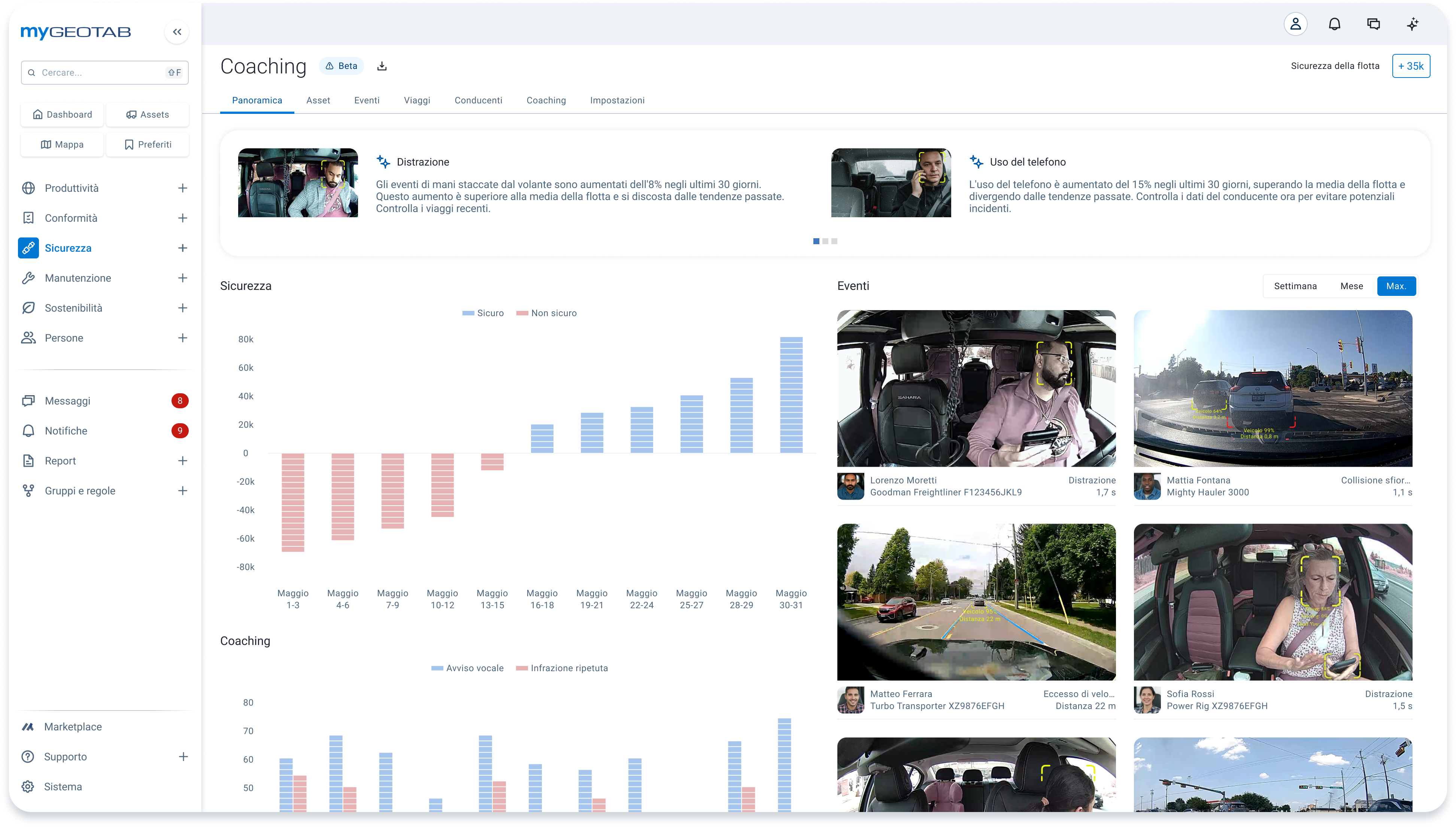
When an ADAS or DMS event fires — or when the 3-axis G-sensor detects sudden deceleration — the GO Focus Plus saves a video clip and uploads it to MyGeotab automatically. High-severity events are surfaced to the fleet manager's dashboard for review and coaching follow-up.
The false-claim resolution workflow:
- Incident occurs on a Thai road
- GO Focus Plus ADAS/DMS triggers and saves clip automatically
- Clip uploads to MyGeotab (timing is data-plan dependent)
- Fleet manager reviews footage alongside GPS trace and vehicle data before a police report is filed
- If a third-party claim is filed, the fleet manager produces footage and GPS data as evidence
- Insurer reviews footage — settlement is reached faster, or the fraudulent claim is rejected
This workflow significantly compresses the claim investigation cycle by providing timestamped video, GPS coordinates, and correlated vehicle data as a single evidence package.
Road-Facing vs Driver-Facing: Why Dual-Camera Matters in Thailand
A single road-facing dashcam captures what happened outside the vehicle. A dual-camera system captures both sides of the story.
In Thai commercial fleet disputes, driver behaviour footage is increasingly requested by insurers to assess:
- Whether the driver was using a mobile phone at the time of impact
- Whether the driver was wearing a seatbelt
- Whether the driver reacted to the hazard or was distracted
- Whether fatigue symptoms were present before the incident
Dual-camera video telematics removes ambiguity on all four points. It also creates a powerful driver coaching tool: fleet managers can identify risky habits — phone use, aggressive steering, fatigue signs — before they result in a collision.
The GO Focus Plus captures both road-facing and driver-facing footage via its integrated DMS (Driver Monitoring System). DMS footage is stored locally on the device and uploaded to MyGeotab as part of incident events.
The Insurance Benefit: What Dashcam Data Does to Your Premium
Insurers price commercial fleet risk based on historical claims and, increasingly, on demonstrated safety behaviour. A fleet that can show:
- Continuous video monitoring of all vehicles
- ADAS event data demonstrating proactive hazard response
- Driver behaviour scores improving over time
- Zero or low at-fault incidents supported by video evidence
...presents a measurably lower risk profile than an unmonitored fleet with the same vehicle count and route exposure.
In markets where insurers actively recognise video telematics data — and the Thai market is moving firmly in this direction — this translates into real negotiating leverage at renewal. More immediately, eliminating fraudulent and inflated claims removes the primary driver of premium increases in the first place.
Geotab's fleet management platform tracks driver behaviour scoring, safety scorecards, and exception events over time. This data package, presented to an insurer at renewal, is the strongest argument available for maintaining or reducing premium rates.
Choosing the Right Dashcam for a Thai Commercial Fleet
Not all dashcams are equal. For commercial fleet use in Thailand, the minimum specification should be:
| Feature | Why It Matters for Thai Fleet Use |
| Event-triggered recording (G-sensor) | Ensures clip is saved automatically at the moment of incident |
| GPS integration | Correlates footage with location, speed, and route data |
| Cloud upload | Footage is accessible remotely — critical when a vehicle is seized by police |
| Dual camera (road + driver) | Covers both the accident scene and driver behaviour |
| ADAS integration | Detects and classifies events automatically |
| Tamper-evident storage | Prevents footage deletion before it can be retrieved |
| MyGeotab or telematics platform integration | Connects video to full trip, driver ID, and engine data |
A basic consumer dash cam (กล้องติดรถ) meets none of these commercial standards. It provides video — but without GPS correlation, cloud backup, or ADAS classification, it is a significantly weaker tool for claim disputes than an integrated fleet video telematics solution.
False and inflated accident claims on Thai roads cost commercial fleet operators millions of baht every year — in direct settlements, legal fees, and premium increases that compound over time. A dashcam alone reduces this exposure. An AI-powered video telematics system with ADAS integration eliminates it as a systematic problem.
The GO Focus Plus, paired with Geotab's fleet management platform, gives Thai fleet operators something no legal budget can replicate: contemporaneous, machine-generated, tamper-resistant evidence of exactly what happened in every incident. Thai fleets that deploy it stop paying for claims they did not cause.
Next Step
Stop paying for claims your drivers didn't cause. The Geotab GO Focus Plus gives your Thai fleet dual-lens AI video evidence, real-time driver alerts, and automatic incident clip saves — all integrated with your fleet management data. See how it works for Thai commercial operations and request a demonstration today.
Frequently Asked Questions
Yes. Dashcam footage is accepted as evidence in Thai civil proceedings, police investigations, and insurance assessments. For maximum admissibility, footage should be GPS-correlated with a timestamp and stored in a tamper-evident system — not on a removable SD card that could be disputed.
A standalone dashcam records video. Video telematics integrates the dashcam with GPS tracking, driver identification, engine data, and an ADAS system — creating a complete incident record that links footage to location, speed, driver, and vehicle behaviour. This integrated record is significantly more effective for insurance disputes than video footage alone.
An ADAS system (Advanced Driver Assistance System) uses cameras and sensors to detect hazards — including forward collision risk, lane departure, driver fatigue, and pedestrian proximity — and alerts the driver in real time. In a fleet context, ADAS triggers automatic video clip saves when dangerous events are detected, creating documented evidence even when the driver does not report the incident.
The most effective proof is GPS-correlated dashcam footage showing the third party's behaviour in the seconds before contact, combined with vehicle speed data from the telematics device. If an ADAS system was active, event classification data can show whether the vehicle triggered a hazard response or whether contact was initiated by the third party.
Geotab recommends the GO Focus Plus for Thai commercial fleet use. It provides dual-camera coverage (road-facing and driver-facing), integrates directly with the GO9 telematics device, includes ADAS event detection, and uploads footage automatically to MyGeotab.
The Geotab Team write about company news.
Table of Contents
- Why False Accident Claims Are a Real Problem for Thai Fleets
- How a Dashcam Resolves Disputed Claims Faster
- What an ADAS System Adds to a Dashcam Setup
- How Video Telematics Works on Thai Roads: The GO Focus Plus
- The false-claim resolution workflow:
- Road-Facing vs Driver-Facing: Why Dual-Camera Matters in Thailand
- The Insurance Benefit: What Dashcam Data Does to Your Premium
- Choosing the Right Dashcam for a Thai Commercial Fleet
- Next Step
Related posts
What Is ADAS? A Guide to Driver Assistance Systems for Philippine Fleets
October 21, 2026
5 minute read
What Is a GPS Jammer? Detection and Protection in the Philippines
October 20, 2026
5 minute read


What the Geotab and TAPA Webinar Reveals About Fleet Safety Management
October 2, 2026
2 minute read

How to maximise vehicle utilisation with a fleet management system in Southeast Asia
October 1, 2026
3 minute read
How Driver Safety Scorecards and AI Video Telematics Are Improving Fleet Safety in Southeast Asia
September 28, 2026
5 minute read