AI dash cams vs. traditional: Which delivers better fleet safety?
AI dash cams proactively prevent collisions and reduce insurance claims by using near real-time alerts and advanced analytics to detect risky driving behavior.

By Geotab Team
Mar 5, 2026
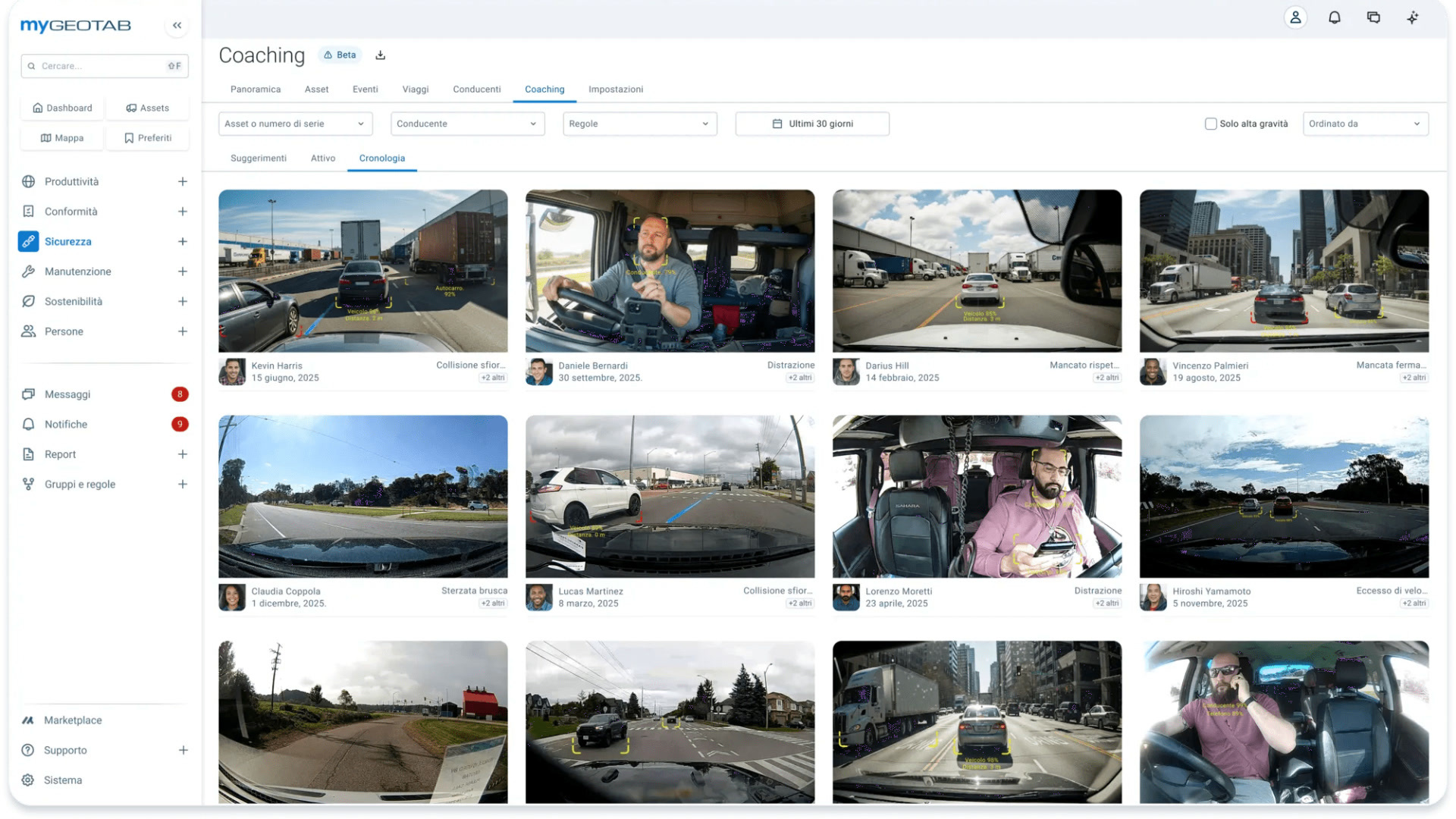
Key Insights
Key insights:
- Proactive Prevention: Unlike traditional systems that only record events, AI dash cams use real-time alerts to spot risky behavior and help drivers prevent collisions before they occur.
- Reduced Financial Risk: By actively preventing accidents, AI-powered systems help fleets lower insurance claims and associated legal costs.
- Data-Driven Analytics: AI dash cams provide deeper insights and measurable data, allowing fleet managers to see exactly where safety improvements are being made.
AI dash cams outperform traditional systems with proactive alerts and analytics that help fleets prevent collisions and lower claims.
You’ve seen the claims that AI dash cams can spot risky behaviour before it causes a collision. But the question isn’t whether they outperform traditional systems, it’s by how much, and where the numbers change first.
Learn more about how dash cams can protect your team and business in our eBook AI powered dash cams: The complete safety guide for your business
Across fleets that combine in-cab alerts with connected coaching workflows, we see fewer collisions, faster claims and improved safety cultures. In this post, we’ll share what we’ve learned from Geotab predictive collision risk (formerly the Geotab Safety Center), plus what market trends suggest where things are headed.
We’ll look at four decision points every fleet leader should consider before investing in a dash cam:
- Safety outcomes - Does the system reduce risk?
- ROI - How fast will it pay off, and where?
- Implementation readiness - Can your team deploy and support it?
- Vendor reliability - Is the provider built for long‑term value?
Together, these criteria show how AI dash cams provide value and how to know if your fleet is ready for the change.
What’s the difference between AI dash cams and standard fleet dash cams?
Today’s fleets often run both legacy and AI-enabled video systems side by side. Understanding what separates them is step one to understanding which delivers better protection.
How traditional fleet dash cams work
Traditional dash cams act as passive recorders. They capture footage, typically to an SD card, and store it locally until someone retrieves it. After an incident, you, or your safety team, download hours of video footage to find a single event. The footage is valuable, but only after something goes wrong. The review process can consume entire blocks of supervisor time each week, creating delays in getting feedback to drivers and slowing safety improvements.
How AI dash cams work
AI dash cams add computer vision and on-device analytics to the mix. The camera doesn’t only record, it interprets. It recognises behaviours like distracted driving, tailgating, seatbelt use, lane drift and phone interaction in real time.
When a driver looks down at a phone, the camera identifies the risk and reacts instantly, with a short audio prompt like “Put your phone down.” That immediacy interrupts the behaviour right when it happens, giving drivers a chance to self-correct before it becomes an incident.
CALL OUT: Adoption of AI-enabled dash cams is accelerating. According to research, “the Australian fleet management camera and telematics market is experiencing strong growth, with active systems projected to grow at a CAGR of 10.9%–11.5%, reaching up to 2.7 million units by 2028–2029” (1)
Learn more about how dash cams can protect your team and business in our eBook AI powered dash cams: The complete safety guide for your business
Key features to compare
If you’re considering an upgrade, these are the important elements:
| Feature | AI dash cams (e.g., GO Focus Plus) | Traditional dash cams |
| Processing location | On-device analysis with intelligent detection models; no manual retrieval needed | SD-card storage; footage downloaded after incidents |
| Real-time in-cab alerts | Instant voice prompts such as “Put your phone down,” triggered within milliseconds of risky behaviour | None - drivers receive feedback only after review |
| Integrated telematics stream | Syncs video with GPS, speed, and G-force data for complete event context | Video only; lacks telemetry correlation |
| Low-light performance | Infrared LEDs and high-sensitivity sensors maintain clarity in night or tunnel conditions | Standard optics; limited night visibility |
| Data retention controls | Cloud-based with configurable retention and privacy settings | Local storage; fixed capacity and minimal privacy controls |
| Driver identification | Automatic trip-to-driver association (e.g., Smart Driver ID) for accurate coaching and compliance. | Manual driver matching required. |
| Event prioritisation | Intelligent sequencing (e.g., Smart Sequence™) surfaces the most critical incidents first, reducing review time. | All events are treated equally; managers must sift through footage manually. |
Now, let’s look at what these differences mean on the road.
Which delivers better fleet safety?
AI systems deliver better safety outcomes by stepping in during risky behaviour, while traditional dash cams only respond afterwards.
Real-time risk detection and in-cab coaching
Traditional systems show you what went wrong. AI systems show you what’s about to. Real-time coaching changes that foresight into immediate correction.
Evidence and faster claims with video and telematics
AI detects and documents. Each event pairs synchronised video with telematics data, including speed, GPS coordinates and G-force readings. That combination provides indisputable context when investigating collisions or defending claims.
This is also where GO Focus Plus, Geotab’s newest AI dash cam, demonstrates what practical intelligence looks like. The system delivers instant in-cab voice feedback the moment when risky behaviour is detected. At the same time the most critical video events - along with speed, location and event context - surface first automatically so reviewers zoom in on the most critical events that require action.
In one pilot, a fleet cut driver phone use by 95% after enabling GO Focus Plus voice coaching - a direct reduction in risky behaviour on the road.
Phone distraction events fall with alerts and coaching
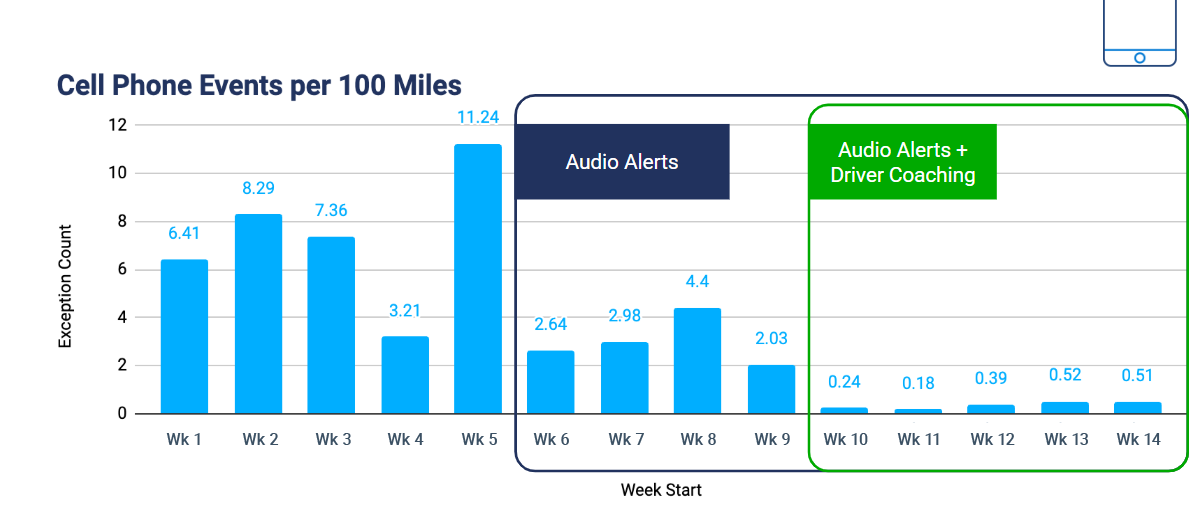
When incidents do occur, synchronised video and telematics give claims teams fast, defensible evidence. Reviews go quicker, claims close sooner and vehicles get back on the road faster.
Predictive analytics and benchmarking over time
Predictive models learn continuously, using every trip to refine accuracy and surface emerging risk patterns. By combining sensor and video data, fleets can track how acceleration, braking and cornering trends change over time, as well as where risk is building ahead of collisions.
Performance benchmarks drawn from predictive analytics let fleet managers compare results across drivers, vehicles and routes, focusing attention on the highest-risk areas.
Geotab’s driver risk model takes this further by linking current driving behaviour to future collision probability, giving safety teams a quantifiable early-warning view of risk.
Geotab data shows that customers who regularly use risk analytics tools see a 5.5% reduction in predicted collisions, evidence that predictive insights lead to improvements in fleet safety.
Cost and ROI: What changes with AI video
AI dash cams deliver returns in three ways: reducing collisions, cutting administrative workload and lowering lifetime ownership costs.
Collision reduction and insurance impact
Safety wins show up on the balance sheet, too. Geotab’s latest fleet safety benchmarking shows predictive-enabled fleets prevented an estimated 3,500 collisions, saving millions in potential claims and downtime.
Some insurers already encourage or reward the use of AI dash cams that provide verified safety data. Fleets able to show year-over-year improvements in loss trends and near-miss rates are in a stronger position when it’s time to renew coverage.
Learn more about how dash cams can protect your team and business in our eBook AI powered dash cams: The complete safety guide for your business
Time saved on reviews and targeted coaching
Event prioritisation, such as Geotab’s Smart Sequence™, cuts review time dramatically. Instead of looking through hours of video footage, managers get a ranked list of high-risk events based on severity and frequency. Driver-level scoring and automated event tagging push the most urgent cases to the top, while routine or false alerts fade into the background.
Safety managers get back hours each week and turn coaching into a high-impact, data-focused practice instead of an administrative chore.
TCO considerations for hardware, storage and data
Upfront cost tells only part of the story. The real savings happen over the system’s full service life, or total cost of ownership (TCO).
AI dash cams with on-device processing reduce cellular and cloud-storage costs by uploading only relevant clips. Predictable installation and maintenance keep expenses steady, while over-the-air updates extend hardware life without new capital investment.
TIP: Run a 36-month cost model that includes data plans, admin time and insurance impact. That’s where you’ll see the difference between a system that’s affordable to buy and one that’s efficient to own.
Bringing it all together
The difference between traditional and AI systems comes down to timing: real-time prevention versus post-incident review. When collisions are prevented, lives are protected and uptime is preserved.
Geotab’s integrated video and telematics platform gives you that advantage, helping your team detect risks earlier, coach with impact and prove results that insurers and executives can see.
Learn more about how dash cams can protect your team and business in our eBook AI powered dash cams: The complete safety guide for your business
Sources
The Geotab Team write about company news.
Related posts
.jpg)
.jpg)
Complete Guide: How to reduce your fleet operational costs
March 5, 2026
4 minute read
%20(2).jpg)
How dash cams protect your drivers and your business: a practical guide
March 5, 2026
5 minute read
How route optimisation helps cut costs, boost efficiency and deliver better
March 5, 2026
3 minute read
.jpg)
6 Best Fleet Management Software to Boost Performance and Cut Costs in Australia
March 2, 2026
2 minute read