Beyond Van Tracking: Turning Fleet Data into Bottom-Line Growth
For years, Australian SMBs viewed GPS tracking as a simple digital safety net, a basic way to locate an asset on a map. In 2026, with a resurfacing inflation cycle and vast interstate freight corridors, moving beyond tracking is essential to preserve margins and unlock true operational sovereignty.

By Geotab Team
Oct 6, 2026
.jpeg)
Key Insights
- Embracing fleet data intelligence empowers 87% of Australian small businesses to lower total fleet expenditures.
- Implementing advanced safety orchestration delivers a massive 65% improvement in overall driver safety profiles.
- Over half of all surveyed Australian transport operations achieve a positive telematics ROI within 12 months.
For years, Australian small and medium-sized businesses viewed GPS tracking as a simple digital safety net—a basic way to locate an asset on a map. In 2026, navigating a resurfacing inflation cycle and the immense scale of regional logistics networks across massive interstate freight corridors means moving beyond tracking is essential to preserve margins and unlock true operational sovereignty.
With national transport operators navigating a complex macroeconomic scenario, treating fleet management as a simple location finder is a highly competitive oversight. Forward-thinking managers realise that true profitability lies in analysing what CAN-bus metrics tell them about operational patterns. The inaugural Geotab Report 2026: Connected Fleets in Australia demonstrates how agile organisations are turning raw telematics into a definitive asset for commercial resilience and sustainable growth.
The Limitations of the "Dot on a Map" Mentality
Adoption rates for entry-level technology remain strong across the country. In the current marketplace, a significant portion of local operations continue to utilise tracking tools defensively—primarily for baseline regulatory compliance or basic vehicle recovery.
While securing basic compliance provides a reliable foundation, managing vehicle data as an active asset enables managers to optimise the twin pillars of fleet expenditure: fuel allocation and workforce orchestration. Recent economic data highlights that fuel usage and operator hours represent the primary components of an organisation's overhead. When a business transforms its approach from basic tracking to absolute fleet intelligence, it begins using high-fidelity data to actively protect these vital investment areas.
Neutralising the Last-Mile Bottleneck
For an agile operation running local delivery routes or heavy machinery on remote job sites, the performance of each asset determines organisational strength. By shifting focus to granular mechanical and behavioural analytics, local businesses are driving substantial, measurable efficiency gains.
1. Maximising Fuel Efficiency and Compliance
Unnecessary vehicle idling and inefficient route variations act as direct drains on corporate capital. By monitoring detailed engine metrics through CAN-bus telematics, small operations are optimising their fuel footprint while navigating strict compliance with modern heavy vehicle emission frameworks such as the ADR 80/04 standards. In fact, eliminating excessive idling and optimising cruise speeds on long-haul corridors lowers total fuel spend by up to 10% to 12%. Furthermore, deploying automated location data allows companies to perfectly maximise their Fuel Tax Credit (FTC) calculations, recovering thousands of dollars previously lost to manual bookkeeping.
2. Collapsing Urban Congestion and Latency
Time spent in gridlock or backtracking between service sites represents an unbillable barrier to growth. Integrating advanced, AI-powered route planning enables small businesses to expand their daily job density, executing a higher volume of customer requests without increasing fixed overhead or overworking current staff. Data from the 2026 national report reveals that 71% of mid-sized organisations improved their on-time delivery rates through these methods, effectively neutralising regional logistical bottlenecks. Concurrently, 67% of enterprise fleets achieved significant reductions in delivery timelines via dynamic scheduling models.
3. Deploying a Visual Shield for Driver Protection
Rising operating expenditures continue to pressure commercial margins nationwide. Organisations implementing advanced, dual-facing camera systems like the GO Focus Pro achieve an outstanding 61% reduction in false claims by presenting insurers with objective, high-definition truth. This video intelligence functions as a reliable protective layer, resulting in a 39% reduction in insurance costs and a 49% decrease in total safety incident costs.
The impact is exceptionally pronounced in demanding environments; for instance, 83% of Oil, Gas & Mining enterprises utilised high-definition video to manage operator fatigue, while 71% of General Freight operations successfully used clear visual evidence to completely exonerate their drivers from liability. Across all surveyed sectors, integrating video telematics delivered a 65% measurable improvement in overall driver safety.
Accelerated Timelines for Capital Recovery
The most common hesitation from local business operators regarding advanced fleet technology is the perceived initial expenditure of onboarding a new system. However, the latest 2026 research invalidates this hesitation by proving that digital synchronisation functions as a rapid capital recovery tool.
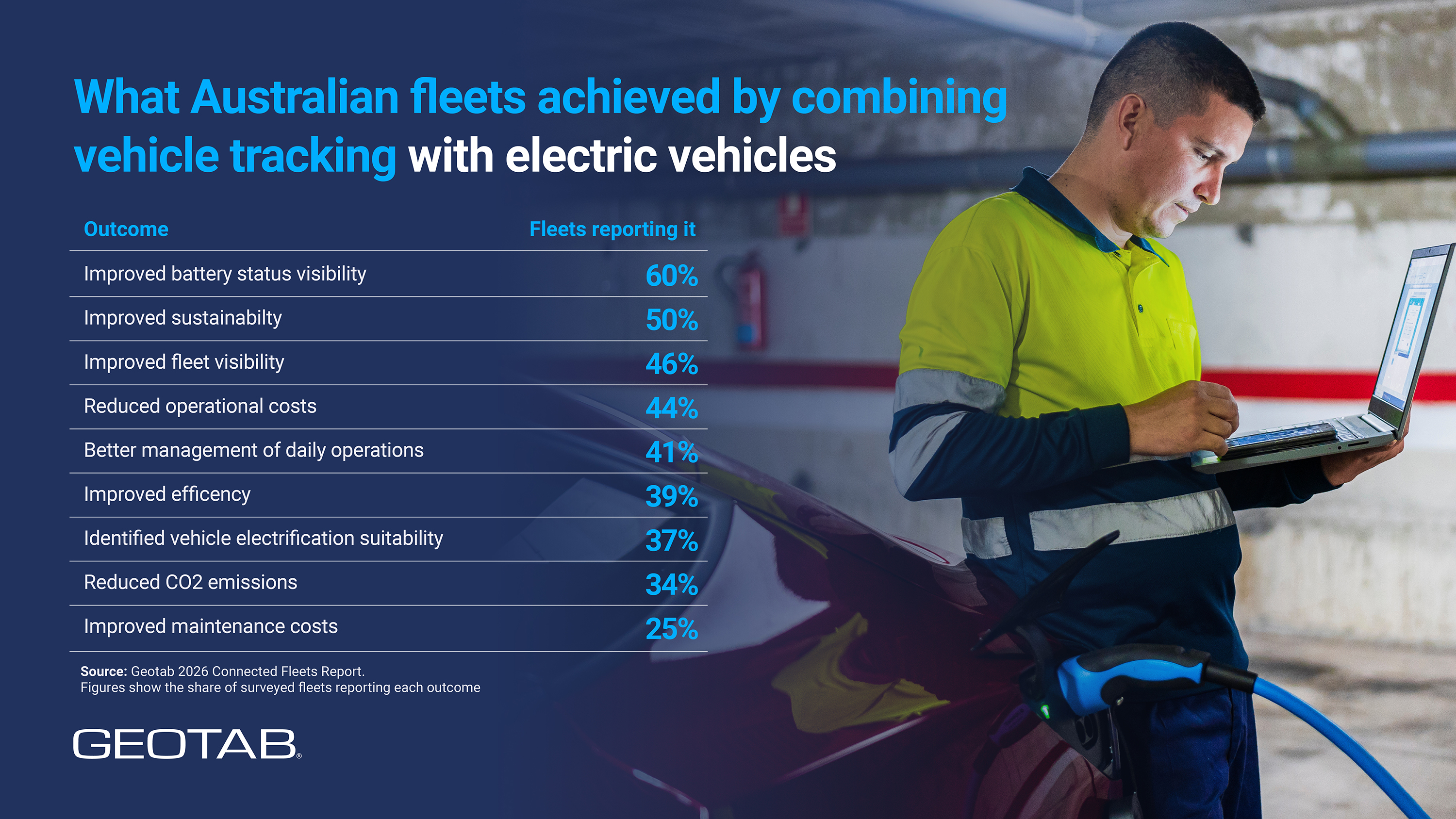
The timeline required to observe a positive return on investment (ROI) is remarkably brief, with more than half of all Australian fleets realising a positive return on investment within the very first 12 months of implementation. The financial layout is highly visible across specific sectors:
- Utilities Leading Efficiency: Fully 63% of Utilities operations achieved a positive ROI in under a year, with 100% of these organisations reporting a definitive reduction in overall fleet costs.
- Fiduciary Taxpayer Value: The support was there immediately for public and private infrastructure teams, ensuring that public assets reduce operational fleet spend by 90%.
- Maximum Relief for Small Business: Among all commercial operations, small businesses (SMBs) achieved the highest rate of budget relief, with 87% of small operators reporting a definitive reduction in total fleet costs after deploying Geotab's platform.
Cultivating Long-Term Operational Sovereignty
In a highly competitive landscape, market leadership belongs to companies that govern their mobile assets via precise, predictive intelligence. Moving beyond standard tracking allows local teams to outperform traditional limitations—boosting overall operational productivity by 57% and building a strong buffer against wider economic volatility. This matches the global scale of Geotab's infrastructure, which processes over 100 billion data points daily across more than 5 million connected vehicles to ensure maximum data integrity. Ultimately, 75% of Australian professionals explicitly categorise these connected platform solutions as highly beneficial to the long-term vitality of their business.
By turning technical oversight into a proactive program of preventative health, your fleet transforms from a recurring operational expenditure into an elite competitive advantage.
📊 Ready to move your fleet beyond the coordinates? Stop letting unbillable latency erode your hard-earned margins. Download the complete Geotab Report 2026: Connected Fleets in Australia to discover how to transform raw data points into direct, bottom-line business growth.
Frequently Asked Questions
Basic tracking primarily monitors simple asset coordinates on a map. Advanced fleet intelligence transforms this data by integrating engine diagnostics, AI-driven route optimisation, and proactive driver safety insights to maximise asset utilisation, streamline compliance, and lower operational risk profiles.
Financial recovery occurs rapidly across local industries. The Connected Fleets in Australia Report 2026 confirms that more than half of all Australian fleets achieve a positive ROI within 12 months, while an exceptional 87% of small businesses experience an immediate drop in total fleet expenditures.
Yes, absolutely. Implementing telematics data eliminates up to 10% to 12% of long-haul fuel waste through idling reduction and speed optimisation. Additionally, combining tracking with video telematics slashes insurance costs by 39% and false claims by 61%.
The Geotab Team write about company news.
Related posts

Flipping the Switch on Overhead: The Real Cost Savings of Fleet Telematics
October 20, 2026
2 minute read

How video telematics helps drivers trust the safety program
October 19, 2026
5 minute read
How does fleet management software help reduce costs and improve compliance in Australia?
October 15, 2026
2 minute read

.jpg)
How Small Businesses Use Telematics to Optimise Operational Expenditures
October 13, 2026
2 minute read