The growing role of AI in fleet management: from optimisation to competitive advantage
Fleet managers are constantly balancing competing priorities. Rising operating costs, increasing customer expectations and ongoing workforce pressures mean every vehicle, route and delivery matters.

By Geotab Team
Sep 15, 2026
Key Insights
- 65% of Australian fleets improved their last-mile operations after implementing AI-powered route optimisation.
- A majority of fleet managers who used route optimisation reduced fuel costs while improving on-time delivery rates.
- 63% of large-scale operators achieved better customer experience scores through hyper-accurate ETAs.
Fleet managers are constantly balancing competing priorities. Rising operating costs, increasing customer expectations and ongoing workforce pressures mean every vehicle, route and delivery matters.
According to Geotab's 2026 Connected Fleets Report, AI-powered route optimisation is delivering measurable results right now, across fleets of every size.
1. How are fleet managers using AI to optimise routes?
The report shares that based on a survey of 517 Australian fleet managers, scheduling and dispatch inefficiencies are among the biggest day-to-day operational challenges, with 59% of respondents identifying them as a key concern.
Small delays can quickly add up. Congestion, unexpected road closures or last-minute schedule changes can increase fuel consumption, extend delivery times and put additional pressure on drivers.
AI-powered route optimisation helps fleets respond to these challenges in real time. By analysing live traffic conditions, weather and delivery schedules, AI can recommend more efficient routes and adjust plans as conditions change, helping fleets improve efficiency while keeping deliveries on track.
Rather than relying on static routes planned before the day begins, fleet managers can make routing decisions based on what's happening on the road in real time, improving both operational efficiency and customer service.
2. How can AI reduce last-mile inefficiencies?
The last mile is often the most complex and expensive part of the delivery journey. Traffic congestion, unexpected delays and changing customer requirements can quickly disrupt schedules, increase fuel consumption and impact service levels.
AI-powered route optimisation helps fleets respond to these challenges in real time by continuously analysing traffic conditions, delivery priorities and route performance. Rather than following a fixed schedule, fleets can adapt throughout the day to minimise delays and improve efficiency.
The Geotab Connected Fleets in Australia Report 2026 found that:
- 67% of enterprise fleets reduced last-mile delivery times after implementing AI-powered route optimisation.
- 71% of mid-sized fleets improved their on-time delivery rates.
- 60% of small businesses reduced delivery windows, allowing them to complete more work using their existing vehicles and drivers.
For fleets of all sizes, AI-powered route optimisation is helping reduce delays, improve vehicle utilisation and deliver a more reliable customer experience.
3. What impact does AI have on fuel costs and delivery times?
Fuel remains one of the most volatile costs in fleet operations. AI-powered route optimisation addresses this by ensuring every kilometre driven is the most efficient option available by reducing unnecessary trips, cutting idle time and eliminating the stop-start patterns that burn fuel without moving freight.
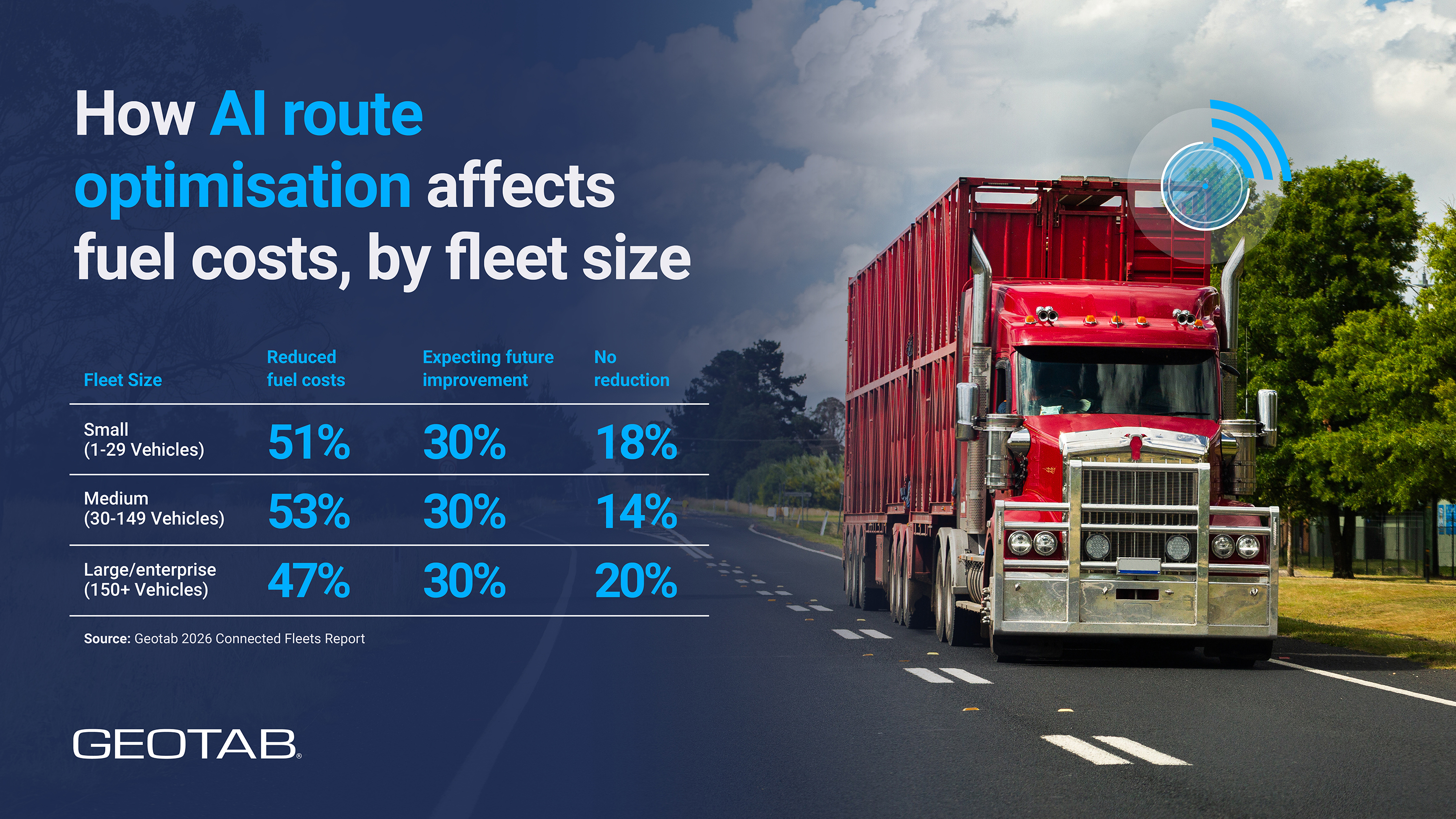
According to the survey, 51% of fleets reported reduced fuel costs following AI implementation. For enterprise fleet managers, 47% identified fuel cost reduction as the primary long-term benefit of investing in AI, a result that demonstrates how AI can translate into an improved bottom line.
Beyond reducing fuel costs, AI-powered route optimisation helps fleets complete deliveries more efficiently. More effective routes mean vehicles spend less time on the road and more time completing jobs, without extending driver hours.
4. How are fleets using AI to stay competitive?
Customer expectations continue to evolve, with businesses expected to provide faster deliveries, more accurate arrival times and greater visibility throughout the delivery journey. For many fleet operators, meeting these expectations has become a key competitive differentiator.
Geotab's Connected Fleets in Australia Report 2026 found that 72% of enterprise fleet managers identified meeting customer demands and expectations as their biggest day-to-day challenge, ahead of driver fatigue, fuel costs and compliance.
AI-powered route optimisation helps fleets respond more effectively by providing more accurate ETAs, adapting to changing traffic conditions and improving delivery reliability. This gives fleet managers greater confidence that deliveries will arrive on time while keeping customers informed if plans change.
The report also found that 63% of enterprise fleet operators reported improved customer experience after implementing AI-powered routing, highlighting the role connected technologies can play in strengthening customer satisfaction and supporting long-term business performance.
5. Turning AI into a competitive advantage
As customer expectations continue to evolve, fleet operators are looking for ways to improve efficiency without adding unnecessary cost or complexity. AI-powered route optimisation is helping organisations achieve this by making better use of existing vehicles, drivers and operational data.
When combined with connected vehicle insights, predictive maintenance and compliance tools, AI gives fleet managers greater visibility into how their operations are performing, and where improvements can be made. Rather than simply responding to issues after they occur, fleets can identify potential disruptions earlier, make more informed decisions and continuously optimise day-to-day operations.
For many Australian businesses, AI-powered route optimisation is no longer just about improving routes. It's becoming an important tool for reducing costs, improving service levels and building more resilient fleet operations in an increasingly competitive market.
Download Geotab's 2026 Connected Fleets Report to explore how Australian organisations are using AI-powered route optimisation and connected technologies to reduce costs, improve safety and strengthen operational performance.
The Geotab Team write about company news.
Related posts

Flipping the Switch on Overhead: The Real Cost Savings of Fleet Telematics
October 20, 2026
2 minute read
.jpg)
How Small Businesses Use Telematics to Optimise Operational Expenditures
October 13, 2026
2 minute read
.jpeg)
Beyond Van Tracking: Turning Fleet Data into Bottom-Line Growth
October 6, 2026
3 minute read

Asset tracking: Halting Australian Construction Site Theft
September 23, 2026
2 minute read
.jpeg)
Calculating Small Fleet ROI: Is the Investment Worth It?
September 22, 2026
2 minute read