Why edge AI is the future of fleet dash cam safety
Edge AI processes video on the camera itself, so there’s no cloud delay or upload wait. This is how GO Focus Plus and GO Focus Pro move fleet safety from reactive documentation to near real-time prevention.

By Geotab Team
Oct 15, 2026

Key Insights
- Edge AI processes video directly on the dash cam. The camera identifies risk and triggers an alert in milliseconds.
- Using continuous inference, Edge AI offers real-time, in-cab coaching and pre-collision warnings that help drivers self-correct before an incident occurs. GO Focus Plus brings this to standard-duty fleets.
- GO Focus Pro extends Edge AI to the vehicle’s perimeter using auxiliary cameras, detecting pedestrians, bollards, and blind-spot hazards that forward-facing cameras miss.
For the past decade, video telematics has answered one question very well: “What happened?”
We watch the footage, see the collision and coach the driver days later. It’s a reactive cycle. But with distracted driving violations increasing and roads becoming more crowded, “what happened” isn’t good enough any more.
The next phase of fleet safety is moving from documentation to prevention. The technology driving that change is edge AI.
What is Edge AI?
Edge AI telematics processes data directly on the vehicle’s hardware rather than sending it to the cloud for analysis. By embedding artificial intelligence in the dash cam itself, the device can interpret video, identify risks and trigger alerts in milliseconds.
In traditional systems, the camera is just a recorder; in edge systems, the camera is the computer. This changes how safety data is handled:
- Cloud AI (traditional): The camera records video, uploads it to a server, waits for analysis and receives a response. This creates a delay and relies on cloud connectivity.
Edge AI (modern): The camera processes video and sensor data locally using continuous inference. The analysis happens instantly at the source.
By moving processing power to the vehicle, fleets reduce the latency that can contribute to collisions and gain the ability to detect risky behaviours in real time.
Why milliseconds define safety
The standard safety workflow has been reactive: a camera detects a risk, sends the data to a server, analyses it and sends an alert back. While this model provides evidence, that round trip takes too long in logistics.
At 105 km/h, a vehicle travels nearly 30 metres per second. A two-second processing delay can make the difference between a near miss and a costly court verdict.
Fleets can no longer rely on reviewing their way to safety. They need a tool that thinks as quickly as their drivers do.
Enter edge AI: Processing at the source
By closing the gap between risk detection and analysis, edge AI fundamentally changes how fleets manage risk.
Local processing lets the camera identify specific high-risk scenarios in real time. It enables proactive pre-collision warnings, with an immediate in-cab alert if a driver is texting while tailgating—before the moment passes and the risk escalates.
This changes the dynamic. Behavioural science tells us that feedback is most effective when it’s immediate. Instead of a manager asking a driver to come into the office three days later to discuss an issue, the camera can provide a gentle voice prompt in the cab: “Eyes on the road.” The driver self-corrects in the moment, building safer habits over time. This can reduce risk, collisions, claims and after-the-fact coaching sessions.
Why precision builds trust
Giving drivers crucial time to react can help prevent collisions, but accuracy determines whether they trust the system. Nothing undermines a safety culture faster than a machine beeping at a driver who is simply checking their mirrors.
Drivers tune out systems that constantly flag false alarms. Because edge AI processes high-definition data locally using advanced AI models, it can improve risk detection and reduce the false positives that cause drivers to disengage from the system.
Safety managers can then focus on genuine coaching opportunities rather than reviewing incorrect data. It also helps address privacy concerns: the system distinguishes between normal driving and risky behaviour, so it uploads video only when a specific safety event occurs.
The next evolution: 360° visibility & zero latency
The first level of edge AI focused on the driver. GO Focus Plus is Geotab’s native edge AI camera, designed to detect distracted driving, tailgating, fatigue and phone use on-device, and coach drivers in the cab before a risk escalates.
The next level protects the entire vehicle. This is important for complex operations such as waste management and heavy transport, where some of the most costly risks are outside the driver’s line of sight.
New hardware, such as the GO Focus Pro dash cam, extends edge AI to the vehicle’s perimeter by applying continuous inference to every angle around the truck.
Solving the “blind spot” problem
Simply adding more cameras isn’t enough to solve visibility gaps; AI also needs to interpret the visual data instantly.
Standard forward-facing cameras can miss hazards that are low to the ground or tucked into blind spots. Advanced systems use auxiliary cameras and continuous inference to monitor the area around the truck. The system can then detect and alert drivers to low-profile hazards, such as bollards, speed bumps or kerbs, that can cause costly damage in tight depots. This 360-degree coverage can also help detect risks involving pedestrians or motorbikes, even when they’re outside the driver’s direct line of sight.
Solving the “lag” problem
This new generation of technology addresses the risks of reversing. Traditional wireless cameras can have a delay, meaning a driver may hit an obstacle before it appears on their screen.
The new zero-latency monitor removes this lag by delivering an instantaneous video stream.
Drivers get immediate visual awareness when reversing and docking, so what they see on screen matches what’s happening behind the bumper. Whether they’re navigating a tight loading dock or reversing in a crowded yard, the visual feedback is immediate and clear.
GO Focus Pro
The next generation of Edge AI hardware is here.
- 360° visibility: Helps eliminate blind spots by monitoring the vehicle’s perimeter and detecting hazards forward-facing cameras can miss.
- Zero-latency monitor: Delivers a zero-latency video stream for precise reversing and docking.
- Advanced AI: Uses advanced AI models for proactive pre-collision warnings and traffic light detection.
- Self-calibrating: Automates pairing and setup with a simple pointing adjustment.
The future is proactive
By moving intelligence to the edge, we’re giving drivers tools to help protect themselves, giving managers data to support exoneration, and giving fleets the 360-degree visibility they need to operate in a complex world.
You can’t fix what you can’t see
Eliminate blind spots with 360° visibility and zero-latency monitoring.
Learn more about Geotab’s AI powered video telematics solution.
The Geotab Team write about company news.
Related posts
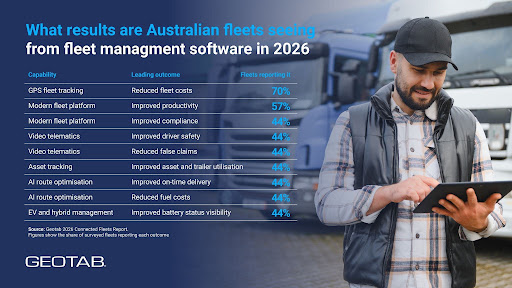
How does fleet management software help reduce costs and improve compliance in Australia?
October 15, 2026
2 minute read
.jpg)
How Small Businesses Use Telematics to Optimise Operational Expenditures
October 13, 2026
2 minute read
How video telematics is improving safety and reducing risk for Australian fleets
October 8, 2026
2 minute read
.jpeg)
Beyond Van Tracking: Turning Fleet Data into Bottom-Line Growth
October 6, 2026
3 minute read

Asset tracking: Halting Australian Construction Site Theft
September 23, 2026
2 minute read