Your dashboard isn’t making you faster
At Connect Europe 2026, Europcar Spain and Hertz shared how connected vehicle data is reshaping rental and mobility operations — from automating manual processes to redefining where humans add the most value. The insight that stayed: the next level of operational excellence won't come from more

By Geotab Team
Jun 10, 2026
Key Insights
- Visibility is not enough — the gap between data and action is where operational excellence is won or lost
- Automation frees people for higher-value work: Europcar turned vehicle inspectors into customer hosts
- The real AI design question is not whether to use it, but when to protect the human interaction
- Frequency — not source — is the key differentiator between OEM data and aftermarket telematics
- The next operational frontier is data outside the vehicle: city context, customer intent, CO2 per trip
Rental and mobility fleets are, on paper, among the most data-rich operations in commercial transportation. Mileage is tracked. Fuel levels are monitored. Geofencing covers a lot of returns. Fault codes reach maintenance workflows before the vehicle reaches the counter. The data layer exists. The question most operators are still working through is what to actually do with it.
Juan Ángel Menso, Ops Director at Europcar Spain and Portugal, said it plainly: “The vehicle, we are no faster because our dashboard is better.”
He was not criticising dashboards. He was describing a problem that most fleet operations hit somewhere between data collection and operational impact — the gap between seeing the data and acting on it. Visibility is not enough. The question is what happens in between.
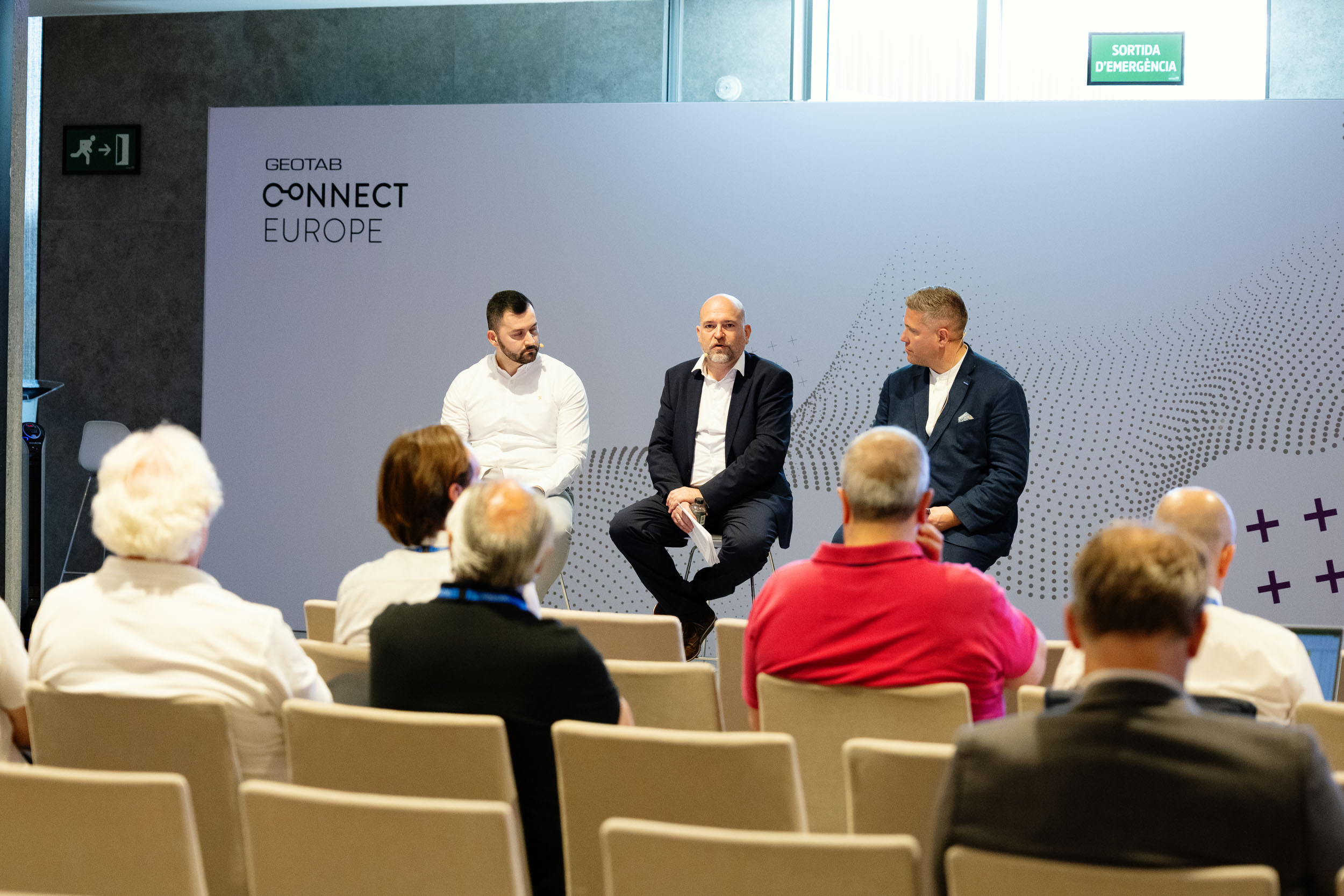
That gap was the real subject of a session at Connect Europe 2026, Geotab EMEA yearly event, where Esidor Pashaj from Hertz and Juan Ángel from Europcar joined Adam Fletcher (Geotab) to discuss what operational excellence actually looks like in rental and mobility in 2026. Not the theory. The ground level.
From checking machines to hosting customers
Both companies have spent the last 18 months automating the tasks that used to require a person to physically interact with a vehicle.
At Hertz, connected vehicle data is increasingly being used to automate operational processes and improve fleet visibility. By reducing manual touchpoints and providing timely information to the right teams, connectivity is helping drive greater efficiency across fleet, maintenance, and customer operations.
At Europcar, the same automation removed one of the most visible friction points in rental operations — the inspector leaning into the vehicle to check the odometer on arrival. That task is gone. What replaced it was not a machine. It was a different kind of conversation.
“We have transformed inspectors into customer hosts,” Juan Ángel said. The person who used to manage the vehicle handover now manages the customer.
This is what operational excellence looks like when it works: not faster dashboards, but fewer decisions that require human attention at all — so that the humans can focus where they still matter most.
AI: the design question is where you put the human
Both Hertz and Europcar are using AI, and both are careful about how they describe it.
Hertz is applying AI across engineering and product teams to accelerate development, improve efficiency, and unlock value from connected vehicle data. Europcar has used ML for demand and pricing management for years, applying the same logic that airlines and hotels use to manage fleet availability in real time.
But the more interesting question Juan Ángel raised was not whether to use AI — it was when to interrupt it with a human.
“AI can amplify us, but in some moments of the workflow you have to put a human talking with a human. Because sometimes everything can be perfect, but it’s perfectly wrong in the experience with the customer.”
The design decision is not AI or no AI. It is identifying which moments in the customer journey require human judgment and protecting those — rather than optimising them away. Damage detection, for example, can be partially automated. The conversation with the customer about damage cannot.

OEM data vs. hardware: the real differentiator is frequency
The session also cut through one of the more persistent debates in fleet connectivity: OEM-embedded data versus third-party hardware like Geotab’s devices.
Esidor’s answer was unambiguous: “Frequency is where the game-changer is.”
From a Hertz perspective, the discussion isn't necessarily about OEM connectivity versus aftermarket telematics - it's about understanding where each adds value. Our focus is on leveraging the strengths of both to improve connectivity coverage, data quality, and operational visibility across the fleet, while creating a simpler experience for the teams that rely on that data every day.
“At Hertz, our focus is on leveraging the best available connectivity solutions to deliver reliable, high-quality data to the business. As OEM connectivity continues to evolve, the opportunity lies in bringing data sources together in a way that simplifies operations and improves decision-making.” Esidor said. “But Geotab can still play a significant role in helping fleet operators simplify connectivity and maximize the value of vehicle data.”
The missing data isn’t on the vehicle
The sharpest moment of the session came at the end, when Adam asked both speakers to name the one piece of data they don’t have today that would unlock the next level of operational excellence by 2030.
Esidor highlighted the importance of more complete OEM data sets, particularly as fleet electrification increases and access to battery, range, and charging data becomes increasingly important.
Juan Ángel’s answer was different — and more surprising.
“I don’t need more data about the vehicle. The data I’m missing is outside the vehicle.”
Three gaps he named:
- City context. Low emission zones, traffic restrictions, planned demonstrations, urban congestion charges — all of these change customer behaviour before they ever enter a rental location. A fleet that can anticipate those signals can position inventory differently, proactively.
- Customer intent. Between check-in and checkout, the rental company knows almost nothing about why the customer needs the vehicle. Wedding or business trip, short urban hop or 800-kilometre drive — that context would allow for genuinely different service design, not just different vehicles.
- CO2 per trip. EU regulation is moving toward mandatory certification of emissions per journey by 2030. The data infrastructure to produce that does not yet exist at scale. Building it now is not optional.
The implication is significant: after years of investment in vehicle connectivity, the next frontier for operational excellence in mobility is not more sensors. It is connecting vehicle data to the context in which vehicles operate — the city, the customer, the regulatory environment.
A dashboard that knows everything about the vehicle but nothing about the city it is moving through is, as Juan Ángel put it, faster than nothing. But not as fast as it could be. “Operational excellence in 2026 isn’t just about having the best vehicles; it’s about having the best insights.” — Adam Fletcher, Geotab
And the momentum doesn't end here.
Join us next year in Paris, June 7–9, 2027, as we push the boundaries of fleet intelligence even further.
Subscribe to the Geotab Blog
The Geotab Team write about company news.
Related posts
The 5 most common digital tachograph penalties in EMEA (and how SMBs can avoid them)
October 9, 2026
2 minute read

Beyond van tracking: turning fleet data into bottom-line growth
October 9, 2026
3 minute read

How small construction fleets use asset tracking to halt site theft
September 9, 2026
2 minute read

Is fleet telematics worth the money? Calculating your small fleet ROI
September 9, 2026
2 minute read

Why manual spreadsheet fleet tracking fails UK small businesses
September 9, 2026
2 minute read
How small UK fleets hedged against the 2026 fuel price surge
September 9, 2026
3 minute read