How video telematics is improving safety and reducing risk for Australian fleets
In-cab video has evolved from a tool used to review incidents after they happen into a proactive safety solution. Today, Australian fleets are using video telematics to support driver coaching, reduce operational risk and improve safety before incidents occur.

By Geotab Team
Oct 7, 2026
Key Insights
- 65% of Australian fleets improved driver safety after implementing in-cab video
- Video telematics can help reduce false claims, cut safety incident costs and lower insurance costs
- Fleets providing video-verified driver scores are receiving insurance premium reductions of 20–30%.
Road incidents are expensive, time-consuming and increasingly difficult to manage without objective evidence. According to Geotab's 2026 Connected Fleets Report in-cab videos deliver measurable results across driver safety, claims management and compliance.
With the new 2026 Heavy Vehicle National Law (HVNL) reforms now requiring transport operators to adopt Safety Management Systems (SMS), the case for video telematics is more compelling than ever.
1. How is in-cab video improving driver behaviour and safety?
Driver fatigue and safety remain the biggest day-to-day challenge Australian fleet managers, cited by 67% of the 517 respondents in the 2026 Connected Fleets Report.
AI-powered in-cab cameras detect high-risk behaviours such as distraction, microsleeps, harsh braking and tailgating and then alert drivers in the moment, before those behaviours become incidents. The result is a shift from reactive investigation to proactive coaching.
Across all industries surveyed, 65% of fleets improved driver safety after implementing in-cab video. Crash rates fell by more than 21% across every sector, with government fleets achieving a 90% reduction and utilities operators reaching 86%. Speeding decreased by more than 21% in general freight (71%), services (70%) and oil and gas (75%).
2.How does video evidence reduce false claims and disputes?
When an incident occurs, understanding exactly what happened can be difficult without objective evidence.
Video telematics provides fleet managers with a clear record of events, helping organisations investigate incidents more efficiently, protect drivers from inaccurate liability and resolve insurance claims faster.
According to the report:
- 61% of Australian fleets reduced false claims after implementing video telematics.
- 71% of general freight operators successfully used video evidence to help exonerate drivers from inaccurate liability claims.
Beyond reducing disputes, video evidence can also help organisations lower legal costs, reduce administration and build stronger relationships with insurers through greater transparency.
3. What role does video telematics play in fatigue and distraction management?
Fatigue remains one of the most significant safety risks for Australian fleets, particularly for organisations operating long-haul or regional routes.
AI-powered video telematics helps detect early signs of fatigue and distraction, alerting drivers in real time and providing fleet managers with insights that support ongoing coaching and safer driving behaviours.
Video telematics outcomes by sector
Source: Geotab 2026 Connected Fleets Report
| Outcome | General freight | Services | Utilities | Oil and gas | Government |
| Fatigue reduced (41–60%) | 48% | 38% | 40%
| 52% | 32%
|
| Distraction reduced (>40%) | 52% | 42% | 45% | 58% | 46% |
| Crashes reduced (>21%) | 79% | 84% | 84% | 89% | 90% |
| Tailgating reduced (>21%) | 88% | 92% | 90% | 88% | 84%
|
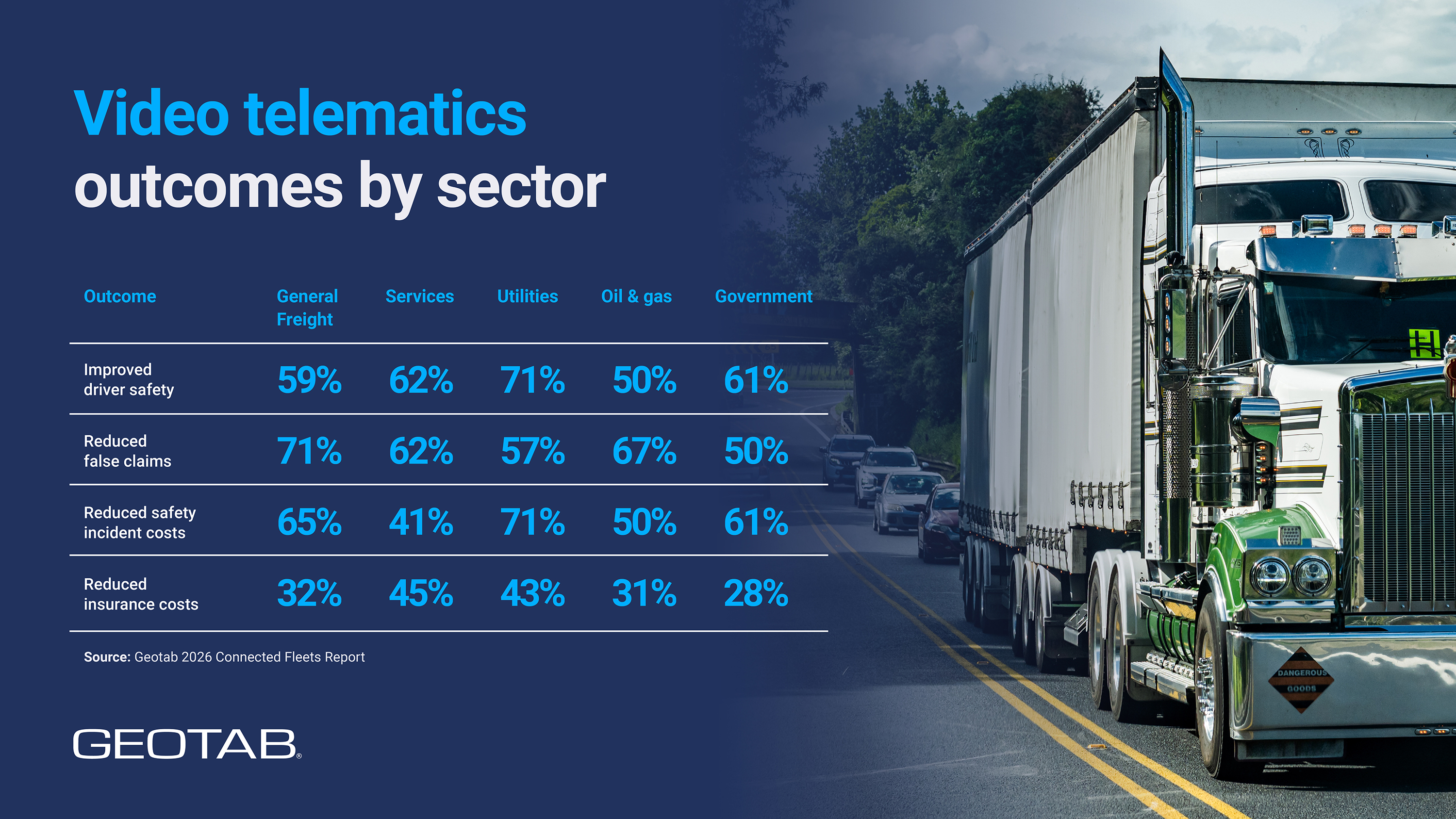
In-cab cameras have led to safety improvements across industries. Among oil and gas operators, where FIFO routes often involve long stints on remote roads at irregular hours, 52% of fleets reduced fatigue incidents by between 41% and 60%. In general freight, 52% achieved distraction reductions of more than 40%.
These improvements demonstrate how video telematics can help organisations identify potential risks earlier, support safer driving behaviours and reduce the likelihood of serious incidents.
4. What are the compliance implications of in-cab video?
Under Australia's Chain of Responsibility (CoR) every party in the supply chain has a responsibility to manage safety risks. Video telematics provides verifiable, time-stamped evidence that supports driver coaching, fatigue management and ongoing safety initiatives.
With the Heavy Vehicle National Law (HVNL) amendments commencing on 1 August 2026, operators face heightened obligations around fatigue management, driver health monitoring and record-keeping. In-cab video, integrated with a fleet management platform, provides the audit trail that satisfies these obligations without requiring manual data compilation.
According to the survey, 39% of fleets reduced insurance costs after implementing video telematics, and 45% achieved a positive ROI within 12 months. For fleets that have historically carried high incident rates or operated in high-risk sectors, the insurance savings alone can justify the investment.
5. Building a safer and more resilient fleet
For many Australian fleets, video telematics is becoming much more than a recording device.
By combining AI-powered insights with connected vehicle data, organisations can identify risks earlier, support driver coaching and make more informed safety decisions across their operations.
Rather than simply responding to incidents after they occur, fleet managers can use video telematics to improve driver behaviour, strengthen compliance and reduce operational risk over time.
As safety expectations continue to evolve, video telematics is becoming an increasingly important tool for organisations looking to protect their drivers, improve operational performance and build more resilient fleet operations.
Download Geotab's 2026 Connected Fleets Report to see how Australian fleet operators are using connected technology to reduce costs, improve safety, and build a lasting competitive edge.
The Geotab Team write about company news.
Table of contents
Related posts
How does fleet management software help reduce costs and improve compliance in Australia?
October 15, 2026
2 minute read


HVNL compliance checklist: 4 areas fleet operators should review in 2026
September 10, 2026
4 minute read
Why Smart OBM systems are your complete compliance solution
September 9, 2026
2 minute read

The Visual Shield: How Video Platforms Protect Small Fleets
August 12, 2026
4 minute read