The vehicle is one puzzle piece, but you need a full solution to scale electrification.
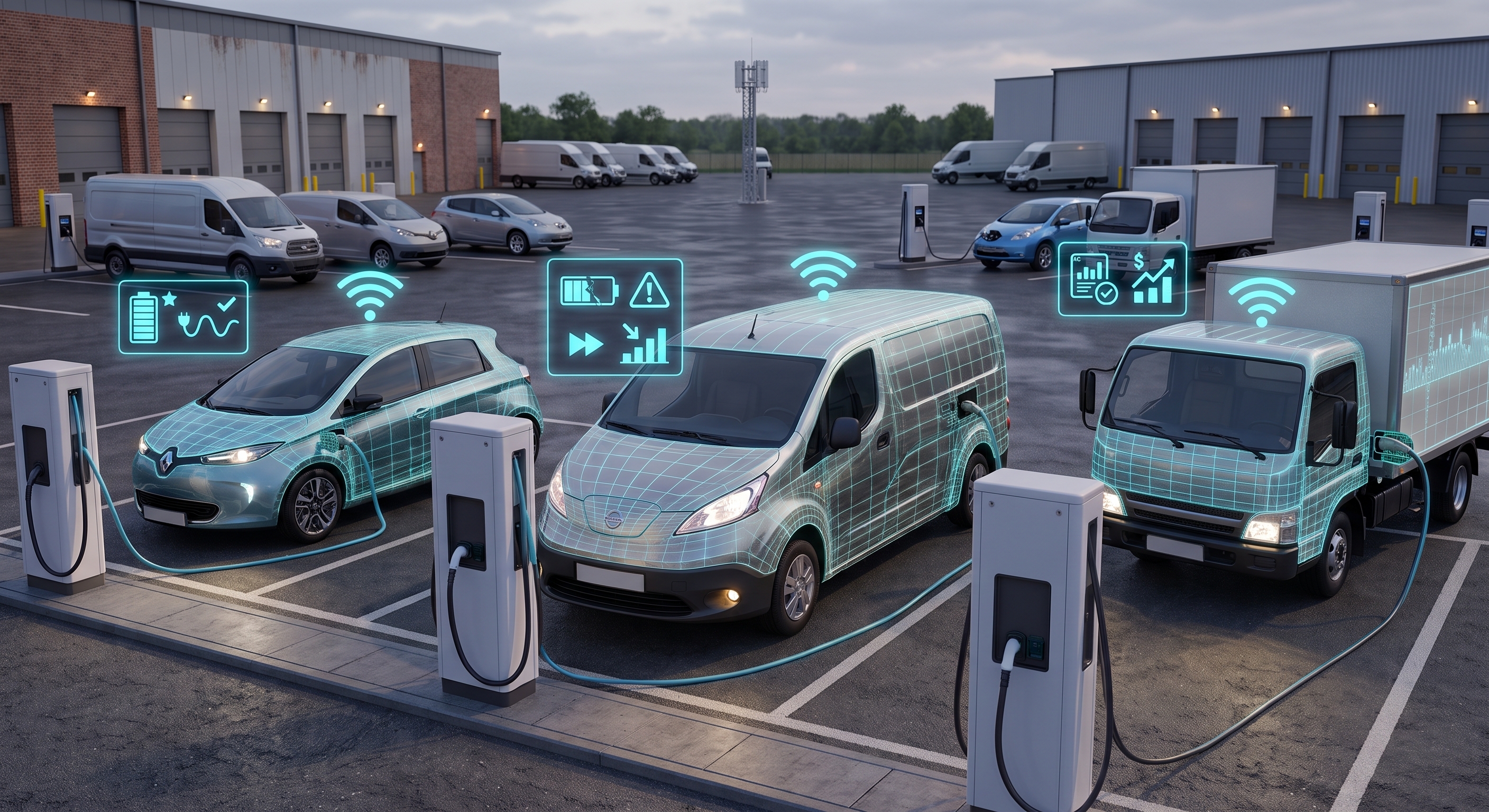
Fleet operators managing large EV transitions share a common starting point: the vehicle specification is just one of many decisions — routing, charging infrastructure, depot layout, and predictive maintenance all require equal attention.

By Geotab Team
Jun 17, 2026

Vehicle is one piece in a complex puzzle for EV transitioning at scale.
Fleet electrification has been framed as a future challenge for long enough that it has quietly become a present one. For operators managing tens of thousands of vehicles across multiple countries, the question is no longer whether to transition — it is how to do it without losing control of uptime, cost, and driver confidence along the way.
Guillaume Arnaud, BD for Leasing and Rental at Geotab, opened the session with a show of hands. Of the fleet operators in the room with EVs already deployed, he asked one to keep their hand up: only if they had experienced zero unexpected shutdowns in the past month. No hand stayed up. “That’s why we’re here,” he said.
At Connect Europe 2026, Geotab’s annual EMEA conference, Guillaume moderated a session on EV transition and predictive maintenance at scale with two operators running some of Europe’s most complex fleets: Balint Bodi, responsible for connectivity globally at Scania — over 700,000 connected vehicles, including a heavy-duty electric truck pulling 63 tons near the Arctic Circle — and Hugo Wackenheim, who leads connected strategy at Petit Forestier, the undisputed European leader in cold chain rental with more than 80,000 vehicles across 350 agencies. The conversation was framed as a practitioner update, not a product pitch. The problems are live and ongoing.
Electrification requires a full solution
The most consistent point from both speakers: in an EV transition, the vehicle itself is just the starting point to have the right specifications optimized for required load capacity, range and fleet operations.
“The vehicle is only one puzzle piece in this,” said Balint Bodi “When we talk about electrification, it’s impacting a lot of other puzzle pieces across your operations.”
Routing. Transport mission planning. Depot layout and driver routines. Charging infrastructure — both on-site and on public networks, where a heavy-duty truck requires different voltage and different physical space than a passenger car. Energy management. Grid connection. Payments, ideally with single invoicing, across countries for en-route charging. Driver training on a complex ‘machine’ to maximize its operational value for the fleets, comfort for the driver and safety for society.
Scania’s approach is to deploy connected vehicle data before a single EV enters a customer’s fleet. Historical route data, mission profiles, load cycles — analyzed to simulate which vehicle specification fits specific operations, which transport missions have the best fit for electrification, and how much battery capacity is actually needed. Weight distribution, axle layout, seasonal conditions. “It’s not only about range when we talk about heavy-duty vehicles,” said Balint Bodi.
The implication is structural: the decision to electrify cannot be made at the vehicle level alone and the evaluation should start with data from current fleet operations.
The cold chain problem nobody talks about
Petit Forestier’s challenge adds a layer most fleet operators do not face. The vehicle is not a single energy system. It is two systems — drive and refrigeration — competing for the same battery.
“We think of the vehicle as a system with a refrigeration unit and a vehicle,” said Hugo Wackenheim. The two cannot be optimized independently. A vehicle stopping during a delivery changes the refrigeration load. The temperature target stays constant; the power draw does not. Managing both in real time requires understanding the combined system, not just the drivetrain.
Petit Forestier has built digital twins of its connected vehicles to run this kind of deep product analysis — modeling autonomy and energy consumption for the full system, not just the motor. Partnerships with refrigeration OEMs Carrier and Thermo King provide the engineering layer. The connected data from Geotab provides the operational one.
The goal is not simply to keep goods cold. It is to keep customers confident in what they are renting. “We want to be sure that we provide our customers with a good product for their transportation,” said Hugo Wackenheim. In the cold chain, a vehicle failure is not a breakdown. It is spoiled goods, a missed delivery window, and someone else’s contract problem.

From emergency surgery to preventive medicine
The second half of the session addressed predictive maintenance — what Guillaume framed as the shift from “waiting for something to break” to something closer to preventive medicine.
For Scania, the model runs on three tracks. The first is proactive uptime services: dynamic service plans that learn from live component data, flexibly scheduling maintenance at the right time enabling fleets to maximize uptime and minimize disruptions on active transport missions. Rather than fixed intervals, the plan adjusts to how each vehicle is actually being used in their operations.
The second is diagnostics before arrival. Workshops have access to full vehicle history, job records, and live health data. A symptom reported by a fleet manager can be matched against similar cases across the service network — root cause identified before the vehicle reaches the workshop, parts ordered, technician assigned. “When you come in, the principles should be the same as for a pit stop in Formula One,” said Balint Bodi. “Preparing for a smooth arrival to enable a quick departure.”
The third is prioritization. Service advisors are dealing with fault signals across entire fleets simultaneously. “Which vehicles should you look at first? Which vehicles require work right now? Which vehicles could actually wait for their planned appointments?” Data-driven prioritization moves the decision from reactive to structured.
For Petit Forestier, operating 350 workshops and maintaining most of its fleet in-house, the shift is already underway. Geotab data feeds remote diagnostics so workshops understand fault codes before a vehicle arrives. Machine learning algorithms — trained on Geotab data — are being developed to surface fault codes before breakdowns occur. “We are switching from a curative maintenance that we had previously to a more preventive or even predictive maintenance,” said Hugo Wackenheim. The financial logic is direct: a vehicle not on the road is not generating rental revenue.
What AI can — and cannot — decide today
Both speakers agreed that AI will play a growing role in maintenance decisions. They disagreed, gently, on how fast and how far.
Hugo Wackenheim was direct. “In a few months, we will have a full flow, including the decision.” The vision combines machine learning for prediction, automation for execution, agentic workflows for scheduling, and LLM-backed voice agents that call customers and coordinate workshop bookings without human input. “The AI will be able to take the planification by phone directly to the customer.”
Balint Bodi was more measured. The near-term value, in his view, is not autonomous decisions but simplification mainly. “You have almost too much data, and what can you make out of it?” The use case that matters now is giving fleet managers and service advisors a clear, prioritized view — which vehicles need attention today, which can wait. “In other use cases, you just want to create an overview, recommendations, and the service advisor or the fleet manager will make the call at the end of the day.”
Both positions are compatible. One describes the direction; the other describes what fleet operators can realistically act on in the next twelve to twenty-four months.
The metric that reframes the transition
Guillaume Arnaud closed with a line that reframes what vehicle value means in an electrified fleet:
“Vehicle value isn’t just about its power to drive anymore. It’s really about its power to tell you exactly when it should stop.”
The shift from combustion to electric is, at the operational level, a shift from managing fuel and mechanical wear to managing data and energy. The fleets that navigate it well are not the ones with the most EVs. They are the ones who use the data those EVs generate to plan everything around them — routes, depots, maintenance windows, charging cycles — before a single vehicle breaks down.
“The future of mobility belongs to those who best ingest and use their data,” said Guillaume. “Because data for data is a nightmare.”
Want to continue the conversation? Join us next year in Paris, June 7–9, 2027, as we push the boundaries of fleet intelligence even further.
Subscribe to the Geotab Blog
The Geotab Team write about company news.
Table of contents
Subscribe to the Geotab Blog
Related posts

The 'ghost fleet' crisis: Why idle rental vehicles are your biggest liability
August 27, 2026
4 minute read
.jpeg)
Euro 1 to Euro 7: complete guide to vehicle emission standards
August 25, 2026
4 minute read
What an EV battery is actually worth at the end of a lease
August 20, 2026
2 minute read

The failure you didn't predict is more than just a repair bill
August 18, 2026
1 minute read