Key Insights
At Connect Europe 2026, speakers from Geotab Vitality and Moove Cars presented an honest pilot update — not a polished success story. 95% of Moove Cars drivers voluntarily joined a gamified safety program, without being required to. Geotab Vitality's PCR metric personalizes weekly safety goals by driving context rather than fleet averages, so every driver has something worth working toward. Early results from one Madrid depot show reductions in harsh acceleration, fuel consumption, and collision risk — evidence that replacing punishment with recognition changes behavior where enforcement hits its ceiling.
Fleet safety programs have not changed much in decades. Monitor behavior. Detect violations. Apply consequences. The model reliably produces data and compliance floors. What it does not produce — consistently, at scale — is genuine behavior change. That gap is where most safety investments stall.
A ride-hailing company gave 10,000 drivers a choice: participate in a safety program, or don’t. Ninety-five percent said yes. They had never been asked before.
That result — from a pilot running at a single Moove Cars depot in Spain — is the kind of number that reframes a product conversation into something more fundamental. It is not a feature adoption rate. It is evidence that the behavioral contract between fleet operators and their drivers has been built on the wrong premise.
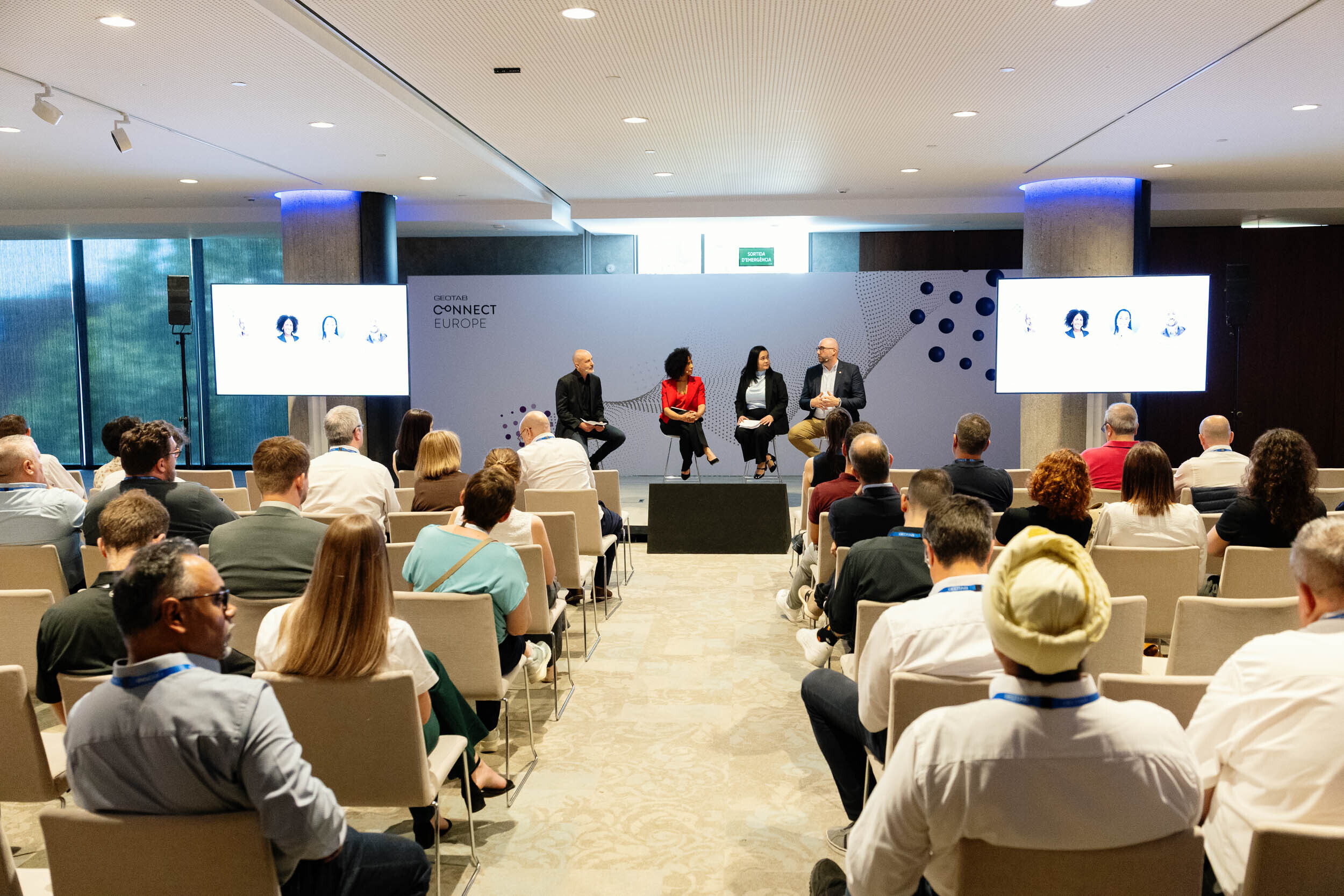
At Connect Europe 2026, Geotab’s annual EMEA conference, three speakers together with Jorge Sanchez, Senior Business Developer at Geotab, dismantled that premise from three different vantage points: Michael Owens, Head of RevGen at Geotab Vitality; Loubna Dhiba Chriquat, CTO of Moove Cars; and Erika Camacho, digital transformation lead at Moove Cars. Their session — Reinforcing Safety: The Impact of Positive Recognition — was framed as an honest pilot update, not a success story. Definitive results are still forming. What is already visible is harder to ignore than a KPI.
The assumption that needed testing
Fleet safety management has operated on a consistent logic for decades: monitor behavior, detect violations, apply consequences. The model produces data. It produces compliance floors. What it reliably fails to produce is genuine behavior change — because it treats the driver as a risk to be managed rather than an asset to be developed.
Moove Cars operates more than 10,000 drivers across 7,000 vehicles, 24/7. The data infrastructure was already in place. Every harsh brake, every acceleration event, every risk indicator was being tracked. The problem was not access to information.
“We had a lot of data,” said Loubna Dhiba. “We were tracking driver behaviours, getting all the information. But we needed a different idea. Try something new. Not punishing.”
The existing model had reached its ceiling. What Geotab Vitality offered was a different architecture — built on the same behavioral science that Vitality applied to health insurance, now directed at driver safety.
What personalization actually means at scale
The core mechanism is the PCR metric — the Predictive Collision Risk Center — which aggregates safety events from Geotab’s global dataset and assigns each driver a contextualized risk benchmark. The contextualization matters more than the score itself.
A Moove Cars driver operating in central Madrid is exposed to different risk conditions than a driver working a rural route. A car driver and a heavy truck driver face structurally different environments. Geotab Vitality adjusts for both. The weekly safety goal each driver receives reflects their actual risk context — not a fleet average that penalizes some and flatters others.

“We want to make sure it is a true reflection of the individual driver,” said Michael Owens. “Through that personalization, drivers are able to get a personalized weekly safety goal.”
The Vitality app then gives drivers visibility into their own progress — against their past score, not against colleagues — and rewards them for improvement. The distinction matters. Most recognition programs celebrate the top performers and, by implication, mark everyone else as failing. A driver at the bottom of a safety ranking has no incentive to engage with a leaderboard they cannot realistically climb. Geotab Vitality is designed so that every driver on the fleet has something worth working toward, regardless of where they start.
The competitive surprise
The pilot launched at one of Moove Cars’ 30 depots. Participation was not mandatory.
The first reaction from drivers was predictable: another application on top of four already in use. “Oh my God, well, another one,” as Erica Camacho described it. Adoption was the risk. What happened instead: 95% of drivers opted in voluntarily.
Not because they were required to. Because the gamified experience turned out to be genuinely engaging in a way the team had not fully anticipated. Drivers started checking the app daily to track their progress. Then they started comparing scores. The competitive dynamic that fleet managers often try to design around emerged on its own — directed, for once, at exactly the right behavior.
“It’s not seen by them like an imposition from above,” said Erika. “The engagement we can see is like a personal challenge for them to be better every day.”
The surprise was not just the adoption rate. It was what the adoption revealed: drivers already want to be recognized for the work they do. The program did not create that desire. It was the first time anyone had offered to meet it.
Early numbers and what comes next
The pilot is in its early stages — one depot, more to follow. The numbers are still forming.
What is already visible: reduction in harsh acceleration, reduction in fuel consumption, improvements in PCR scores across participating drivers. The full financial case — accident cost reduction, lower insurance premiums — is being built as the data accumulates.
“The most significant KPI at the moment is the reaction and the adoption,” said Erika. “Doing things the other way. No punishment.”
For Geotab Vitality, the business case runs on three tracks. Risk: reduced predictive collision probability, measurable at the driver level. Retention: a program that treats drivers as worth investing in becomes a recruitment and retention tool, not just a compliance mechanism. And operational efficiency: most fleet recognition programs today are manual, time-consuming, and built to celebrate only the top performers — leaving the majority of the fleet unengaged. Geotab Vitality automates the entire cycle and extends it across everyone.
The platform roadmap points to idling next — another behavior with a direct cost correlation — while safety remains the North Star.
The question the pilot is really answering
What Moove Cars is testing is not a product feature. It is a premise: that the behavioral contract between a fleet and its drivers can be redesigned, and that the outcomes — safer roads, lower costs, engaged drivers — follow from the redesign rather than from enforcement.
“We believe in the carrot approach versus the stick,” said Michael Owens. “We show the driver what good looks like. We provide them a dynamic, progressive goal to constantly put them on this continuous improvement journey for safe driving, and we reward them for actually changing their behavior.”
The stick has a ceiling. The evidence from one depot in Spain suggests the carrot is already past it.
Want to continue the conversation? Join us next year in Paris, June 7–9, 2027, as we push the boundaries of fleet intelligence even further.
Subscribe to the Geotab Blog

The Geotab Team write about company news.
Table of contents
Subscribe to the Geotab Blog
Related posts
.jpg)
.jpg)
Insights via OEM data with Geotab: A Source of Competitive Advantage for Businesses.
June 19, 2026
4 minute read
The vehicle is one puzzle piece, but you need a full solution to scale electrification.
June 17, 2026
5 minute read


Fleet connectivity at scale is an organisational decision — not a product one
June 9, 2026
4 minute read