United Utilities achieved 35% fuel economy gain and 25% safer drivers with Geotab fleet telematics
A 2,300-vehicle water utility used predictive maintenance and driver behavior data to cut emissions, reduce costs and build a safer fleet.
Published: Sep 20, 2024
Updated: Oct 1, 2026
Success Highlights
- Predictive maintenance delivered £10,813 in documented direct savings by catching faults through engine hours and diagnostic codes before components failed.
- Pump trucks running five to ten stationary hours daily were being serviced by odometer alone, masking engine wear that caused a £60,000 failure and 23 days of downtime on a single vehicle.
- Driver safety scorecards delivered a 25% improvement by distributing weekly risk-tiered reports directly to drivers, turning behavioral data into measurable performance gains.
- Geotab's Electric Vehicle Suitability Assessment (EVSA) identified that 30% of the commercial vehicle workforce had home charging eligibility, enabling data-driven EV transition prioritization by vehicle and site.
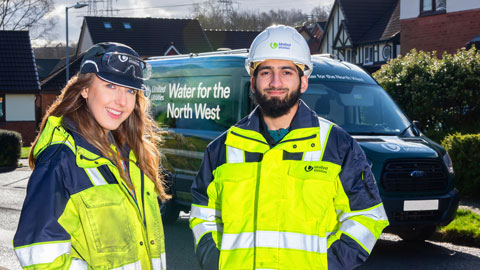
United Utilities operates a fleet of more than 2,300 vehicles, including cars, vans, trucks and 4x4s, that must remain available 24/7 to respond to emergencies across North West England. A single unplanned breakdown represents serious consequences: the company faces regulatory penalties of £15,600 per second above its “Customer Minutes Lost” target when a critical alternative supply vehicle (ASV) cannot operate.
To address fleet sustainability, driver safety and vehicle availability, United Utilities partnered with Vodafone Business Fleet Analytics powered by Geotab, deploying Geotab GPS vehicle tracking devices, the Sustainability Overview, the Electric Vehicle Suitability Assessment and the My Vodafone Fleet App.
What fleet challenges did United Utilities need to solve?
United Utilities is a regulated water utility serving millions of customers across North West England. The company operates continuously across a wide geographic area, responding to both planned maintenance work and unplanned emergency events such as mains pipe bursts.
United Utilities faced four interconnected fleet challenges at the time of implementation:
- Vehicle availability: Fleet vehicles needed to be operational at all times, with no tolerance for unplanned downtime during emergency response situations. The company's 12-year-old ASVs, which inject water into the network during planned pipe replacements and reactive pipe burst events, are particularly critical assets with no direct electric replacement available.
- Aging ICE vehicle maintenance: Rather than replacing older internal combustion engine vehicles with newer models, United Utilities committed to extending the service life of existing vehicles to bridge the gap until suitable electric alternatives became available. Older vehicles are more prone to faults, making real-time diagnostic visibility essential to prevent failures from escalating.
- Transition to electric vehicles: United Utilities set a low-carbon fleet target for 2028 and needed data-driven guidance to determine which vehicles to electrify, in what order and what charging infrastructure would be required across operational sites and employee home locations.
- Driver safety: United Utilities set a target of zero driver injuries involving company vehicles by 2030, a goal requiring systematic behavioral data, a safety cultural mindset and avoiding generic training programs.
Geotab telematics powered United Utilities' fleet management strategy
United Utilities implemented Vodafone Business Fleet Analytics powered by Geotab, integrating the following components across the full 2,300+ vehicle fleet:
- GO device, with connectivity, installation, network and support services
- My Vodafone Fleet App for operational fleet monitoring
- Geotab intelligent data and open platform
- Geotab Sustainability Overview for monitoring
- Geotab EVSA for EV transition planning
How predictive maintenance worked for United Utilities
Real-time vehicle diagnostic data from GO devices is transmitted directly to United Utilities' maintenance garages. The predictive maintenance program operates through three mechanisms:
- Engine management light (EML) alerts are automatically flagged and triaged by severity level, allowing technicians to prioritize response.
- Trucks are now serviced based on engine hours data rather than calendar intervals or mileage alone, a critical change for specialist vehicles whose engines run for five to ten hours daily to power pumps, accumulating wear that odometer readings do not capture.
- Autonomous notifications ensure replacement parts are staged in advance, reducing vehicle downtime and preventing minor faults from becoming major failures.
Before GO device deployment, one United Utilities truck suffered a complete engine failure. The vehicle had low annual mileage and received periodic servicing, but its engine ran five to ten hours daily powering onboard pump systems, hours that were invisible to the maintenance team. The truck remained off-road for 23 days and repairs including outsourcing to third-party contractors cost £60,000. Engine hours reporting has since been integrated into the standard servicing schedule for all affected vehicles.
Driver safety scorecards delivered a 25% performance improvement
Operations management teams receive weekly driver behavior reports covering four key risk indicators: idling, harsh braking, harsh cornering and speeding. Reports are used to tailor coaching and training to the specific behaviors that represent the highest risk to drivers and other road users.
The Geotab Driver Safety Scorecard provides a risk-tiered view of individual driver performance, segmenting the fleet into low risk, mild risk, medium risk and high risk categories. Scorecards are distributed weekly to drivers directly, keeping individual performance visible and encouraging drivers to take personal responsibility for safe behavior on the road.
In addition to speed and braking data, the system tracks seatbelt violations by vehicle, enabling fleet managers to identify specific vehicles where seatbelt compliance is a recurring issue and address it through targeted intervention rather than fleet-wide campaigns.
How Geotab’s Sustainability Overview and EVSA support the EV transition
The Geotab Sustainability Overview and EVSA combined historical usage data with consultancy to determine which vehicles were practical candidates for electrification, in what order, what infrastructure would be required and what was the estimated CO2 emission savings.
Key outputs for United Utilities included:
- Identification of operational site dwell locations suitable for charging installation
- Specification of the number and types of chargers required at each site
- Identification of drivers with home charging eligibility: 30% of the commercial vehicle workforce confirmed to have off-road parking capable of accommodating home charging infrastructure
- EV charging data integration to validate charging events and detect potential fraud, protecting fleet budget
Carl Doyle, Green Fleet Business Lead at United Utilities, said: “The reports and expertise we received helped us to understand what was possible while making sure changes supported our charging infrastructure — so we could make the right decisions for our business.”
What results did United Utilities achieve with Geotab fleet telematics?
Driver safety results: 25% score improvement
Driver safety scores improved by 25% following the implementation of driver behavior reporting, Driver Safety Scorecards and targeted driver training. This improvement directly reduces the probability of road traffic accidents, lowers vehicle maintenance costs caused by harsh driving patterns, reduces fuel consumption and improves overall vehicle availability.
United Utilities got a 35% fuel efficiency gain and 26% emissions reduction
- Fuel economy increased by 35% as a result of combined fleet management efforts including idling reduction, driver coaching and route optimization insights.
- Emissions per vehicle fell by 26%, reducing the fleet's contribution to air pollution and supporting United Utilities' low-carbon 2028 target.
- Idling time dropped by 14%. Reduced idling directly lowers fuel costs, decreases engine wear, reduces maintenance frequency and cuts CO2 and other emissions that contribute to air pollution.
Predictive maintenance saved United Utilities £10,813 in direct fleet costs
Documented savings from preventive maintenance totaled £10,813 between January 2022 and July 2023. This figure covers fault categories including anti-lock braking system (ABS), cooling system, exhaust gas recirculation (EGR), electronic stability programme (ESP), glow plugs, misfire detection and water in fuel across the entire fleet, calculated assuming a 25% vehicle failure rate and based on the cost of replacing individual parts at the point of early detection rather than complete component failure.
This figure represents direct parts and repair savings only. The broader cost of unplanned vehicle downtime substantially exceeds direct maintenance costs:
- Every vehicle off-road day prevented saves United Utilities an average of £2,000, accounting for vehicle hire, service penalties, driver downtime and overtime costs.
- Alternative supply vehicles that cannot perform their function expose United Utilities to a £15,600 per-second regulatory penalty imposed by the Water Services Regulation Authority for customer minutes lost above the target threshold.
- Engine temperature monitoring triggers immediate vehicle inspection, avoiding van engine replacement costs of approximately £7,000 and heavy goods vehicle engine replacement costs of up to £30,000.
What makes predictive fleet maintenance more effective than scheduled servicing?
Traditional scheduled maintenance relies on calendar intervals or mileage thresholds. For fleets with specialist vehicles, such as pump trucks that run stationary for hours daily or aging ICE vehicles with higher fault rates, mileage and calendar data do not accurately reflect engine wear or component stress.
Predictive maintenance, enabled by real-time telematics from Geotab GO devices, tracks engine hours, diagnostic trouble codes, EML alerts and component-specific fault signals. This allows maintenance teams to:
- Service vehicles based on actual operational load rather than assumed use patterns
- Order replacement parts in advance before a vehicle fails in the field
- Triage alerts by severity to allocate technician time efficiently
- Detect early-stage faults in high-risk components such as DPF systems, cooling systems and EGR valves before they trigger full failure
For United Utilities, this approach is critical for its aging ASVs, specialist assets with no current electric equivalent, where every day of unplanned downtime carries both regulatory and financial consequences.
United Utilities expands its predictive maintenance program
United Utilities is expanding its use of vehicle data to build a deeper technical understanding of fault prediction at the component level. One specific focus area is the diesel particulate filter (DPF): a high count of DPF regeneration events can indicate a vehicle is not being driven at sufficient speed or distance to complete passive regeneration, leading to filter saturation, engine warning lights and eventual DPF failure. Fleet managers who understand this signal can intervene before the failure occurs.
The company's broader direction is toward a fully proactive maintenance model, one in which fleet managers anticipate failures at the component level, manage maintenance schedules dynamically based on real operational data and continue building the case for electrification vehicle by vehicle using Geotab EVSA outputs.
Stephen Wolstenholme, Head of Fleet at United Utilities, said: “Vodafone Business Fleet Analytics powered by Geotab is helping our fleet become sustainable. For us, being able to maximize business efficiencies, protect employees and give our customers a great service, while doing this has been game-changing.”
Frequently Asked Questions
Predictive maintenance uses real-time telematics data to track engine hours, diagnostic trouble codes and component-specific fault signals, allowing maintenance teams to service vehicles based on actual operational load rather than calendar intervals. United Utilities documented £10,813 in direct savings from preventive maintenance and prevented critical breakdowns. By identifying early-stage faults before they escalate, fleets can order replacement parts in advance and avoid expensive emergency repairs.
Driver behavior monitoring through Geotab's Driver Safety Scorecard tracks key risk indicators like harsh braking, speeding, idling and seatbelt compliance, enabling targeted coaching rather than generic training. United Utilities achieved a 25% improvement in driver safety scores, reducing accident probability and vehicle maintenance costs. Combined with other fleet management efforts, the company also improved fuel economy by 35% and reduced emissions by 26% through idling reduction and driver coaching.
Geotab's Electric Vehicle Suitability Assessment combines historical usage data with consultancy to identify which vehicles are practical candidates for electrification and determine charging infrastructure requirements. For United Utilities, the EVSA identified operational site dwell locations suitable for charging installation, specified charger types and quantities needed and confirmed that 30% of the commercial vehicle workforce had home charging eligibility.
Specialist vehicles like pump trucks that run stationary engines for five to ten hours daily accumulate significant engine wear that mileage and calendar data do not capture. United Utilities previously experienced a complete engine failure costing £60,000 because periodic servicing overlooked these hidden operating hours. By integrating engine hours reporting into maintenance schedules, the company now services vehicles based on actual operational load, preventing major failures in critical assets like its 12-year-old alternative supply vehicles.
Table of Contents
- What fleet challenges did United Utilities need to solve?
- Geotab telematics powered United Utilities' fleet management strategy
- What results did United Utilities achieve with Geotab fleet telematics?
- What makes predictive fleet maintenance more effective than scheduled servicing?
- United Utilities expands its predictive maintenance program
Client profile
Client name:
United Utilities
Industry:
Water and wastewater services
Fleet size:
2300+
Fleet focus:
Client profile
Client name:
United Utilities
Industry:
Water and wastewater services
Fleet size:
2300+
Fleet focus:
Other stories

Ruan Transportation: Built to bring drivers home with Geotab
August 1, 2026
9 minute read
Waste Connections of Canada improves safety and accountability across 18,000 vehicles with Geotab
February 6, 2026
4 minute read
Imperial Dade Canada Boosts Safety and Sustainability with Geotab
January 27, 2026
1 minute read