New Study Highlights the Best and Worst Performing US Cities for Urban Freight Efficiency
Altitude by Geotab report benchmarks freight efficiency across nine major US cities using real-world data from commercial vehicles
November 3, 2025
•2 minute read

Atlanta, GA - (July 16, 2025) A new study using real-world commercial vehicle data has revealed some of the most and least efficient cities for freight movement across the United States. The Altitude Freight Efficiency Score, developed by Altitude by Geotab, ranks nine major urban areas based on how well their transportation networks support the flow of goods. Denver and Chicago emerge as the top-performing cities, while Los Angeles and New York rank lowest for freight efficiency.
Efficient freight movement is a key driver of economic growth - trucks move 72% of America’s freight by tonnage and are the sole source of freight services for more than 80% of American communities. But freight performance varies widely between cities. Strategic infrastructure planning, congestion management, and resilience to disruption all play a role in how effectively freight moves through urban areas.
The Altitude Freight Efficiency Score evaluates city performance across three areas: infrastructure readiness; infrastructure resilience; and infrastructure externalities. It provides each city with a standardized score from 0 to 100. Scores above 50 reflect strong performance, scores between 25 and 50 indicate moderate efficiency, and scores below 25 highlight networks that require additional attention.
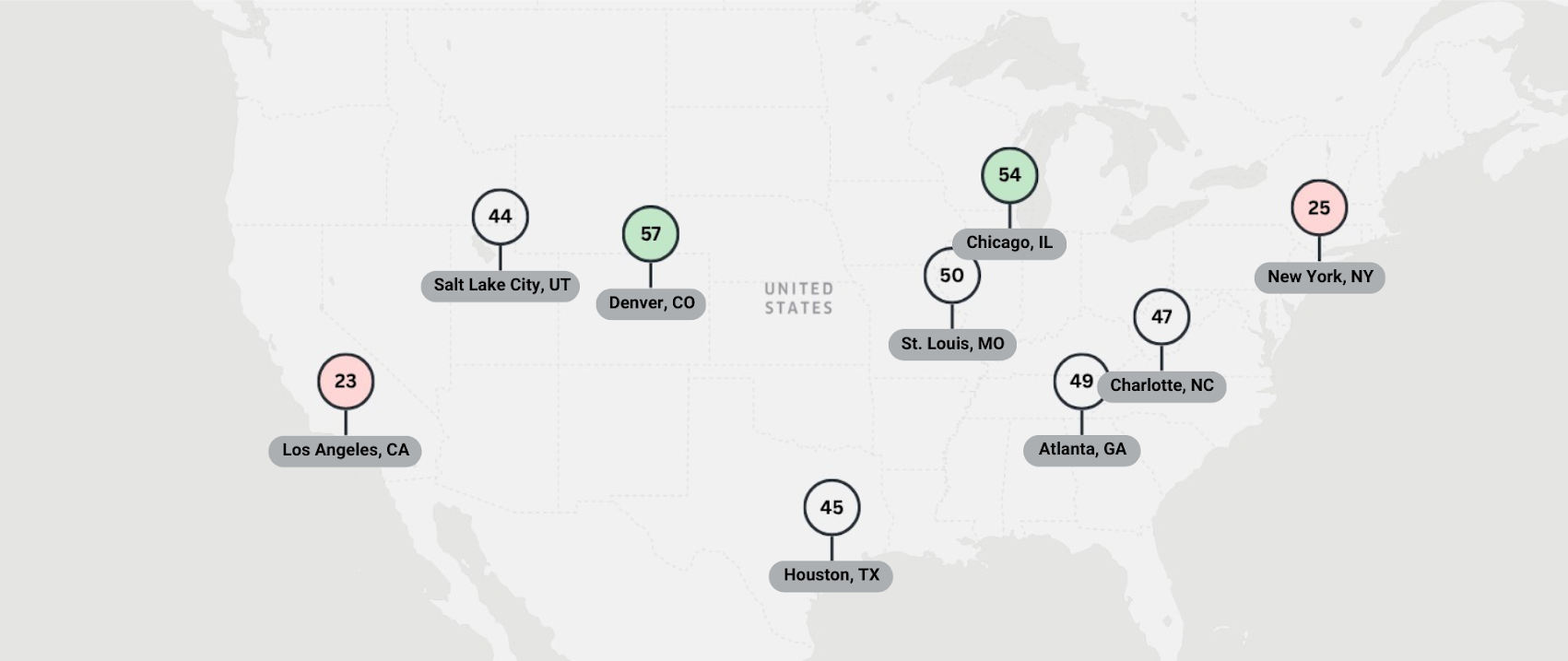
The final Altitude Freight Efficiency Score for each of the nine cities studied in this report, with higher scores indicating transportation systems that enable more efficient freight movement.
City-by-city: key findings
- Denver (57) and Chicago (54) rank as the most efficient freight cities, demonstrating stronger all-around performance in congestion management, resilience to disruptions, and minimal idling.
- Los Angeles (23) and New York (25) score lowest overall, with severe congestion pulling down their infrastructure readiness despite some strength in resilience and idling reduction.
- Salt Lake City (44) and St. Louis (50) lead on congestion performance, thanks to lower population density and well-planned highway networks, though Salt Lake City records the highest idling times.
- Atlanta (49) performs above average, with effective traffic management keeping congestion relatively predictable, though resilience and idling leave room for improvement.
- Charlotte (47) and Houston (45) fall into the moderate range, with opportunities to boost resilience and reduce congestion impacts.
The analysis draws on trip, stop and route data from medium and heavy-duty trucks operating in these cities. The Freight Efficiency Score is weighted as follows:
- Infrastructure readiness (60% weighting) – Measures congestion levels, predictability of traffic patterns, and the availability of low-congestion travel hours.
- Infrastructure resilience (20% weighting) – Measures how well a city’s transportation network recovers from disruptions, including weather events and major public gatherings.
- Infrastructure externalities (20% weighting) – Measures waste in the system, primarily through commercial vehicle idling, which adds to operational costs and environmental impact.
The report highlights that improving freight efficiency offers tangible benefits for cities, businesses and communities. Reducing congestion and improving traffic predictability helps lower operational costs for fleets and makes supply chains more reliable. Stronger infrastructure resilience allows cities to recover faster from disruptions.Minimizing idling reduces both costs and emissions, contributing to cleaner air and better public health.
Nate Veeh, AVP of Market Development at Altitude by Geotab commented on the report: “Cities looking to improve their freight efficiency should focus on investments that make traffic patterns more predictable, strengthen emergency response and disruption recovery capabilities, and reduce unnecessary vehicle idling as part of broader sustainability goals. The Altitude Freight Efficiency Score offers planners a consistent, data-driven way to benchmark progress and guide investment decisions.”
For more information, please visit: https://altitude.geotab.com/insights-and-customer-stories/freight-efficiency-score-report/
About Altitude by Geotab
Altitude by Geotab is a leading provider of advanced mobility insights and solutions for public and commercial sectors across North America. Headquartered in Oakville, Ontario, the company leverages its expertise in data analytics to help decision-makers gain a comprehensive understanding of road network movements. By delivering reliable and contextualized insights, it enables improved planning capabilities and better financial outcomes, while maintaining data confidentiality and privacy. Our solutions drive safer, more efficient and more sustainable mobility throughout North America. Learn more at altitude.geotab.com and follow us on LinkedIn.
Media Contact
Nicole Riddle
Media Relations Manager
pr@geotab.com
About Geotab
Geotab is a global leader in connected operations, video telematics and AI-powered insights. Trusted by more than 100,000 customers — from small and mid-size fleets to Fortune 500 enterprises and public-sector organizations, including the U.S. federal government — Geotab connects approximately 6 million vehicles and assets and processes 100 billion data points daily. With ISO/IEC 27001:2022, SOC2, FIPS 140-3 and FedRAMP authorizations, Geotab's open platform and partner ecosystem unify safety, compliance and operations in a unified system. Our mission: a safer, more efficient and more sustainable world in motion. Learn more at www.geotab.com and follow us on LinkedIn or visit Geotab News and Views.
GEOTAB and GEOTAB MARKETPLACE are registered trademarks of Geotab Inc. in Canada, the United States and/or other countries.
Geotab in the News
Related News


Geotab integrates J1979-2 protocol to California truck compliance offering
October 6, 2026
1 minute read

Geotab Launches Geotab Fleet Card to Help Commercial Fleets Save Millions in Fuel Costs
October 1, 2026
2 minute read

Geotab receives Business Intelligence Group’s 2026 Sustainable Transportation Award
September 29, 2026
2 minute read