Beyond the hype: Real AI priorities for field service leaders
New data shows that field service teams are moving quickly from curiosity about artificial intelligence to real-world adoption. Learn what’s working now, what’s slowing progress and how to build trust with the people AI impacts.

By Geotab Team
Mar 25, 2026

Key Insights
- Predictive wins are real: AI is already improving workforce effectiveness by helping teams move from reactive to predictive.
- Trust is the biggest blocker: Adoption stalls when technicians question intent, leaders worry about privacy or AI recommendations don’t feel believable due to weak data.
- Start small, measure impact and iterate: Focus on a few high-value use cases, establish a baseline using the right metrics and scale once you can prove results.
Over the past few years, AI headlines have moved faster than most field service teams could. It’s not surprising that many leaders have remained curious but cautious as they attempted to separate the AI hype from real operational value.
Heading into 2026, the AI frenzy is settling into practicality. The focus is on making sure AI is usable and fits cleanly into human workflows. Many field service leaders now see AI as a powerful tool for moving from reaction to prediction, helping teams work proactively and get jobs done right the first time. And the latest data from Field Service Next shows that many have moved from evaluation to action.
82% of field service leaders say AI solutions make up 10-25% of their tech stack. And almost 100% are taking steps to implement it, from pilot programs to fully deployed AI solutions across multiple service areas.
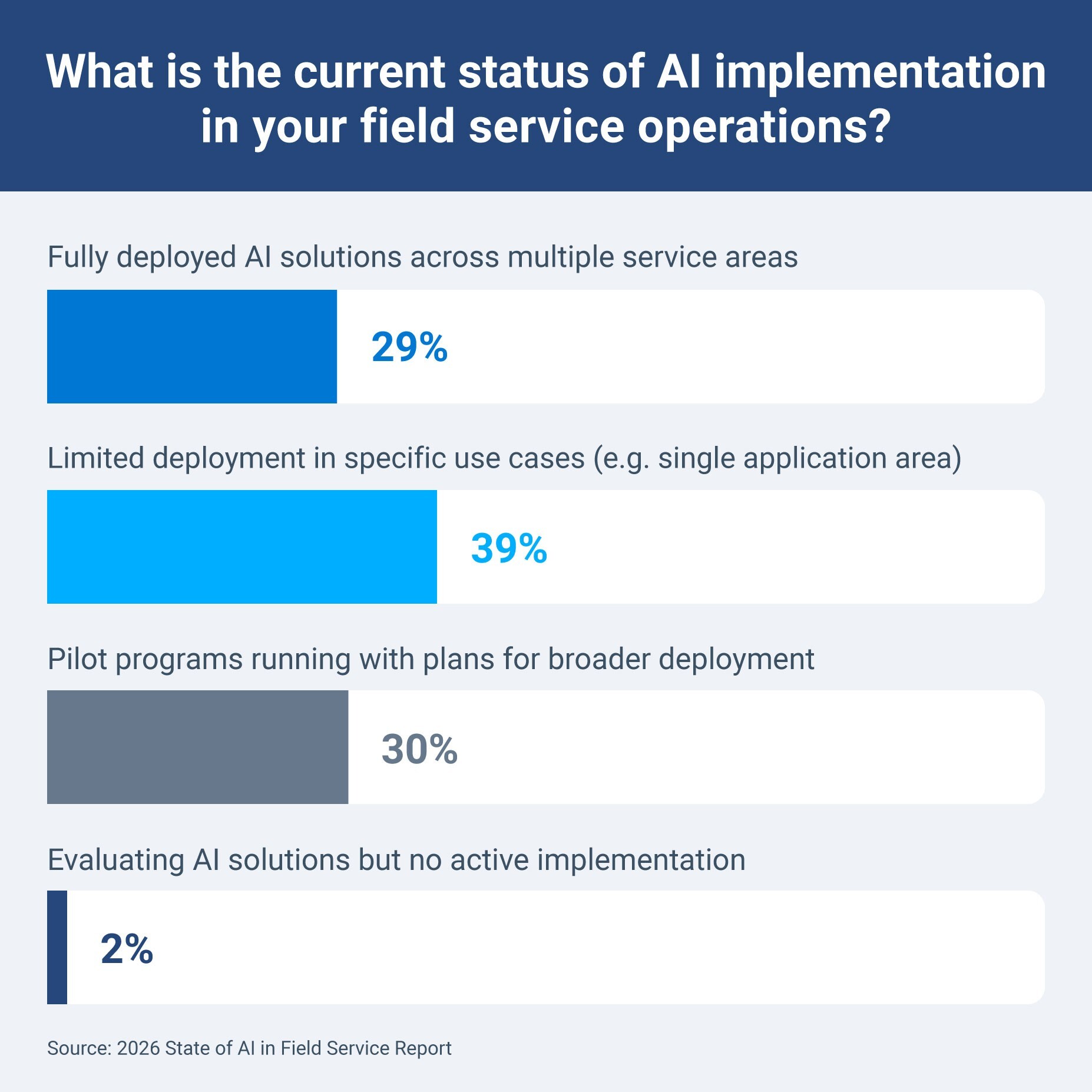
These investments make good business sense. Boston Consulting Group estimates that AI could drive 15-20% revenue impact and improve gross margin by 5-10 percentage points for field service organizations through transformative solutions such as connected equipment and generative AI technician co-pilots.
Even with the financial upside, some leaders remain cautious about the pace of change. That caution is understandable, but standing still is its own risk. The winners in 2026 and beyond won’t be studying AI from the sidelines. They’ll be hands-on, experimenting strategically, learning fast and using AI to sustainably shift operations.
If you’re looking for practical ways to move forward with AI without creating chaos, keep reading. You’ll also see how North American field service leaders are putting AI to work now and planning for what’s next, based on data from the 2026 State of AI in Field Service Report.
How predictive AI is driving proactive decision making
AI is moving field service organizations away from reacting to problems and toward predicting what’s going to happen next. This shift lets leaders intervene before time-wasting disruptions — like arriving on site without the right part or unexpected vehicle breakdowns — tank budgets and customer satisfaction.
It’s already showing up in high-impact areas, like maintenance and driver safety.
- 100% of fleet leaders surveyed rate AI-enabled predictive maintenance as effective or very effective. Respondents highlight transformative AI levers like forecasting vehicle failures, anomaly detection and monitoring. Anticipated benefits include higher vehicle uptime and availability.
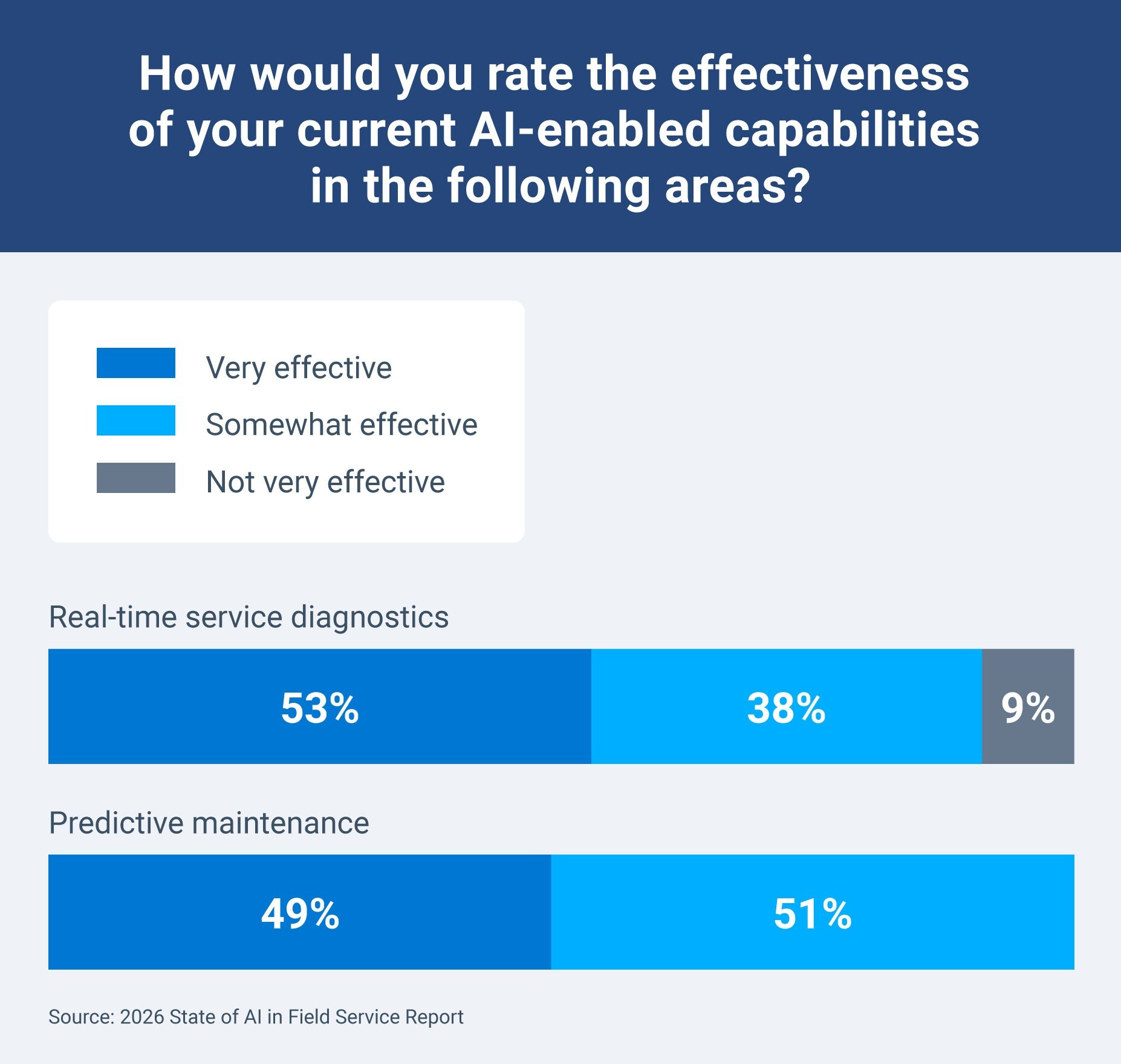
This predictive edge depends on one thing: data at scale. For example, Geotab is connected to over 5.5 million vehicles worldwide and collects 90 billion data points every day. This makes it possible to predict when a particular make or model of vehicle needs maintenance based on similar vehicles and use cases across the globe. Fleet managers can plan ahead to take the vehicle off the road at the right time, without disrupting service.
The predictive power of AI extends into other important areas, like driver safety. A year or two ago, many field service organizations were still in reactive mode when it came to safety, which often looked like this:
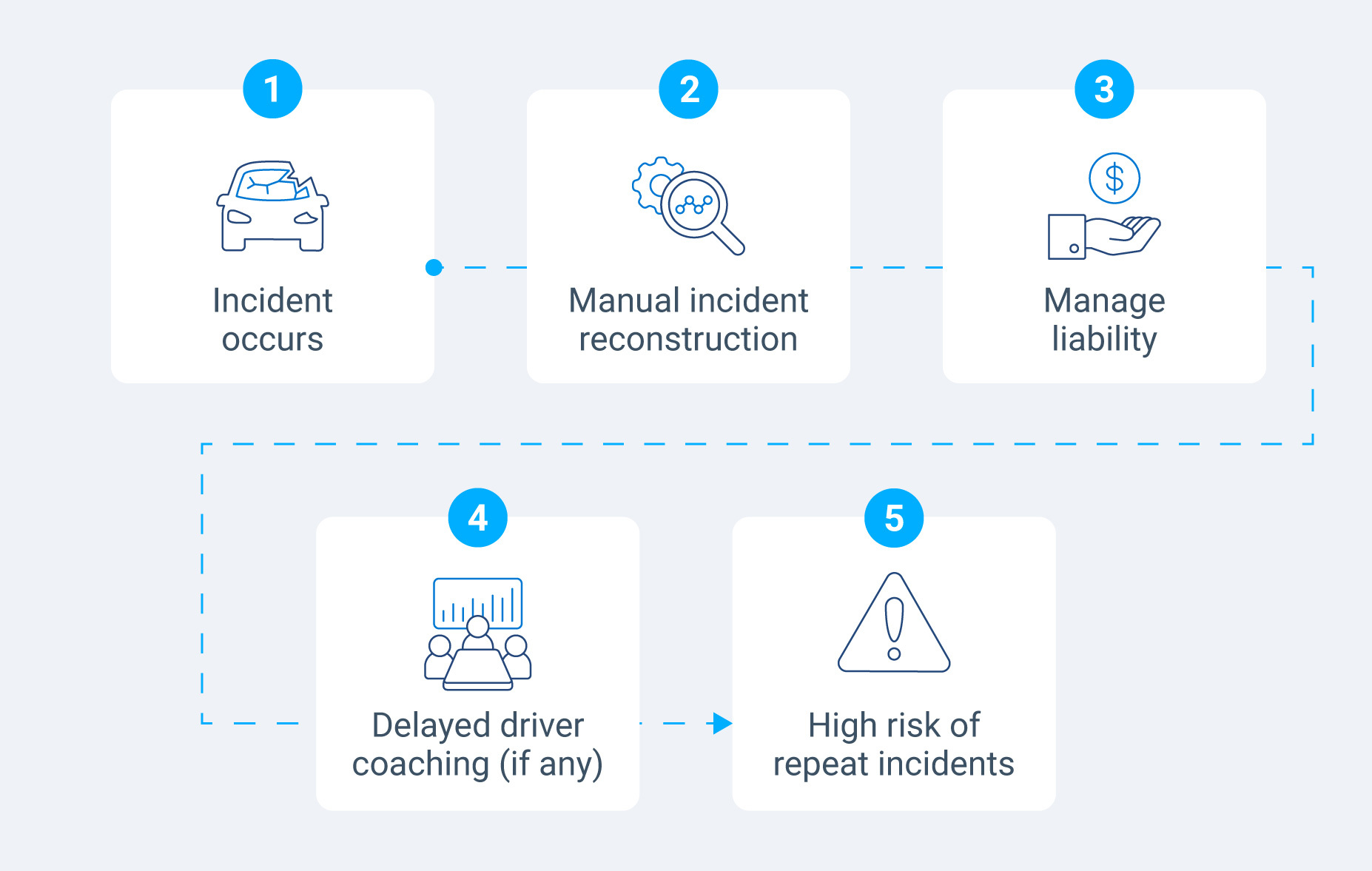
Today, predictive analytics powered by AI can predict with high confidence whether a driver is going to get in an accident in the next 100, 1,000 or 10,000 miles. This changes the dynamic:
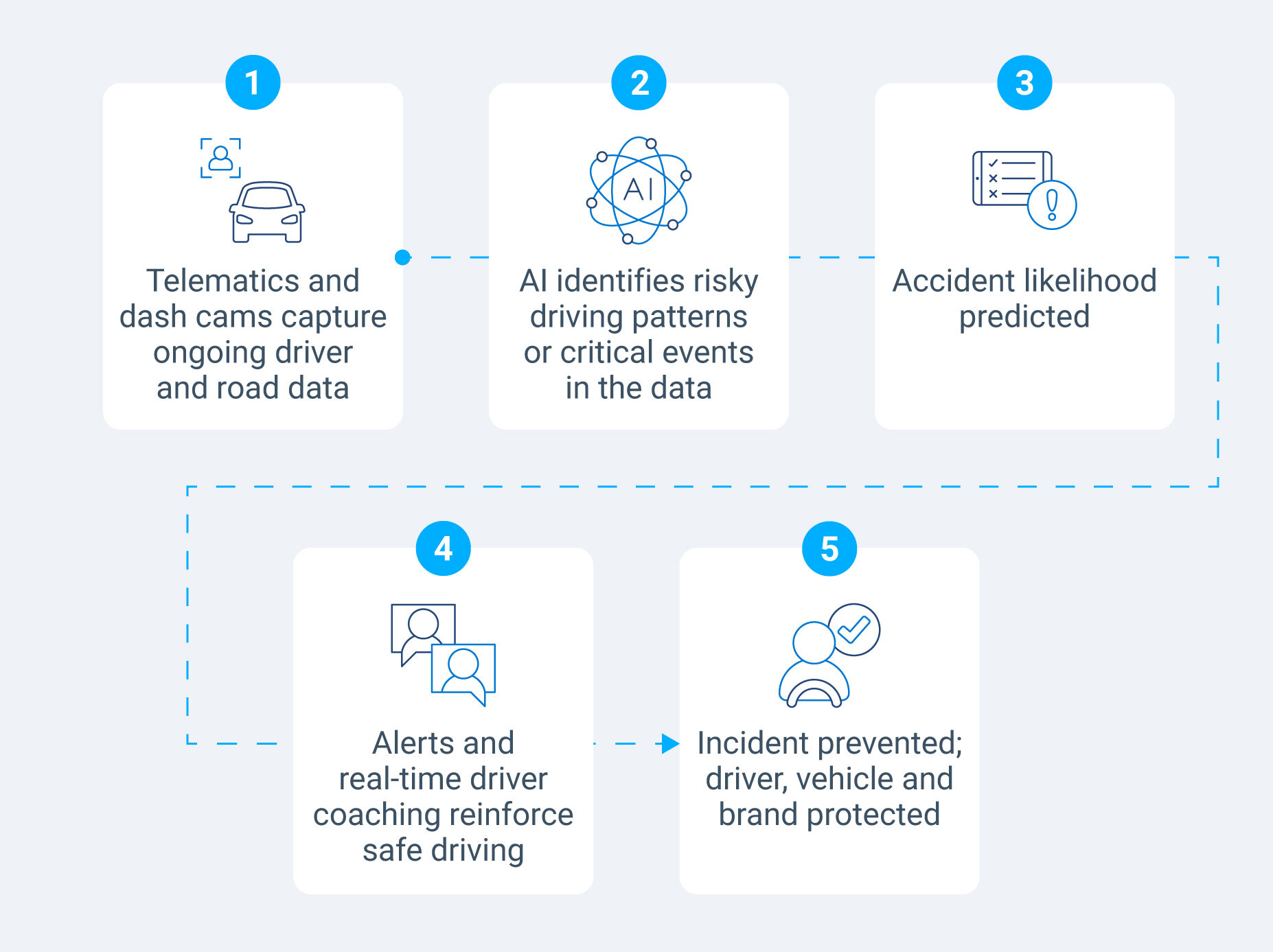
So, why does AI adoption stall even when the value is so clear? It’s because barriers still exist.
Trust issues block AI adoption
The 2026 State of AI in Field Service report identifies three persistent barriers to AI adoption.
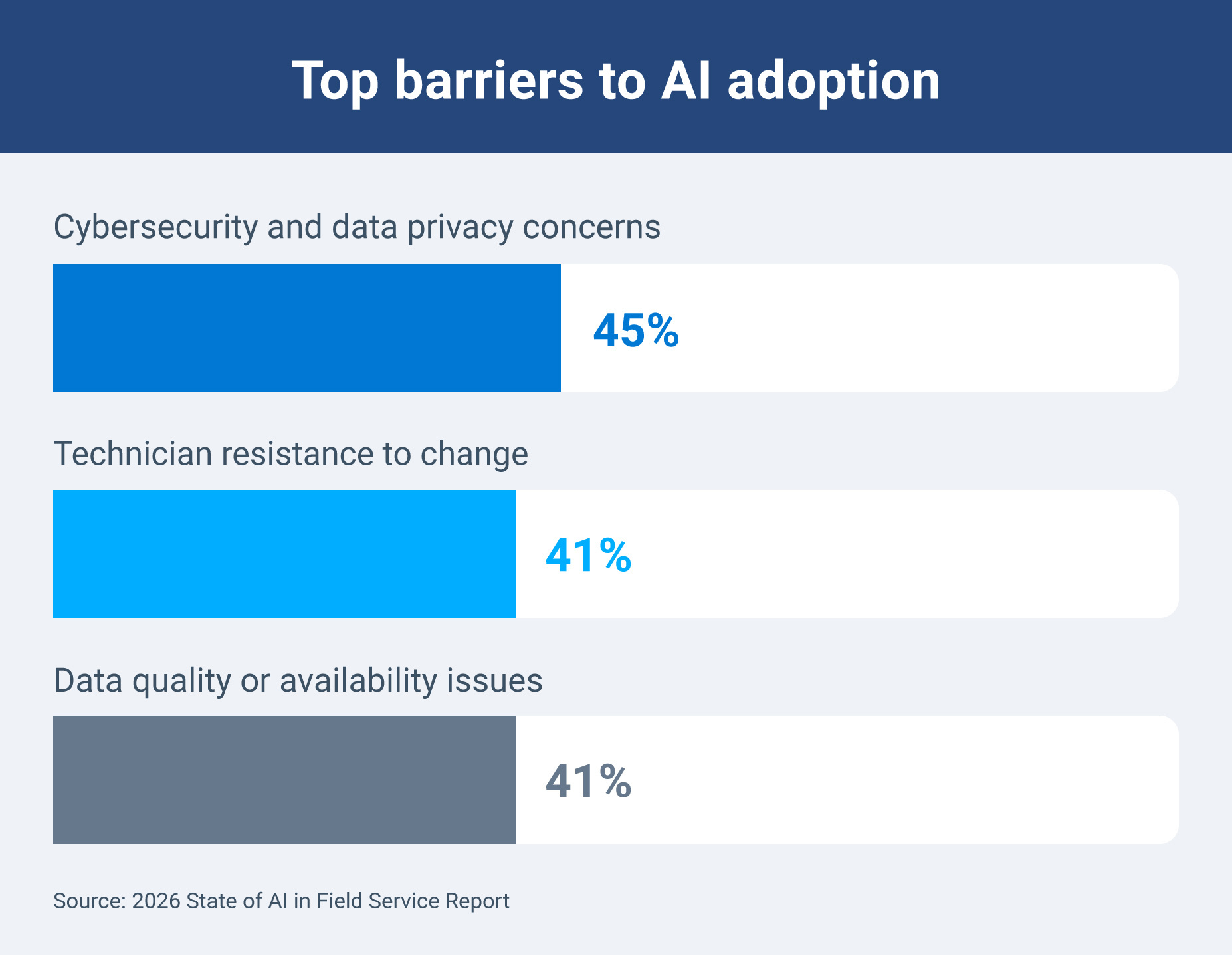
Barrier 1: Cybersecurity and data privacy concerns (45%)
Getting a handle on cybersecurity and privacy requires strong governance frameworks. You need secure infrastructure, but you also must ensure any AI tech partner you work with can prove security maturity, including the following:
- Third-party certifications (e.g. SOC 2 Type II or ISO 27001)
- Strong encryption and access controls
- Regular process and environment testing
- Clear policies for data governance, retention and incident response
You can also look for strong security social proof. For example, some vendors work with the United States military and other government bodies, which signals they meet stringent security requirements.
Barrier 2: Technician resistance to change (41%)
Resistance to AI tools is often rooted in uncertainty about why new technology is being introduced. Take AI-powered fleet dash cams for example. Even when the goal is safety, they can trigger a “big brother is watching” reaction. Taking a baby-steps approach can help — like turning off the cab-facing camera at launch until drivers get more comfortable.
But change management matters too when it comes to securing employee buy-in. This is particularly critical given that 75% of field service leaders are only “somewhat confident” their workforce will adapt to increased AI integration. Tactics like safety culture framing, identifying internal AI champions and being clear on the “why” behind AI tool training can reduce pushback.
Time and incentives help to resolve resistance
Once technicians experience how AI actively makes their work lives better, it often stops feeling mandated and starts feeling like support. In practice, it’s the everyday wins and the right reinforcement that change minds.
- AI-enabled dash cameras can reconstruct incidents on the spot, provide clear context to attending officers and support faster, fairer driver indemnification.
- AI tools can help technicians complete more jobs efficiently and hit performance targets. The benefits show up in tangible ways, including smoother workflows, fewer frustrating surprises and happier customers.
- Incentives can reinforce the perception shift. For example, when teams recognize and reward safe driving behaviors, AI becomes a tool for improvement and engagement rather than scrutiny.
Barrier 3: Data quality or availability issues (41%)
Data quality issues directly undermine trust in AI outputs. When the data feeding AI systems is incomplete, inconsistent or outdated, even the most sophisticated analysis can produce insights that feel “off.”
In field service, that often shows up as predictions that don’t match reality:
- A fleet vehicle maintenance recommendation that feels unnecessary
- A scheduling decision driven by inaccurate job duration or travel-time forecasts
- A collision-risk prediction that doesn’t align with the driver’s past behavior
If the output isn’t believable, it won’t be adopted. If humans are left out of the process, they can’t catch errors. Without the right data foundations and the appropriate amount of human oversight, AI momentum stalls before it ever reaches the front line.
Waiting for “ideal” conditions can quickly undermine AI momentum. Think of it this way: you’re not barging blindly ahead; you’re starting small, with the right data signals and a clear way to measure impact.
Get started with AI without getting stuck
Last year I noted that small, strategic AI implementations can deliver significant, measurable improvements. I still believe this is true. But there are two foundational things you should do to make sure even small AI projects don’t sputter and stall.
Prioritize data readiness
AI in field service fails when data foundations aren’t reliable. It’s the quality and integrity of the data that allow teams to predict issues early and trust what the system recommends. Strong governance and security controls protect the operational and customer information systems rely on.
You need to consider whether the data you have today is suitable to make predictive AI work for you. Start by identifying the data sources that actually drive your priority use cases — like vehicle health signals, location/route data, work order history or technician availability. Then make sure they’re connected, consistent, secure and usable.
Once you have the right data infrastructure in place, you can determine where the quick wins lie that will resonate across the organization. This is important to gain buy-in to keep investing.
- For a smaller organization with a lean team and ever-changing priorities, quick wins might lie in intelligent scheduling, dispatch and route optimization.
- For a larger organization with thousands of drivers on the road, the wins might be found in driver safety and predictive maintenance.
Your AI solution partner can play a role here. Look for offerings like a robust open API ecosystem that integrates with your existing tech, expert and responsive engineering support and access to partners that can help ensure your data infrastructure is set up for success from the start.
Home in on the right metrics and measure your baseline
You don't need a dozen metrics to prove AI is working. Instead, pick the top three you rely on every day. Measure your pre-AI baseline and then keep measuring results at regular intervals to track progress.
Twenty-eight percent of leaders are prioritizing investment in intelligent scheduling and route optimization over the next 12 months. These organizations might choose to measure the metrics outlined below.
Chart title: Sample baseline metrics for scheduling and route optimization
| METRIC TO MEASURE | WHAT SUCCESS LOOKS LIKE |
| Travel time per job | Decreased average drive time decreases as routing improves.
Decreased fuel spend will also show up. |
On-time arrival rate
| Increased on-time technician arrivals.
Decreased follow-up calls and customer complaints. |
| Technician utilization | Increased daily billable work completion without additional headcount. |
Bonus: When you can show how AI improves factors like revenue, customer experience and technician efficiency, other teams pay attention. This opens the door to broader buy-in and faster rollout of the next set of quick wins.
Start small, prove value and expand with confidence
If you're not experimenting with AI, you’re already falling behind competitors. And the data reveals it may take awhile to catch up. Eighty-four percent of field service leaders say they didn’t realize measurable value from an AI implementation for 12 to 24 months, so starting now matters.
AI development is iterative and early adoption promotes continuous learning and improvement. You get smarter and the AI gets smarter. Models improve and the pace of change accelerates.
Don’t fall behind. See what field service leaders are doing now and prioritizing next by downloading the 2026 State of AI in Field Service report.
Subscribe to get industry tips and insights
The Geotab Team write about company news.
Table of Contents
Subscribe to get industry tips and insights
Related posts

Unified data: The key to fleet liability reduction for government agencies
March 19, 2026
9 minute read


Building a proactive government fleet safety program with data and AI
March 9, 2026
5 minute read


Building resilient school bus operations through four student transportation trends
February 24, 2026
6 minute read

How to stop wasting mechanic hours on ‘ghost codes’ and low-priority repairs
February 2, 2026
2 minute read