Fleet accident management: How to improve safety and reduce costs
A single collision can cost a fleet far more than a repair bill. This guide walks through the fleet accident management workflow, the role of telematics and the best practices that keep costs and downtime under control.

By Geotab Team
Sep 4, 2026

Key Insights
- A structured fleet accident management process turns a stressful incident into a controlled, documented workflow that protects the business.
- The process moves through six stages, from immediate response to post-incident review, giving fleet managers a repeatable framework for every collision.
- Telematics data speeds up detection, strengthens claims and supports driver coaching after an incident.
- A written policy, regular driver training and ongoing trend review are the practices that keep collision costs down over time.
A single commercial vehicle collision can cost fleets tens of thousands of dollars once the repairs, downtime, liability and insurance increases add up.
For a business running dozens or hundreds of vehicles, that expense multiplies quickly, and the process of resolving it can be just as costly as the collision itself. Fleet accident management helps businesses handle these incidents while reducing associated risks and costs.
This guide is made for fleet managers and operations directors who want to move from a reactive approach to a structured, data-driven safety program. It walks through the core steps of the workflow, the operational challenges that come up along the way and what to look for when evaluating fleet accident management software or a third-party provider.
Fleet accident management workflow
Accident management covers the full lifecycle of a vehicle incident, from the first minutes after a collision to the final review of what happened and why. Understanding each stage in advance and documenting it in a written policy reduces confusion in the moment and protects the business both legally and financially.
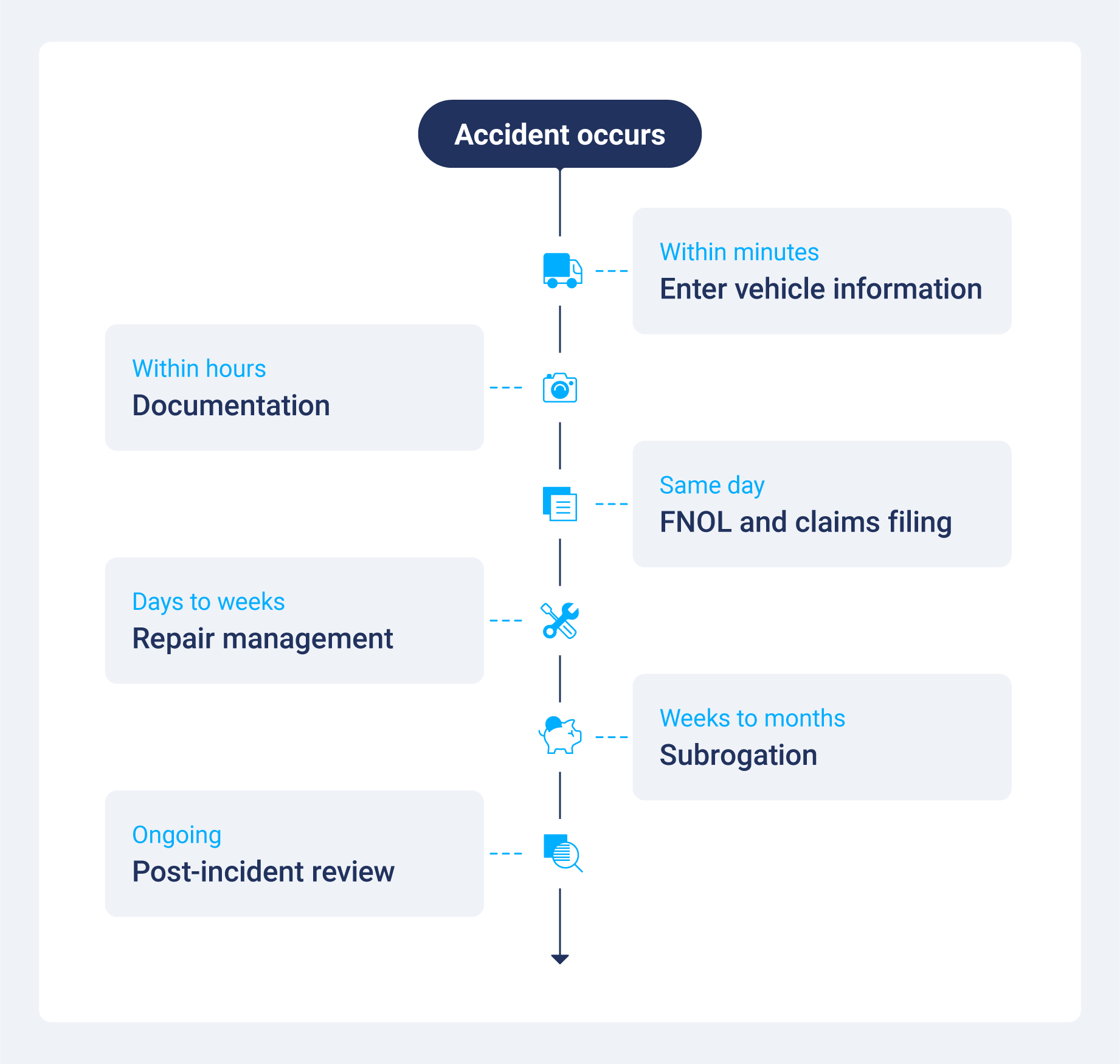
The table below offers a quick summary of what each step looks like in the process:
| Workflow step | Typical timeframe |
| Immediate incident response | Minutes |
| Accident documentation | Within hours |
| First notice of loss (FNOL) and claims filing | Same day |
| Repair management | Days to weeks |
| Subrogation | Weeks to months |
| Post-incident review and risk analysis | Ongoing |
1. Immediate incident response
In the first minutes after a collision, the driver's priority is safety. Drivers should move to a safe location if possible, check for injuries, contact emergency services when needed and avoid admitting fault or discussing details with another party. A calm, practiced response reduces the chances of a second incident on scene.
The fleet manager's role starts as soon as the call comes in. This includes logging the incident, initiating first notice of loss with the insurer and arranging roadside assistance or towing if the vehicle cannot be driven. A 24/7 driver support line staffed by trained specialists gives drivers immediate guidance and helps reduce stress.
2. Accident documentation
Good fleet safety program documentation starts at the scene. Drivers should capture photos of all vehicles involved, exchange third-party contact and insurance details, record witness information and note the police report number if one is filed.
Telematics data adds an objective layer to this record. GPS location, vehicle speed and hard-braking events at the time of the incident can confirm or clarify what a driver report describes. Thorough documentation at this stage is the foundation for a faster claims process and a stronger subrogation case later.
3. First notice of loss (FNOL) and claims filing
First notice of loss (FNOL) is the initial report filed with an insurer to formally open a claim. Filing quickly, ideally within hours of the incident, helps avoid delays in repair authorization and cost recovery.
Fleet management software or a third-party provider can automate FNOL submission, which reduces manual entry errors and gives fleet managers real-time visibility into the status of each claim. This is one of the areas where dedicated accident management services tend to outperform a manual, spreadsheet-based process.
4. Repair management
Once a claim is open, the fleet manager coordinates damage assessment, selects a repair shop and authorizes the work. Certified repair oversight, including technicians with I-CAR Platinum certifications, helps catch repair issues before they become much larger repair bills.
A vetted network of pre-approved repair shops that meet quality and turnaround standards reduces vehicle-off-road time. Coordinating a rental vehicle for the driver during this window keeps the business productive while the vehicle is out of service.
5. Subrogation
Subrogation is the process of recovering repair, rental and diminished value costs from the at-fault party or their insurer. Many fleets leave money on the table here, either by not pursuing subrogation aggressively or by lacking the documentation to prove fault.
This is a common gap that specialized fleet accident management services can close, since a dedicated subrogation team knows how to identify recovery opportunities that internal teams might otherwise miss.
6. Post-incident review and risk analysis
The final stage looks backward to protect the fleet going forward. Reviewing accident data helps identify root causes, driver behavior patterns and recurring risk factors across the fleet.
This analysis feeds directly into driver coaching, policy updates and preventive safety programs. Some fleets now apply a predictive safety model to flag high-risk drivers before a collision occurs, rather than only reviewing data after the fact. Closing the loop with a data-driven review is the only reliable way to reduce repeat incidents over time.
Why fleet accident management matters
A vehicle incident affects far more than the vehicle involved. Without a defined process, a single collision can disrupt operations, strain budgets and create liability that follows the business for months.
An effective fleet accident management strategy helps organizations:
- Reduce vehicle downtime
- Lower repair and insurance costs
- Speed up claims processing
- Improve driver safety
- Meet regulatory and insurance requirements
- Reduce liability by maintaining accurate collision records
- Identify trends that help prevent future collisions
These benefits compound over time. Fleets that track accident-related costs against safety investments often find it easier to prove fleet safety ROI to leadership, which supports the case for continued investment in prevention rather than only reacting after a collision.
How telematics improves fleet accident management
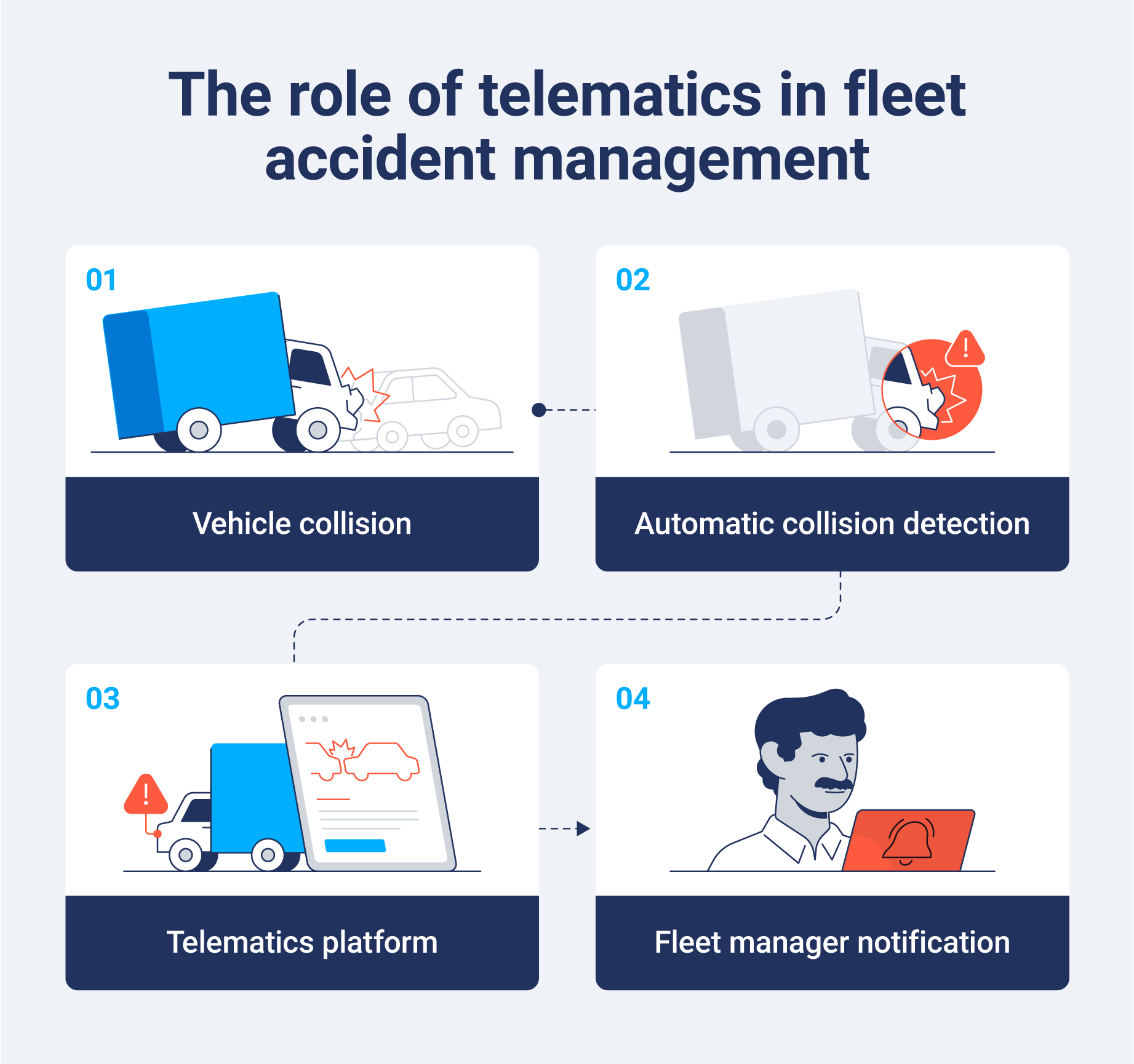
Modern automotive fleet accident management companies increasingly build telematics directly into the accident management process, automating many of the manual tasks fleet managers used to handle by phone or email.
Paired with a collision avoidance system, this technology shifts the emphasis from reacting to incidents toward preventing them in the first place.
Common capabilities include:
- Automatic collision detection that alerts fleet managers when a crash occurs
- GPS location tracking to identify where the accident happened
- Vehicle diagnostics to assess damage severity
- Dash cam footage to provide evidence during investigations and insurance claims
- Driver behavior monitoring to identify factors like speeding, harsh braking or distracted driving before and after an incident
- Accident reconstruction using vehicle data to better understand what occurred
Faster incident detection
Automatic collision detection removes the delay between an incident and a fleet manager learning about it. Instead of waiting for a driver to call it in, telematics sensors can flag a sudden change in speed or force and alert the fleet manager right away, which starts the FNOL and roadside assistance process sooner.
Better evidence for claims
Dash cam footage and vehicle data give fleet managers an objective account of what happened, rather than relying solely on driver recollection. This evidence can shorten claims review, reduce disputes over fault and support a stronger outcome for fleet insurance claims when a third party is involved.
Driver coaching and risk reduction
Accident data does more than settle claims. Reviewing braking, speed and route patterns helps fleet managers identify drivers who need additional support and target coaching where it will have the most impact. Programs designed to prevent dangerous driving before it leads to an incident are one of the most effective ways to reduce collision frequency over time.
Fleet accident management best practices
Technology supports the process, but a strong accident management program still depends on a clear policy, trained drivers and regular review. The following practices apply regardless of fleet size or industry.
Create a written accident response policy
A written policy removes guesswork from a stressful situation. It should spell out what drivers do in the first minutes after a collision, who at the company gets notified and how documentation gets submitted. Pairing this with a broader fleet safety program gives drivers and managers a consistent reference point, rather than leaving them to improvise.
Train drivers before accidents happen
Drivers who have practiced the response steps in advance are far less likely to make costly mistakes at the scene, such as admitting fault or failing to document damage. But one-time training often is not enough.
Regular refreshers during onboarding and periodic safety meetings keep the policy top of mind when an incident actually happens.
Review accident trends regularly
A monthly or quarterly review of collision data helps fleet managers spot patterns, such as a specific route, time of day or vehicle type associated with a higher incident rate. Over time, these reviews turn individual incidents into fleet-wide insight. That is where the biggest long-term cost savings originate.
Improve your fleet accident management strategy with Geotab
Building a complete fleet accident management program does not happen at once. Start by addressing what creates the most risk today, then layer in telematics data as your team grows more comfortable with the process.
Geotab collision risk solutions give fleet managers the data needed to detect incidents faster, document them accurately and support both claims and coaching from a single platform. See how connected fleet safety solutions fit into your accident management strategy by talking to a Geotab expert.
Subscribe to get industry tips and insights
Frequently Asked Questions
Fleet accident management includes the full lifecycle of a vehicle incident, starting with the immediate driver response, on-scene documentation, first notice of loss and claims filing, repair coordination, subrogation and post-incident review. Together, these steps reduce costs, downtime and liability after a collision.
Fleet accident management covers the operational side of a collision, including driver support, repair coordination and vehicle availability, while auto insurance covers financial liability for damages. Many fleets rely on both, with insurance for the payout and accident management services, whether internal or outsourced, for keeping operations moving smoothly.
Yes, small fleets need a formal accident management process. Even small fleets benefit from a written policy, since the cost of a single unmanaged collision can represent a significant share of total fleet expenses relative to fleet size.
Subrogation is the process of recovering repair, rental and diminished value costs from the at-fault party or their insurer. Pursuing subrogation consistently, rather than only when it is convenient, reduces the accident-related expenses a fleet absorbs each year.
Telematics improves accident management by supplying objective data like GPS location, speed and hard-braking events that make claims processing faster, reduce disputes over fault and support driver coaching after the incident.
The Geotab Team write about company news.
Table of Contents
Subscribe to get industry tips and insights
Related posts


Driver risk management: How public fleet managers save time with smarter video tools
September 2, 2026
3 minute read

How video telematics helps drivers trust the safety program
August 27, 2026
4 minute read

Lone worker safety for utility fleets: A checklist for the sites beyond cellular reach
August 24, 2026
3 minute read

Fleet cameras: How to choose the best system for safety and visibility
August 5, 2026
4 minute read

From video archives to active prevention: The case for AI dash cams
July 22, 2026
4 minute read