Minimum tire tread depth: How to stay safe and legal
Learn how to determine minimum tire tread depth for commercial vehicles, including 4/32" steer tire regulations and replacement best practices.

By Geotab Team
May 20, 2026

Key Insights
- Minimum tire tread depth for commercial vehicles is 4/32 of an inch for steer tires and 2/32 of an inch for all other positions, though safety performance declines before reaching those limits.
- Replacing tires at 4/32 of an inch improves wet-weather stopping distance and reduces the risk of hydroplaning.
- Simple methods to quickly assess tire tread depth include the penny test, quarter test and tread depth gauges.
- Proactive tire monitoring via telematics and scheduled maintenance helps fleets stay in compliance, reduces downtime and prevents costly violations.
For fleet managers and owner-operators, staying ahead of minimum tire tread depth requirements directly affects compliance and uptime. Worn tires contribute to almost 11,000 motor vehicle crashes every year. This is why regular maintenance is so important when it comes to preventing collisions, roadside violations and costly downtime. A single out-of-service order can sideline a truck, disrupt delivery schedules and trigger fines — all of which add up fast.
Luckily, tire-related violations are entirely avoidable with the right maintenance processes and monitoring tools in place. Learn the legal minimum for tire tread, why your fleet should aim higher and the best ways to measure and maintain your organization's tires.
The legal minimum for tire tread
In the United States, the Department of Transportation (DOT) sets a baseline minimum tire tread depth of 2/32 of an inch for most passenger vehicles. For commercial motor vehicles — Classes 3 through 8 — the FMCSA establishes stricter standards. These requirements reflect the vehicles' greater stopping distances and load weights.
The FMCSA minimum tread depth requirements for commercial vehicles are:
- Steer tires must be 4/32 of an inch, measured in every major tread groove across the tire
- All other tire positions (drive, trailer) should be 2/32 of an inch
- Tires must be free of exposed body ply or belt material, tread separation, bulges or cuts that expose the interior
It is important to understand the difference between FMCSA citation thresholds and the Commercial Vehicle Safety Alliance (CVSA) out-of-service criteria. A driver with a steer tire at 3/32 of an inch will receive an FMCSA citation but remain in service. But under CVSA rules, a vehicle is placed out of service when steer tires are under 2/32 of an inch.
Real-world compliance consequences include:
- Out-of-service orders: The vehicle is grounded until violations are resolved, creating immediate downtime and missed loads.
- CSA score impact: Tire violations fall under the Vehicle Maintenance BASIC (Behavior Analysis and Safety Improvement Category) and carry a severity weight of up to 8 out of 8. Violations can stay on the record for 24 months.
- Insurance consequences: Poor CSA scores can raise insurance premiums and compliance renewal negotiations.
- State-level variation: Some states, such as Colorado, enforce stricter inspection protocols or have additional tread requirements for mountain driving or seasonal conditions.
Why the legal limit isn't always the safety limit
Meeting the legal minimum is the compliance floor. Research consistently shows that wet-weather stopping performance degrades significantly before tires reach 2/32 of an inch of tread depth. AAA testing conducted at 60 mph found that tires worn to 4/32 of an inch required an average of 87 additional feet to stop on a wet road compared to new tires [link].
The underlying cause of this is water evacuation. Tire grooves are engineered to channel water away from the contact patch at highway speeds. As tread depth increases, capacity decreases. Below 4/32 of an inch, the grooves can no longer reliably displace water, increasing the risk of hydroplaning.
Recommended tread depths by safety condition are as follows:
- Wet weather: Replace at 4/32-inch thickness. Water evacuation drops sharply at this level, increasing the risk of hydroplaning.
- Snow and winter conditions: Replace at 5/32-inch thickness. Winter tire performance degrades faster than wet-road traction.
- Cold temperatures: Rubber compounds stiffen regardless of tread depth. Tires approaching minimum depth in winter conditions present a compounded risk. Review the tire depth chart below for more details.
| Depth | Legal? | Performance |
| 2/32” | Yes (minimum) | Compromised wet-weather performance, and stopping distances increase by 50% compared to new tires. |
| 3/32” | Yes | Performance drops steeply and wet braking is noticeably longer. |
| 4/32” | Yes | Safety threshold. Water evacuation begins declining. |
| 5/32” | Yes | Acceptable for dry conditions. Minimum recommended for winter driving. |
| 6/32” | Yes | Good. Wet and winter performance is reliable. |
| 7/32” | Yes | Good. Solid grip in most conditions. |
| 8-9/32" | Yes | Very good. Near-optimal performance |
| 10/32”+ | Yes | New or near-new. Optimal water evacuation and stopping distance. |
3 ways to measure tire tread depth
Automated telematics systems provide fleet-wide visibility into vehicle health, though manual tread checks remain a critical first line of defense. Pre- and post-trip inspections are required by the FMCSA. A driver who knows what to look out for can catch a failing tire before it becomes an out-of-service violation.
| Method | What to look for | What it means |
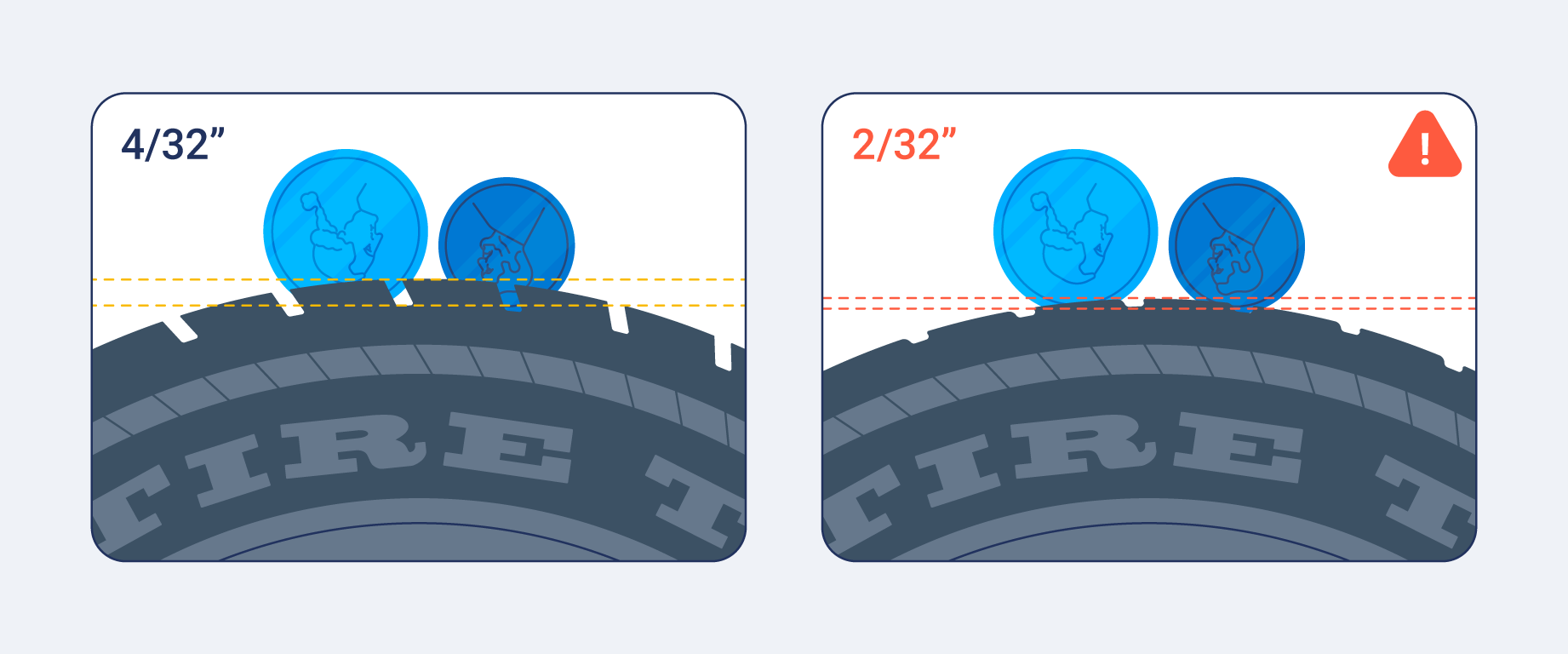
| Penny test | Insert the penny with Lincoln's head down. If the entire head is visible, the tread is at or below 2/32". | At or below the legal minimum. Replace immediately. |
| Quarter test | Insert the quarter with Washington's head down. If the entire head is visible, tread is at or below 4/32". | Approaching safety threshold. Begin planning for replacement. |
| Tread depth gauge | Insert the probe into the groove, press flat. Read results in 32nds. Measure inner, center and outer tread. | Exact depth in 32nds. Color zones: green (greater than or equal to 6/32"), yellow (4-5/32"), red (less than or equal to 3/32") |
| Wear indicator bars | Raised bars molded between tread ribs around the circumference of the tire. | When flush with the tread surface, the tire has reached the 2/32" legal minimum. |
1. Try the penny and quarter tests
Coin tests are a driver-level quick check and are easy to perform during a pre-trip inspection. Here is how to do each:
Penny test (2/32" threshold):
- Select the shallowest tread groove on the tire.
- Insert a penny with Lincoln's head pointing down into the groove.
- If Lincoln's entire head is visible, tread depth is at or below 2/32", and the tire has reached the legal minimum.
Quarter test (4/32" threshold):
- Follow the same steps with the quarter, inserting Washington's head down.
- If Washington's entire head is visible, tread is at or below 4/32", the recommended replacement threshold for wet conditions and the FMCSA steer tire minimum.
These tests, while easy, are not without their limitations. Coin tests do not give exact depth measurement in 32nds of an inch. Human error, lighting conditions and inconsistent groove selection can affect the result.
2. Use a tread depth gauge
A dedicated analog or digital tread depth gauge provides an exact reading in 32nds of an inch. Both types work the same way:
- Insert the probe into the tread groove
- Press the shoulder of the gauge flat against the tread block
- Read the result
Digital gauges display the measurement on a screen, while analog gauges use a sliding scale. Always measure at least the inner edge, center and outer edge across the tire face to avoid inaccurate readings due to uneven wear. Many gauges include color-coded zones:
- Green indicates tread above 6/32 of an inch
- Yellow indicates 4/32 to 5/32 of an inch
- Red indicates anything at or below 3/32 of an inch
3. Check wear indicator bars
Every commercial-grade tire is molded with tread wear indicator bars — raised strips of rubber that run perpendicular to the tread grooves at approximately 2/32 of an inch from the bottom of the groove. To find them, look for small arrows or "TWI" markings on the sidewall pointing to the bars.
When the tread around the indicator bars wears down to the level of the indicator bars, the surface is flush and the tire has reached the legal minimum. At that point, the tire should be immediately replaced. Indicator bars are a reliable pass/fail signal, especially for a walkthrough inspection, but they only indicate when a tire has reached its limit.
Monitoring tire health for commercial fleets
Manual checks are essential, but managing tire health across an entire fleet requires a more systematic approach. Fleet managers invest in telematics and maintenance workflow tools to automate inspection schedules so nothing falls through the cracks.
Dashboard for a centralized view of tire health
For example, Geotab's telematics platform gives fleet managers a centralized view of vehicle health data, making it easier to track fleet-wide maintenance needs.
Fleet managers can build scheduled maintenance triggers and monitor vehicle condition data in one place, rather than relying on driver reports. This improves consistency and makes it easier for teams to act on issues before they become compliance threats.
TPMS for underinflation monitoring
Tire pressure monitoring systems (TPMS) also help catch underinflation early.
Under-inflated tires can:
- Wear faster at the shoulder
- Generate excess heat
- Reducing fuel efficiency
Integrating TPMS alerts means pressure issues can be addressed before they escalate.
Routine maintenance for longer tire life
Tire rotation and alignments can be helpful as well. Regular tire rotations distribute wear evenly along the tire set, extending usable life. Wheel alignment checks are just as important, since a misaligned axle can wear down tread in weeks rather than months.
Identifying uneven tread wear patterns
Tread depth does not give you the full picture. A tire can have adequate depth but be approaching failure on one edge due to uneven wear. Catching wear patterns early can prevent mechanical damage, reduce premature costs and identify fleet-wide patterns that could indicate a larger problem.
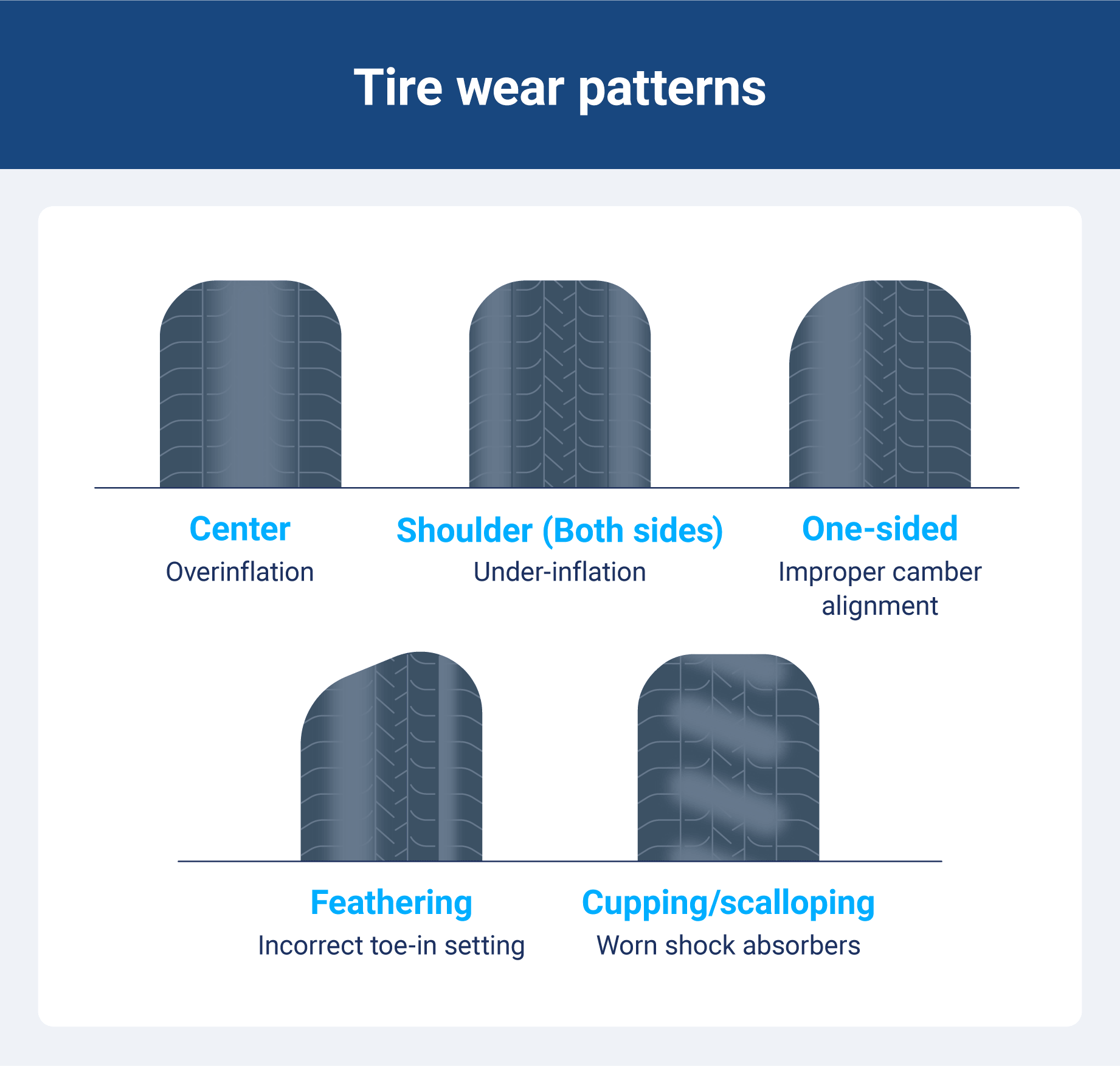
Common wear patterns fleet management programs should watch out for and their causes include:
- Center wear: Tread worn in the center of the tire with shoulders intact. This is caused by over-inflation and can be corrected by adjusting pressure to the manufacturer's requirements.
- Shoulder wear (both edges): Tread is worn on both outer edges, but the center is intact. This is caused by under-inflation and can be corrected by inflating to the correct specification.
- One-sided wear: Tread is worn on one shoulder only. This is caused by improper camber alignment and can be corrected by wheel alignment.
- Feathering: Tread ribs are worn smooth on one side and sharp on the other. This is caused by an incorrect toe-in setting and can be corrected by alignment adjustment.
- Cupping or scalloping: Uneven, wavy wear around the circumference. This is caused by worn or failing shock absorbers or struts and can be corrected by inspecting and replacing suspension components.
When to replace tires regardless of tread depth
Though tread depth is a primary indicator, it is not the only one. Tires age from the inside out, which is why it is so important to learn not just what tread depth to replace tires but also how structural compromises play a role. Heat, UV exposure and oxidation all cause rubber components to dry, crack and lose elasticity over time, compromising the vehicle.
Most tire manufacturers and the National Highway Traffic Safety Administration (NHTSA) recommend replacing tires after six years, regardless of tread condition, with a hard limit of 10 years. Find your tire's manufacturing date by looking at the DOT code on the sidewall. The last four digits indicate the week and year the tire was made.
You should always replace your tires immediately if they show:
- Sidewall bulges or bubbles, which indicate internal structural failure
- Deep cuts or gashes in the sidewall that expose internal cords
- Visible tread separation or chunks missing from the tread face
- Consistent or severe dry rot cracking across the sidewall
- Any tread depth at or below 2/32 of an inch
Track tire tread depth more efficiently
Managing minimum tire tread depth requirements is easier with connected maintenance workflows and electronic logbooks. Modern fleet telematics platforms combine vehicle health data, maintenance scheduling and inspection reports so you can act on compliance issues before they become costly errors.
Staying compliant with minimum tire tread depth standards protects your drivers, your fleet and your business. Explore how to build proactive tire maintenance into your daily operations.

Subscribe to get industry tips and insights
Frequently Asked Questions
In the United States, the minimum tire tread depth for passenger vehicles is 2/32 of an inch. For commercial motor vehicles regulated by the FMCSA (Classes 3-8), steer tires must have at least 4/32 of an inch of tread in every major groove, while all other tire positions require a minimum of 2/32 of an inch.
Yes, 7/32 tread is good. It falls well above both the legal minimum and the recommended safety replacement threshold of 4/32 of an inch. At 7/32 of an inch, tires retain strong water evacuation capacity and solid wet-weather grip.
The legal minimum is 2/32 of an inch for all vehicle positions or 4/32 of an inch for commercial steer tires under FMCSA. However, the safety recommendation is 4/32 of an inch. Because of this, many fleet operations set proactive replacement at 4/32 of an inch for driver and trailer tires to build a safety buffer and avoid in-service violations.
The Geotab Team write about company news.
Table of Contents
Subscribe to get industry tips and insights
Related posts


Best ELD for trucks: Top devices for compliance and safety [2026]
December 18, 2025
6 minute read


Best ELD for owner operators: Top 6 picks and how to choose one
December 1, 2025
6 minute read