Fleet Safety Results: Richfords Cuts Speeding and Harsh Driving with Geotab Vitality

By Sheena Owen
May 11, 2026
Key Insights
By the numbers:
- A 59% improvement in safe driving behaviours (53% in the first 30 days):
- Acceleration - 48% decrease
- Harsh Braking - 55% decrease
- Harsh Cornering - 73% decrease
- Speeding - 61% decrease
- These improvements in driver behaviours led to a 22% reduction in collision risk, compared to similar fleets - as measured by Geotab’s Predictive Collision Risk (PCR) algorithm.
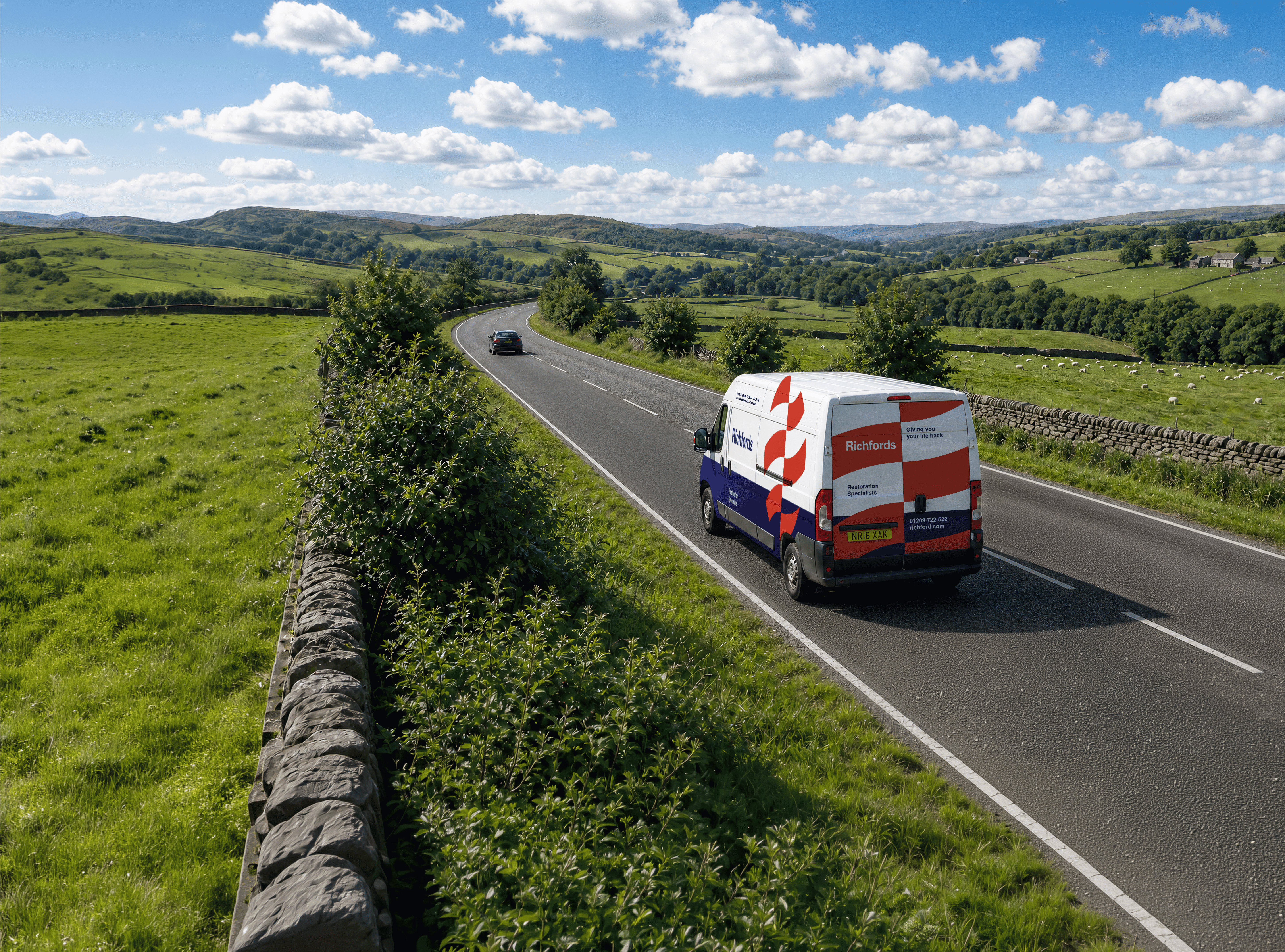
When your drivers are your business, safety cannot be an afterthought. At Richfords, our technicians respond to emergencies — fires, floods, water damage — often at a moment's notice. Every one of our 53 vans is a mobile workplace, and every driver behind the wheel represents our company. We put the drivers first, not the vans. If they cannot drive, they cannot do their job. That simple truth is that driver safety has always been our top priority — and we felt we could be doing more.
The challenge: Build consistency
We already had Geotab installed across our fleet and were using the data to provide driver feedback. The problem was timing.
Our driver performance reports were periodic, which meant we were often looking in the rear-view mirror. By the time a speeding event or harsh braking incident reached my desk, some time had passed. The conversation with the driver felt disconnected from the moment, and it was difficult for them to take ownership of something they could barely remember.
What we wanted was consistency in driver behaviour; shifting from being reactive, to a proactive safety culture, with uniform engagement across the entire fleet. We wanted every driver to feel personally invested in how they drove, not just aware that someone in the office was watching.
Why Geotab Vitality was the right fit
When we were introduced to Geotab Vitality, it immediately stood out because it goes beyond surfacing data that managers need to act on. Geotab Vitality encourages drivers to actively build safer habits — and it measures that progress in a way they can see and understand.
The scoring system is transparent. Drivers know exactly how they’re being assessed, and the metrics are easy to follow. Because we were already on Geotab, the implementation was straightforward — no new hardware, no complex integration. The setup was simple and we were up and running quickly.
We started with a small pilot group to test the waters, and it did not take long for word to spread.
The driver response: competition, pride and genuine buy-in
I will be honest — I expected some pushback. Our drivers already knew they were being tracked by Geotab, so the concept was not new, but there were initial concerns about the technology: how easy would it be to log on, and whether the app would work smoothly on their phones. Those worries disappeared almost immediately. The app was intuitive and drivers picked it up with minimal issues.
What surprised me most was how quickly the culture shifted. The leaderboards created a healthy sense of competition. Drivers started comparing scores, challenging each other, and genuinely taking pride in where they ranked.
One driver in particular had been regularly identified in our speeding reports, and we had been working with him to improve his driving behaviour. Within the first month of the pilot, he achieved zero speeding occurrences — the most significant individual improvement we had seen.
The pilot group became advocates. Adoption across the rest of the fleet happened naturally after that. Today, approximately 45 of our 47 active drivers are fully onboard, across a 53-van fleet.
Real results across the board
Since launching Geotab Vitality, we have seen measurable reductions in speeding, harsh braking, harsh cornering, and harsh acceleration across the fleet. Bringing speed down has had a cascading effect — when drivers slow down, everything else improves too.
By the numbers:
- A 59% improvement in safe driving behaviours (53% in the first 30 days):
- Acceleration - 48% decrease
- Harsh Braking - 55% decrease
- Harsh Cornering - 73% decrease
- Speeding - 61% decrease
- These improvements in driver behaviours led to a 22% reduction in collision risk, compared to similar fleets - as measured by Geotab’s Predictive Collision Risk (PCR) algorithm.
But, the results only tell part of the story - the real change is in consistency. Drivers are self-managing now. They check their own scorecards, spot when their score dips and change up immediately — not because a manager told them to, but because they want to. That shift from external enforcement to personal ownership is something no monthly report could ever achieve.
The impact beyond the dashboard
The biggest benefit of Geotab Vitality is one I did not fully anticipate: time.
Previously, a significant amount of time was spent reviewing speeding data, coordinating follow-ups with drivers and their line managers, and addressing issues after the fact. This has now been streamlined, freeing up time to further strengthen existing compliance activities — including vehicle inspections, policy reviews, and training.
Line managers have benefited too. They are no longer the bearers of bad news. The entire dynamic has shifted from negative reinforcement to positive engagement. Drivers are happier. Morale is up. And the conversations we do have about driving are collaborative, not confrontational.
It is a win-win. Safer driving, lower risk, happier drivers, and more time for the things that actually move our business forward.
Looking ahead
For any fleet manager still relying on after-the-fact reporting to manage driver behaviour, my advice is simple: give your drivers the tools to manage themselves. When people can see their own performance in real time, when they are rewarded for doing the right thing rather than penalised for getting it wrong, the culture shifts. And once that culture shifts, the results follow.
Geotab Vitality did not just improve our fleet metrics. It changed the way our drivers think about driving.
Subscribe to get industry tips and insights
Sheena Owen is part of the Fleet Management team at Richfords, a fire and flood restoration company operating a fleet of 53 vans across the UK.
Table of Contents
Subscribe to get industry tips and insights
Related posts

A 95% location rate in 2026: what Geotab brings to rental, leasing and mobility fleets
October 22, 2026
2 minute read



Why the OEM versus device-level telematics debate misses the point for mixed-fleet operators
September 25, 2026
2 minute read