What is CARB certification? Requirements, rules and how fleets stay compliant
CARB certification means that a vehicle or piece of equipment meets California’s strict emission limits, which are intended to reduce air pollution and greenhouse gases.

By Geotab
Jul 17, 2026

Key Insights
- CARB certification is the mandatory registration and verification process that proves your commercial vehicle meets California’s diesel exhaust emission standards.
- Non-compliant fleets can face fines of up to $10,000 per vehicle per day and risk vehicle impoundment, port bans and DMV registration holds.
- Multiple CARB programs apply to fleets: the Clean Truck Check, Transport Refrigeration Unit (TRU) rules, Advanced Clean Fleets and more.
- Providers like Geotab offer advanced telematics solutions that monitor vehicle emissions, facilitate accurate reporting and ensure adherence to CARB regulations.
Operating a commercial fleet in California without proper CARB certification is a costly gamble, with fines reaching $10,000 per vehicle per day. Non-compliant trucks may also be impounded, barred from California ports and flagged for DMV registration holds.
CARB certification is the mandatory registration and verification process that proves your commercial vehicles meet California's strict diesel exhaust emission standards. It covers everything from engine model year to particulate matter filter status. This guide covers who needs it, how to get a CARB compliance certificate and how to maintain your fleet.
What is CARB certification?
CARB stands for the California Air Resources Board, a state agency established in 1967 to combat severe air pollution and protect public health. CARB compliance means involves matching California's vehicle emissions regulations for engine and exhaust emissions. What it means to be CARB compliant is that a vehicle or fleet meets these regulations.
For fleets, this means adhering to specific regulations that govern vehicle modifications, emissions testing and timely reporting of compliance data.
Maintaining CARB compliance helps fleets reduce air pollution and stay registered with the Department of Motor Vehicles (DMV) while improving operational efficiency.
By using approved methods and technologies, such as continuous emissions monitoring systems, fleets can accurately gather and report emissions data. California’s pioneering efforts in establishing rigorous emissions standards have inspired several other states to adopt similar measures.
Who needs CARB certification?
If you operate diesel-powered commercial vehicles in California, CARB certification applies to you regardless of where those vehicles are registered. While the basic requirement is straightforward, the details can vary depending on how your fleet operates. The breakdown below explains how CARB rules apply across different roles and scenarios.
Fleet operators and motor carriers
Any diesel-powered commercial vehicle weighing 14,000 pounds or more that operates in California must be registered in CARB's Truck Regulations Upload, Compliance and Reporting System (TRUCRS). Motor carriers must ensure every fleet vehicle has a valid compliance certification before it enters California, including if the vehicle is just passing through.
Carriers with refrigerated trailers (reefers) must also register those units in the Air Resources Board Equipment Registration (ARBER) system and ensure they meet applicable emissions limits.
Owner-operators
Owner-operators must follow the same rules as motor carriers. If you operate a single diesel truck in California that weighs 14,000 pounds or more, you must:
- Register in TRUCRS
- Carry proof of compliance
- Maintain annual reporting
Exceptions exist for vehicles that log fewer than 1,000 miles per year in California, but those exemptions must still be documented in the system.
Brokers, shippers and logistics providers
CARB compliance responsibility extends beyond the driver. Freight brokers and forwarders may only dispatch California routes to carriers that are CARB certified. California-based shippers and receivers must also verify that the trucks they use hold valid compliance documentation. Carrying or providing proof of CARB status is not optional.
What does CARB require for fleets?
Fleets operating in California must adhere to a range of CARB regulations designed to protect air quality and ensure environmental sustainability. Compliance is not just a legal requirement — it’s a vital component of responsible fleet management, requiring managers to meet and maintain:
- Emissions standards: Vehicles must meet CARB's particulate matter (PM) and nitrogen oxide (NOx) emission limits.
- Engine model year requirements: As of January 1, 2023, all diesel commercial trucks operating in California must have 2010 model year or newer engines or approved retrofit equipment.
- Reporting obligations: Most programs require annual reporting through TRUCRS or ARBER to confirm ongoing compliance.
- Inspections: The Clean Truck Check program uses onboard diagnostics (OBD) to verify emissions performance. Some programs also require physical inspections.
- Documentation: Drivers must carry valid proof of CARB compliance at all times when operating in California.
Key CARB regulations for fleets
Several CARB programs apply to commercial fleets. The table below provides a quick comparison.
| Regulation | Key consideration |
|---|---|
| Clean Truck Check | OBD-based emissions inspection; register in TRUCRS |
| Transportation Refrigeration Units | Register in ARBER; meet PM and NOx limits |
| Advanced Clean Fleets | ZEV purchase requirements for qualifying fleets |
| Off-road diesel | Emissions performance standards; annual reporting |
| Additional requirements | Idle reduction limits idling to five minutes and Low Carbon Fuel Standard (LCFS) requires tracking and reporting carbon intensity of fuel used |
Clean Truck Check (Heavy-Duty Inspection and Maintenance)
The Clean Truck Check Program — formerly known as Heavy-Duty Inspection and Maintenance Regulation — requires heavy-duty vehicle owners to ensure their vehicles meet specific emissions standards through regular inspections and maintenance.
Vehicles must be registered in TRUCRS, and vehicles that fail must be repaired and retested before turning to California roads. This program is one of the most direct ways CARB verifies that trucks are actually meeting emissions requirements.
Transport Refrigeration Units (TRUs / reefers)
TRUs, the refrigeration units mounted on trailers, railcars and shipping containers, have their own CARB requirements. These units must meet strict PM and NOx limits. Carriers operating reef trailers must register them in ARBER and demonstrate compliance through documented maintenance and emissions records.
Advanced Clean Fleets (ACF)
The ACF rule was made to accelerate the transition to zero-emission vehicles (ZEVs) for California-based fleets. As of 2024, certain private fleet requirements under ACF have changed, but state and local government fleets still have active ZEV purchase requirements.
Off-road diesel and small engine regulations
Construction, agricultural and port equipment fleets must deal with the In-Use Off-Road Diesel Fleet Regulation. This program requires operators of diesel-powered off-road equipment like bulldozers, cranes and forklifts to meet CARB emissions performance targets, submit annual reports and keep maintenance records.
Equipment must either meet CARB's Best Available Control Technology (BACT) standards or turn over to cleaner units on an approved schedule.
Additional requirements
Two more CARB programs affect day-to-day fleet operations:
- Idle reduction: California has specific emissions requirements, limiting diesel engine idling to five minutes in most cases. Fleets must implement idle-reduction strategies like automatic engine shut-offs and driver coaching to remain in compliance and reduce unnecessary fuel costs.
- Low Carbon Fuel Standards (LCFS): The LCFS requires fleet operators to track and report the carbon intensity of the fuels they use. Fleets that shift to lower-carbon fuels can earn LCFS credits, which can provide financial value.
How to get a CARB certification
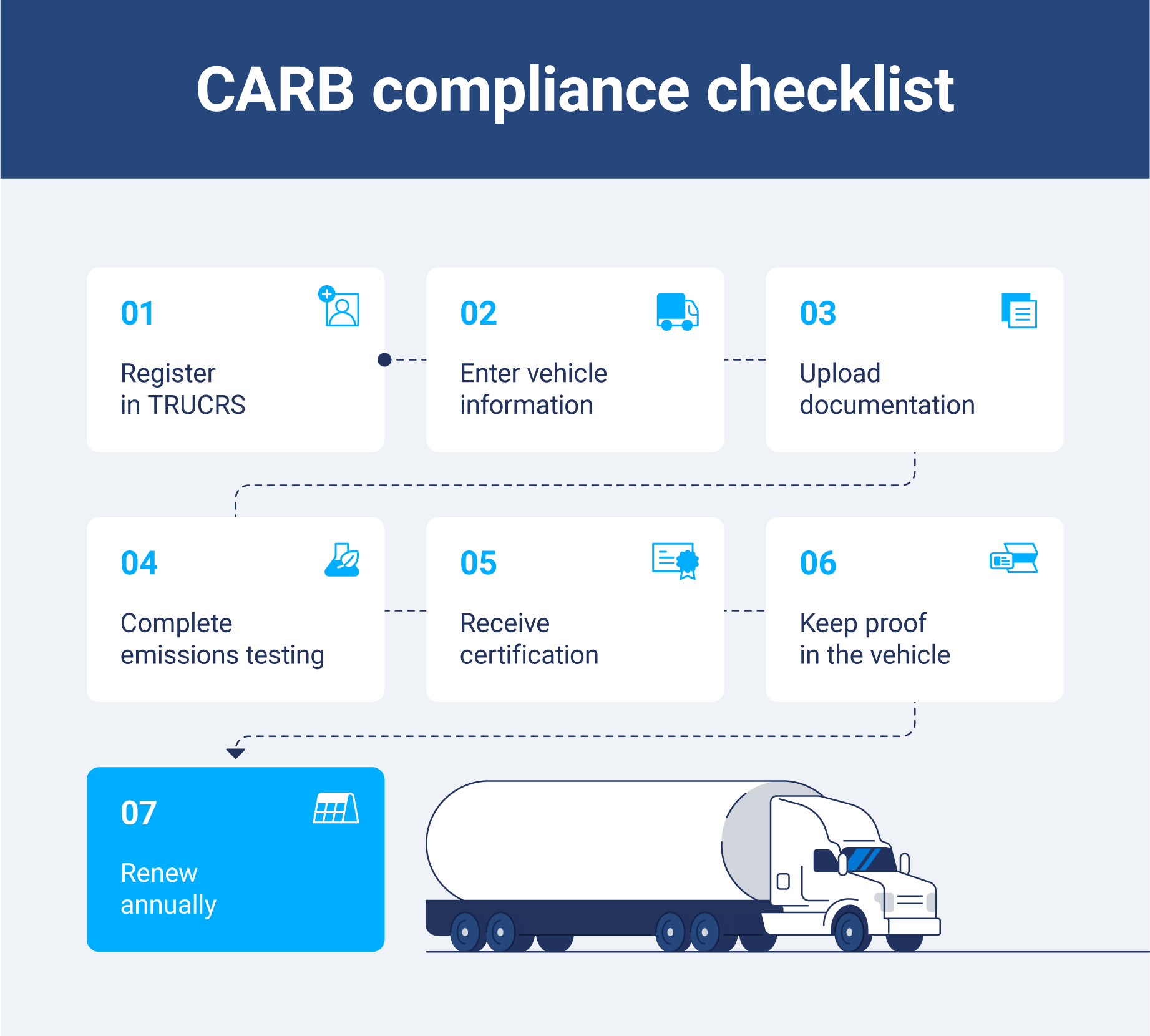
To obtain a CARB compliance certificate, you can start by registering your vehicles through the appropriate channels — often via the California DMV and CARB’s Truck Regulations Upload, Compliance and Reporting System (TRUCRS).
Step-by-step overview of the Truck and Bus Regulation and Clean Truck Check program:
- Register in TRUCRS: Create an account in CARB's Trucks Regulations Upload, Compliance and Reporting System.
- Enter vehicle and engine data: Input each vehicle's make, model, GVWR (gross vehicle weight rating), engine model year and engine family number.
- Upload documentation: Submit vehicle identification numbers (VINs), engine details, diesel particulate filter (DPF) serial numbers if applicable and records of aftermarket modifications.
- Complete emissions testing (if required): Under the Clean Truck Check Program, vehicles must pass an OBD-based inspection at an authorized testing station. Vehicles that do not pass must be repaired and retested.
- Submit and receive certification: Once data is verified and testing is passed, your vehicle will be declared compliant in TRUCRS and you will receive a CARB Compliance Certificate. Drivers must keep proof of this certification in the vehicle at all times during California operations.
- Maintain annual reporting: CARB compliance is not a one-and-done process. Most programs require annual renewal and updated reporting in TRUCRS.
For reefer trailers, you will also need to complete ARBER registration.
How to check your CARB compliance status
You can verify CARB compliance by reviewing your vehicle's emissions documentation and by checking your status in the CARB reporting systems:
- Log in to TRUCRS and locate your vehicle record.
- Review compliance status. TRUCRS will show one of three statuses: Compliant, Conditional or Non-Compliant. Conditional status usually means additional documentation or testing is required.
- Check your reporting history. Confirm that annual reports have been submitted and were accepted.
- For TRUs, check ARBER. Verify each reefer trailer's registration and compliance status in the ARBER system.
Brokers and shippers may also request a compliance status link directly from your TRUCRS or ARBER record. CARB enforcement officers have visibility into fleet compliance data, so keeping records current is essential for audits and everyday operations.
What happens if your fleet is not CARB compliant
CARB non-compliance can trigger consequences that go far beyond immediate fines, impacting both operational continuity and long-term business viability, with CARB collecting nearly $20 million in penalties from non-compliant fleets.
Here are some repercussions that you may face if your fleet fails to meet CARB standards:
- Hefty fines: Penalties can reach up to $10,000 per vehicle per day, quickly escalating costs and disrupting fleet budgets.
- Legal actions and enforcement: Non-compliance may result in DMV registration holds, mandatory recalls or other enforcement actions requiring costly corrective measures.
- Operational disruptions: Vehicles may be removed from service until they are brought into compliance, leading to lost revenue and scheduling challenges.
- Reputational damage: Failure to meet regulatory standards can tarnish a company’s image, affecting customer trust and future business opportunities.
- Long-term financial implications: Beyond fines, the costs associated with retrofitting or replacing vehicles can have significant long-term financial impacts.
- Environmental and public health risks: Increased emissions contribute to poorer air quality and more smog formation, posing risks to community health and inviting further regulatory scrutiny.
Tips to keep your fleet compliant
Maintaining CARB requirements takes consistent monitoring and proactive reporting. These practical steps help reduce risk and keep your operations running:
- Regular fleet audits: Confirm that every vehicle operating in California has a current TRUCRS registration and a valid compliance certificate.
- Proactively check compliance status: Do not wait for an inspection or citation. Log in to TRUCRS and ARBER regularly to verify that all records are current.
- Identify and close gaps quickly: If a vehicle shows conditions or a non-compliant status, act immediately. Delays increase the risk of fines and service disruptions.
- Implement tracking tools: Use telematics software to monitor engine health, idle time and emissions-related diagnostics. Real-time data helps you catch issues before they become compliance violations.
- Plan for future transitions: Even if private fleets are not currently required to purchase ZEVs under ACF, understanding your fleet composition and any additional EV needs helps you prepare for evolving requirements.
Automate fleet compliance with Geotab
Ensuring CARB compliance is critical for any fleet operating in California and other CARB states — including vehicles passing through these states — as it safeguards your business against fines and regulatory pitfalls while contributing to a cleaner environment. To simplify the process, you can try our fleet compliance software to automate compliance reporting.
Integrating Geotab’s tool into your fleet management strategy helps you streamline the certification process and maintain ongoing regulatory compliance. Geotab is the only telematics provider with an executive order for aftermarket T-harness installation and an offer for both a CARB Clean Truck Check certification and a T-harness installation exemption.
Subscribe to get industry tips and insights
Frequently Asked Questions
You can obtain a CARB compliance certificate by registering your vehicle through the California DMV and submitting the required emissions data and documentation via CARB’s reporting systems. Partnering with a CARB-certified telematics provider can also streamline this process.
CARB compliance regulations apply directly to California, though 17 other states and the District of Columbia have formally adopted the same policies:
- Colorado
- Connecticut
- Delaware
- Maine
- Maryland
- Massachusetts
- Minnesota
- Nevada
- New Jersey
- New Mexico
- New York
- Oregon
- Pennsylvania
- Rhode Island
- Vermont
- Virginia
- Washington
- District of Columbia
You can verify CARB compliance by checking your vehicle’s certification documents and emissions test results or by consulting with your fleet management provider, who can confirm adherence to CARB standards.
For 2026, key CARB regulations include continued enforcement of the Truck and Bus Regulation (requiring 2010 model year or newer engines), ongoing Clean Truck Check inspections for heavy-duty diesel trucks, ARBER reporting for TRUs and ZEV purchase requirements for state and local government fleets under ACF.
TRUCRS (Trucker Regulations Upload, Compliance and Reporting System) is CARB's main registration and reporting system for heavy-duty diesel trucks. ARBER (Air Resources Board Equipment Registration) is a separate system specifically for Transport Refrigeration Units (TRUs) like reefer trailers.
Yes, you can still use a DPF to make an old truck compliant in most cases. A diesel particulate filter (DPF) retrofit can bring an older engine into compliance with CARB's PM emission limits. However, the DPF must be a CARB-approved device, and its serial number must be documented in TRUCRS.
Geotab team
Table of Contents
- What is CARB certification?
- Who needs CARB certification?
- What does CARB require for fleets?
- Key CARB regulations for fleets
- How to get a CARB certification
- How to check your CARB compliance status
- What happens if your fleet is not CARB compliant
- Tips to keep your fleet compliant
- Automate fleet compliance with Geotab
Subscribe to get industry tips and insights
Related posts

Before the storm call: Five ways to know your utility fleet is ready
August 6, 2026
3 minute read
10 best ELD for hotshot truckers to stay compliant and profitable
July 6, 2026
9 minute read


B.C.'s new dash cam law: A six-month clock is about to start for commercial fleets
June 2, 2026
5 minute read