The EV Confidence Gap: How to maximize your electric fleet and reduce costs
Fleet data shows underutilization is a common operational challenge. Here’s how to close the gap.

Senior Manager, Sustainable Mobility at Geotab
Apr 23, 2026
Key Insights
- 65% of North American EVs are plugged in before their battery even drops below half capacity—revealing a major "confidence gap" in current operations.
- Geotab's analysis of U.S. truck movement data shows 26% of heavy-duty and 38% of medium-duty trucks travel under 150 miles before returning to base; at a 250-mile threshold, that rises to over 40% of heavy-duty and 58% of medium-duty fleets — making them electrifiable today with existing vehicles.
- Heavy-duty trucks average five hours of depot dwell time per day, providing sufficient window for opportunity charging without operational disruption — eliminating one of the most commonly cited barriers to expanded EV deployment.
The discussion around fleet electrification often revolves around barriers: policy changes, technology limitations, and future battery chemistry. However, fleets that have already made the investment in EVs are in a strong, resilient position, providing a clear advantage against fuel market volatility and evolving regulations.
Right now, there is a huge opportunity to maximize the operational and environmental benefit of these existing assets. Many fleets aren't yet getting the most out of them, and the power to reduce fuel use and emissions is already sitting in those batteries. By shifting from a focus on vehicle limitations to data-driven dispatching, fleets can immediately maximize the environmental and financial ROI of the assets they already own.
The gap between EV investment and impact
Over the past few years I've spent a lot of time looking at how commercial fleets are actually deploying their EVs. The picture is more complicated than "EVs aren't ready" or "fleets are all in." The real story is somewhere in the middle: a meaningful number of organizations have committed to electrification, acquired the vehicles, and then deployed them conservatively. We call this the “underused EV”.
One of the clearest ways to see this is through depth of discharge — how much of a battery's capacity is actually used each day. In the U.S., the average depth of discharge for commercial vehicles is just 36% daily, compared to 48% in Europe, where operators tend to have more confidence in range and charging availability. Fleets aren't running their vehicles to the limits of what the battery can handle; they're keeping a large buffer. That caution has a cost: it means EVs are doing far less work than they were built for, and the economics take much longer to materialize.
We tend to play it safe by giving electric vehicles the shortest, easiest routes—but that means they’re doing far less heavy lifting than they’re actually built for.
The opportunity is larger than most realize
Part of what drives this caution is the persistent assumption that commercial EVs, especially in medium- and heavy-duty applications, aren't capable enough for real-world operations. The data doesn't support that.
Quick facts on truck driving patterns
- A Geotab analysis of U.S. truck movement over a one-year period reveals that 26% of heavy-duty trucks and 38% of medium-duty trucks travel less than 150 miles before going back to base.
- When extending that threshold, the figure jumps to more than 40% of heavy-duty and 58% of medium-duty trucks driving less than 250 miles between visits to their depots.
These figures represent a prime segment for immediate electrification, based on vehicles available today.
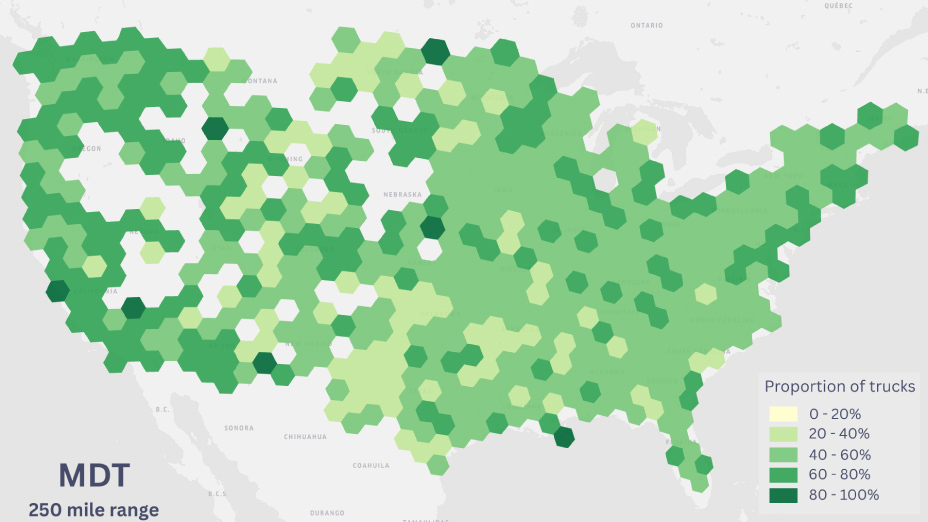
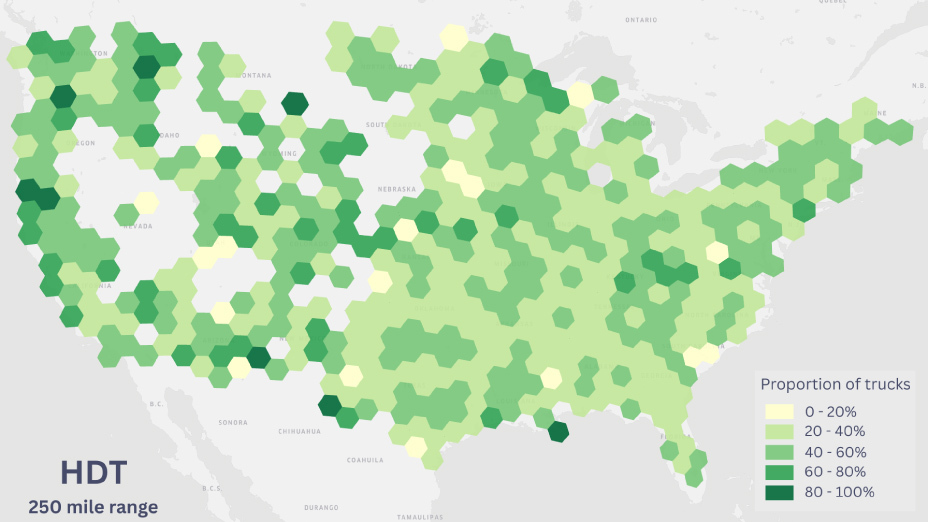
Source: Altitude by Geotab, “Outlining the Path Toward Trucking Electrification”
Dwell time matters too. With heavy-duty trucks averaging five hours of dwell time at depots daily, there is a consistent window for high-capacity charging. The technology is ready and the duty cycles are compatible for many applications — though securing adequate site charging infrastructure remains a genuine challenge. For fleets that have it in place, the question is whether they have the operational confidence to deploy accordingly.
The 2025 NACFE Run on Less — Messy Middle truck demonstration is instructive here. Geotab served as the telematics data partner for the run, which followed 13 fleets across four fuel types, including battery electric trucks from Tesla, Windrose, Daimler and Volvo. The BEV participants took on regional and long-haul work that the broader industry still tends to assume is out of reach for electric. Their depth of discharge data reflected it — these vehicles were being used to capacity, often reaching 100% or more depth of discharge per day.
Using data to close the gap
Getting more from existing EV investments isn't a vehicle performance problem. It's an operational one. And it can be addressed with the right data.
- Monitor EV usage and set a target to gauge progress. If you’re only using 40% of the battery each day, work toward 60%.
- Use real-time state of charge and remaining range so dispatchers can assign routes with confidence rather than anxiety.
- Build charging strategies around when vehicles actually need to be ready rather than defaulting to a full charge every night regardless of tomorrow's dispatch.
Seize the opportunity
The opportunity to reduce emissions and improve the bottom line doesn't always require waiting for the next policy cycle, the next vehicle model, or the next breakthrough in battery chemistry. For a meaningful portion of commercial fleets, it requires looking at what's deployed and making sure we're actually using it to its full potential.
Subscribe to get industry tips and insights
Frequently Asked Questions
Depth of discharge refers to how much of an EV battery's capacity is actually used each day. Geotab data shows that U.S. commercial fleets average only 36% daily depth of discharge, compared to 48% in Europe, indicating that most vehicles are being charged far earlier than necessary. Tracking this metric helps fleet managers understand whether their EVs are being deployed to their full potential and identify opportunities to improve operational efficiency.
Geotab’s EV Charge Monitoring and EV Performance Pages provide the data needed to monitor usage and optimize EVs.
Yes — From a range perspective, Geotab's analysis of return-to-base truck movement across the U.S. shows that over 40% of heavy-duty trucks and 58% of medium-duty trucks travel less than 250 miles before returning to base, which is within the range capabilities of today's electric models. Heavy-duty trucks also spend an average of five hours parked at depots each day, providing ample opportunity to recharge. The data suggests the barrier to broader EV deployment is often operational confidence and infrastructure access rather than vehicle capability.
Maximizing EV impact is largely an operational challenge, not a technology limitation. Geotab recommends monitoring EV utilization and setting progressive targets, using real-time state of charge and remaining range data to help dispatchers assign routes confidently, and building charging schedules around actual dispatch needs rather than defaulting to a full charge every night. These data-driven strategies can meaningfully reduce fuel costs and emissions without requiring new vehicles or infrastructure.
Many fleets deploy EVs conservatively out of concern for range, assigning them only to the shortest routes and charging them well before it's necessary — with 65% of North American EVs plugged in before the battery even drops below 50% capacity. This caution leaves significant environmental and financial value unrealized, as these vehicles are capable of handling a much larger share of typical commercial duty cycles. Fleet managers can close this gap using their existing telematics data to build operational confidence.
Senior Manager, Sustainable Mobility at Geotab
Charlotte Argue is a sustainable transportation expert, conference speaker and industry board member with 15+ years experience in EVs.
Table of Contents
Subscribe to get industry tips and insights
Related posts

A 95% location rate in 2026: what Geotab brings to rental, leasing and mobility fleets
October 22, 2026
2 minute read

Why the OEM versus device-level telematics debate misses the point for mixed-fleet operators
September 25, 2026
2 minute read


EV fleet transition plan: Step-by-step guide for U.S. fleets 2026
September 17, 2026
6 minute read

EV fleet transition: How to plan a successful fleet electrification strategy
September 11, 2026
8 minute read

Fleet electrification ROI: How to calculate and maximize savings
September 11, 2026
5 minute read