The Simple Truth: Why Rewarding Safe Driving is Your Fleet’s Smartest Business Decision
Rewarding safe driving through positive reinforcement delivers a 443% ROI and creates lasting behavior change, with Geotab Vitality customers seeing 41% improvement in safe driving behavior and 8% reduction in collision risk within 60 days.

President and CEO of Geotab Vitality
Feb 25, 2026

Key Insights
- Traditional fleet safety programs hit a ceiling because they manage safety reactively, creating repetitive coaching cycles with the same high-risk drivers.
- Positive reinforcement through gamification and rewards generates 443% ROI with 41% improvement in safe driving behavior within 60 days.
- Geotab Vitality's AI leverages 25 years of data from 6 million vehicles to create accurate risk profiles based on vehicle type, driving style, and contextual area risk.
- Rewarding safe driving shifts responsibility from fleet managers to drivers while delivering measurable gains in safety, fuel efficiency, and driver retention.
The safety ceiling is real
Today’s fleets have invested heavily in telematics, scorecards, and coaching. You have the data, safety has improved, and yet I hear from many of you, that you feel like you’ve hit a “ceiling.” The same drivers are showing up on your scorecard every few months, and your collision numbers have plateaued.
The hard truth is that many fleets are still managing safety in the past tense. They’re using data as a rear-view mirror, reacting to safety events that have already happened.
Your safety program is working - but it’s also created a hidden challenge
Modern fleet safety leverages technology and AI to help fleets manage collision risk:
- Telematics devices and cameras capture data, to identify what’s happening on the road,
- Scorecards and dashboards turn data into insights fleets can act on, and
- Mobile apps help get that information into the hands of drivers.
These tools enable smarter interventions by adding visibility, and reducing blind spots. But, all of that data comes with a cost… every data point requires action, and in many fleets, “Fleet Manager,” “Safety Manager,” and “Operations Leader” can all be the same person.
The debate - the “carrot” vs. the “stick”
When I talk with fleets about rewarding drivers - I often hear a simple, critical question: “Why should I reward people for driving safely? It’s part of their job.”
And, they’re not wrong - fleets have every right to expect their drivers to be safe on the roads. The challenge is… not every driver will. And, while coaching, warnings and penalties (the "stick") do shift driver behavior temporarily, they rarely create lasting safe habits.
Because of this, the “stick” leads to a repetitive coaching cycle, where the same high-risk drivers end up back on the scorecard within a few months of being coached - and this is one of the main reasons for the “safety ceiling.”
Here’s the pattern:
- Fleet manager coaches a group of high-risk drivers
- They improve - they’ve been told they’re not meeting expectations
- But, overtime, they revert back to their old habits…
- Right behind them, is another group of drivers being coached
- And the cycle repeats itself
So, the “engine” for fleet safety becomes the fleet manager… with their bandwidth being the limiting factor for further gains. And, if they stop pushing… a fleet’s safety performance will start to fade.
This is where the “carrot” works differently. The data tells us that positive reinforcement and reward leads to higher levels of improvement vs. implementing penalties alone.
The real challenge - the behavior gap
Instead of simply punishing mistakes that have already happened, we need to address the human side of risk. As people, we’re not good at changing our behavior - even when we have the best intentions, the data tells us that only 1 in 10 will follow through.
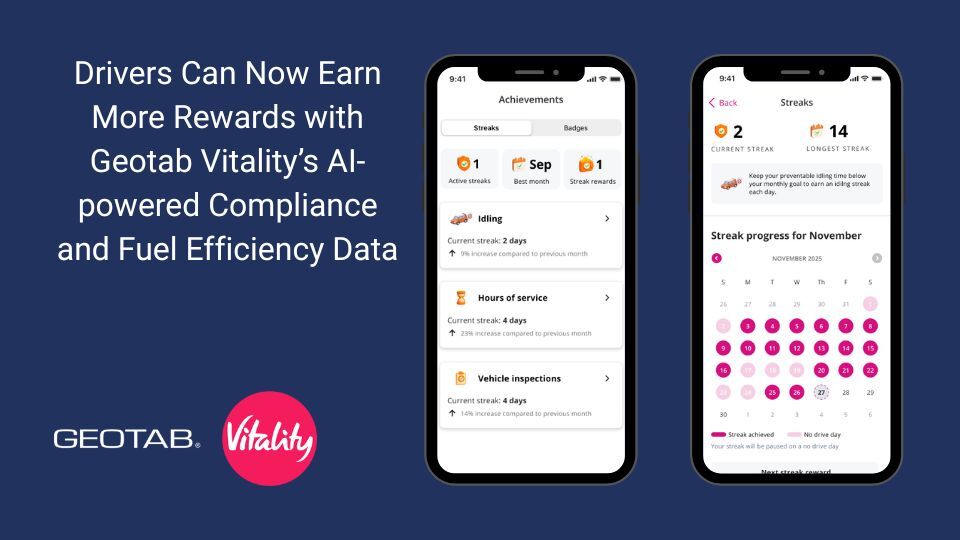
Geotab Vitality was designed to solve the behavior gap - we use positive reinforcement and gamification - like a personalized fitness app, but for safe driving - to engage and motivate drivers, to think about safety every time they get behind the wheel.
- Empower Fleet Drivers: We give drivers simple weekly goals and personalized feedback, and use behavioral science to change how they think - so they begin to want to improve, and to take ownership of their performance.
- Less Oversight. More Impact: This shifts the burden off the fleet manager’s shoulders. Drivers manage their own safety goals, reducing the time spent reviewing reports, chasing down drivers, and having repetitive coaching conversations.
Fleets should still expect compliance with their safety program, but by choosing to reward good habits, they can move from short-term fixes to a sustained, proactive safety culture.
The Science behind Behavior Change
Geotab Vitality combines powerful data and AI, with a deep understanding of human behavior.
Because there are many types of fleets - to generate an accurate risk profile, it’s critical to identify key differences in the data. Geotab Vitality leverages Geotab’s Predictive Collision Risk algorithm, trained on 25 years of insight from nearly 6 million vehicles. The model uses AI to isolate factors that make fleet risk unique:
- Vehicle Type: Data from a transport truck, a sprinter van, or a passenger vehicle needs to be interpreted differently.
- Driving Style: Long haul, mid-mile, and local delivery all have varying degrees of risk.
- Contextual Area Risk: Environmental factors like congestion, road conditions, and weather patterns differ between Northern Canada, rural Texas, and downtown Manhattan.
The algorithm clusters drivers into similar groups, so they’re only compared to their global peers. This increases scoring accuracy, and leads to stronger driver engagement - because it aligns with a driver’s experience on the road.
We then layer in Vitality - a global leader in behavioral science. They bring 25 years of experience in the practice of behavior change, a user base of 41 million customers, and a foundation of over 60 million “life years” of data. Vitality’s technology leverages proven behavioral science techniques, designed to create lasting change:
- Gamification: Game mechanics that increase engagement.
- Nudges: Small changes in the environment that steer decisions, without forcing them.
- Personalized Insights: Identifying a user’s next best action, that will lead to the largest benefit.
- Feedback loops: Providing timely, clear information about performance.
- Incentives: Using rewards to shape behavior.
- And more…
So what does it look like when applied to drivers and fleet safety?
Rewards that Pay for Themselves (and then some…)
Rewarding safe driving is a direct, measurable investment with clear returns - here’s the impact seen by a Geotab Vitality customer - Richards Building Supply

- Real Behavior Change: a 41% improvement in safe driving behavior (achieved in just 60 days), resulting in an 8% reduction in collision risk vs. fleets in their peer group (sustained since Aug. 2025).
- Operational Efficiency: a 2.7% reduction in fuel spend - safer driving is also efficient driving.
- Driver Morale & Retention: an 11.2% improvement in driver turnover - drivers love to feel recognized, and be rewarded for their hard work.
- Savings Fleets can Reinvest: a 443% ROI (net of costs) - translating to over $195K in projected annual savings.
The closing question I’ll leave you with…
So, coming back to - “Why should I reward my drivers for doing their job?” I’d answer with a question of my own - “If you could see further improvement in fleet safety, AND shift some of the effort from fleet manager to driver… wouldn’t that be worth rewarding?”
Let’s stop managing safety in the past tense. Instead, let’s recognize drivers for their efforts, foster a proactive safety culture, and take the final step to move from the repetitive coaching cycle, to a positive reinforcement model that creates lasting change.
In 2026, fleets don’t need more data to improve safety. The real unlock - comes from fostering a culture where drivers want to engage and improve.
Visit Geotab Vitality for more information.
Subscribe to get industry tips and insights
Frequently Asked Questions
The safety ceiling occurs when fleets have invested heavily in telematics, scorecards, and coaching but find their collision numbers have plateaued. Many fleets get stuck in a repetitive coaching cycle where the same high-risk drivers repeatedly appear on scorecards after being coached, because traditional safety programs manage safety reactively rather than creating lasting behavioral change.
Geotab Vitality combines Geotab's Predictive Collision Risk algorithm with Vitality's 25 years of behavioral science expertise to create a positive reinforcement model. The platform uses gamification, personalized feedback, and weekly goals to motivate drivers to want to improve their safety performance, shifting the focus from punishment to rewards for safe driving habits.
Geotab Vitality customers have seen significant measurable returns, with one customer (Richards Building Supply) achieving a 443% ROI translating to over $195K in projected annual savings. This includes a 41% improvement in safe driving behavior, 8% reduction in collision risk, 2.7% reduction in fuel spend, and 11.2% improvement in driver retention.
While coaching, warnings, and penalties temporarily shift driver behavior, they rarely create lasting safe habits and lead to repetitive coaching cycles. Positive reinforcement and rewards create higher levels of improvement by engaging drivers to take ownership of their performance and think about safety proactively, rather than just reacting to past mistakes.
President and CEO of Geotab Vitality
Steve Lockington is the CEO of Geotab Vitality, dedicated to transforming driver safety through behavioral science and advanced telematics.
Table of Contents
- The safety ceiling is real
- Your safety program is working - but it’s also created a hidden challenge
- The debate - the “carrot” vs. the “stick”
- The real challenge - the behavior gap
- The Science behind Behavior Change
- Rewards that Pay for Themselves ( and then some… )
- The closing question I’ll leave you with…
Subscribe to get industry tips and insights
Related posts
.jpg)
Neil Cawse: Sustainability’s pragmatic path — Delivering value today
March 25, 2026
1 minute read

Unified data: The key to fleet liability reduction for government agencies
March 19, 2026
9 minute read


Building a proactive government fleet safety program with data and AI
March 9, 2026
5 minute read

Driving Through the Deluge: How Rain Affects Traffic Speeds Across Major Cities
March 5, 2026
1 minute read

Building a coaching culture: How to end the ‘gotcha’ game in your fleet
March 4, 2026
3 minute read