Total cost of ownership: How to calculate and lower fleet TCO
Knowing the total cost of ownership (TCO) of your fleet vehicles is the difference between guessing at your budget and controlling it. This guide walks through every cost component, how to calculate TCO step-by-step and proven strategies for lowering the total cost of ownership across your organizat

By Laurie Sehl
Jul 16, 2026

Key Insights
- The total cost of ownership (TCO) includes every expense from acquisition to resale, not just purchase price.
- Fleet TCO breaks down into acquisition, financing, running and resale costs like downtime and driver turnover.
- Telematics platforms like Geotab give fleet managers the real-time data needed to calculate and reduce TCO across the entire fleet.
- Strategies like right-sizing, preventive maintenance and route optimization can meaningfully lower the total cost of ownership over a vehicle's lifecycle.
Total cost of ownership (TCO) expenses are often one of the largest bills when it comes to fleet costs. Too many organizations focus only on the vehicle purchase price, but that upfront cost represents only a fraction of the actual expense. Total cost of ownership includes everything from initial acquisition to fuel, maintenance, insurance and eventual resale.
Fleet managers who understand the full picture can make informed decisions that improve ROI and lower their fleet total cost of ownership, all while gaining a clearer view of fleet management KPIs that drive operational performance.
What is total cost of ownership?
Total cost of ownership breaks down the true cost of operating vehicles over their lifetime. The TCO of a vehicle includes the initial cost of the vehicle, the return of funds when the vehicle is sold and all costs that come between buying and selling that vehicle.
TCO fleet management refers to the process of calculating and managing the total cost of ownership across your entire operation, taking into account how fuel, maintenance, downtime, driver behavior and administrative overhead compound
Total cost of ownership formula
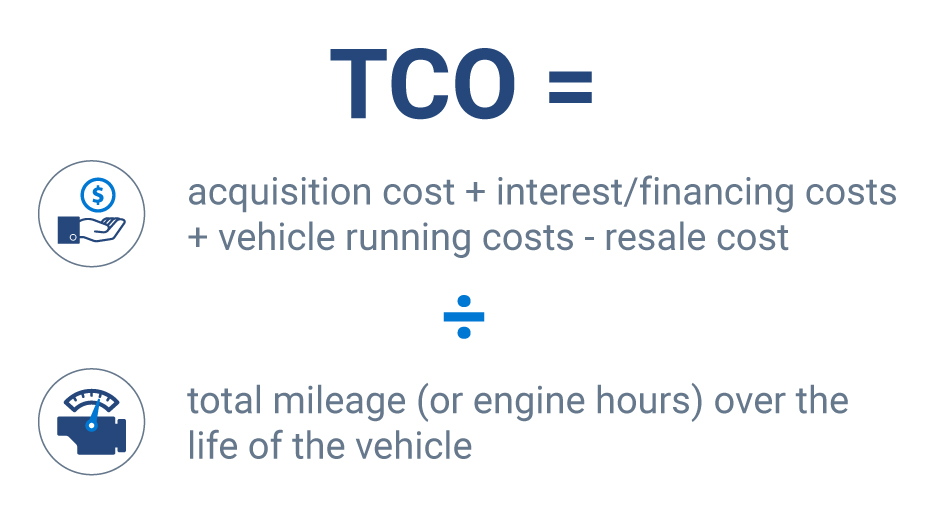
The total cost of ownership formula is straightforward at a high level:
TCO = Acquisition Costs + Financial Cost + Operating/Running Cost + Maintenance Costs + Downtime Costs - Resale Value
Each of these inputs requires its own data set. The more accurate your inputs, the more useful your TCO calculations become for budgeting and vehicle replacement planning. Telematics data from Geotab can automate many of these inputs, removing the guesswork from your formula.
Components of total cost of ownership
Fleet managers who understand what drives total cost of ownership know how to address pricey areas to keep budgets reasonable. These are the key components you should pay attention to:
- Acquisition costs: These costs include the initial vehicle purchase or lease price, upfitting expenses, licensing fees and taxes. This upfront investment represents your single largest expense and can be offset by lowering operating costs over time.
- Financing costs: These costs include interest on loans and opportunity costs of capital tied up in vehicle purchases. What you pay here varies enormously depending on whether you buy or lease your vehicles.
- Fuel expenses: This is one of the highest ongoing costs for most fleets. Small improvements in fuel efficiency lead to compounded savings, especially for larger fleets.
- Maintenance and repairs: This includes proactive maintenance, unexpected repairs and parts and replacement labor costs. Fleet managers can lower these numbers with proactive maintenance to prevent costly breakdowns.
- Insurance premiums: Coverage costs vary by vehicle type, driver safety records, claims history and any risks specific to your fleet. Use telematics data to negotiate for a lower insurance premium and demonstrate clear fleet management ROI.
- Registration and compliance: This covers license plate renewals, vehicle inspections, regulatory compliance and administrative expenses.
- Telematics and fleet management technology: Enterprise-grade telematics devices and fleet management cost-per-vehicle technology is an investment that pays dividends through improved visibility, reduced fuel waste, lower maintenance costs and stronger asset utilization.
The three stages of TCO
TCO analysis follows the same three foundational stages, no matter how many vehicles you manage. Review each stage to get a clearer view of where money flows in and out across a vehicle's life:
- Stage One (Acquisition): This stage covers everything that happens before a vehicle turns a wheel in service: the purchase or lease price, upfitting, taxes, delivery fees and any administrative setup costs. Acquisition typically represents the largest line item in TCO, but it is also the most visible, leading managers to overweigh it.
- Stage Two (Operation): This is the longest stage and often the costliest in aggregate. Fuel, maintenance, insurance, registration, tools, downtime and driver-related expenses all accumulate here across the full ownership period.
- Stage Three (Disposal): The final stage covers what happens when you sell, trade or decommission a vehicle. Resale value, remarketing costs and disposal all factor in. It is important to time disposal before maintenance costs spike (but while residual value remains strong). A proactive fleet replacement strategy helps you identify the right moment to exit each asset.
How to calculate TCO
Understanding the TCO definition is only half the battle. Figuring out how to calculate TCO? That is even more important.
To help you understand how to best calculate vehicle operating costs with the total cost of ownership formula, we have broken everything down into categories. Each category is summarized below with helpful tips for using Geotab’s tools and solutions to enhance data-driven decisions.
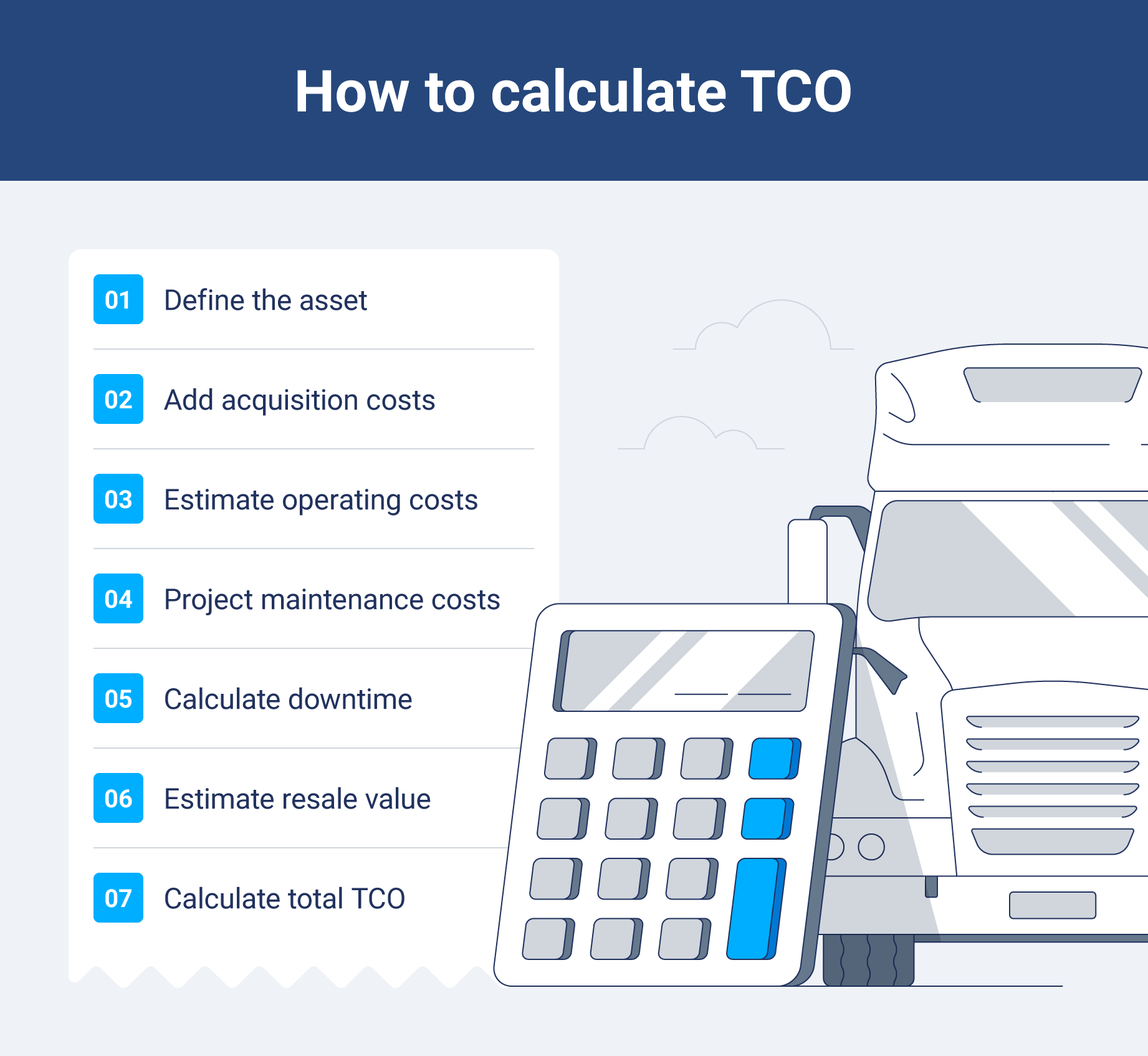
Follow these steps to build an accurate, repeatable TCO calculation for any vehicle in your fleet.
Step 1: Define the asset and ownership period
Start by identifying the specific vehicle or asset class and the expected ownership lifecycle. For example, a five-year horizon for a Class 8 truck or three years for a light-duty service van. This period anchors every subsequent cost estimate.
Step 2: Aggregate all acquisition costs
Collect the full acquisition figure:
- Dealer price
- Manufacturer incentives
- Upfitting (storage, configuration, installation)
- Licensing
- Pre-delivery inspection
- Local and environmental taxes
- Initial tank fill
- Any administrative fees
Step 3: Estimate operations costs using historical data
Pull fuel costs from your vehicle telematics or fuel card records. Project forward based on estimated mileage, current fuel prices and your fleet's average miles per gallon. For fleets without historical data, the ATRI annual trucking cost report provides reliable per-mile benchmarks.
Step 4: Project maintenance costs
Use manufacturer service schedules as your baseline, then layer in your own repair history per vehicle class. Separate scheduled maintenance from unplanned repairs to identify outlier vehicles that inflate your total.
Research shows that typically only 20% of equipment makes up for 80% of production output and business risk. Identifying and maintaining assets with a strong TCO analysis can reduce unplanned downtime by 40% to 60% and extend asset lifecycles by up to 50%.
Step 5: Quantify downtime
Estimate the number of days each vehicle type is out of service annually, then assign a dollar value based on lost revenue or productivity per day. Downtime is one of the most underreported components of total cost of ownership, yet it directly impacts your bottom line every time a vehicle is sidelined.
Step 6: Estimate resale value
Use industry benchmarks such as Black Book or NADA Guide to project residual value at the end of your ownership period.
Factor in:
- Mileage
- Condition
- Brand and current market demand for your vehicle type
High-mileage commercial trucks depreciate faster than light-duty vehicles.
Step 7: Finalize the calculations
Combine all cost inputs and subtract the projected resale value.
Once calculated, compare results across vehicle makes, models or vendors to inform your next purchase or lease decision. Use the trucking cost per mile calculator to translate your total TCO figure into a per-mile benchmark you can track over time.
What costs to include in a TCO calculation
You understand how to calculate TCO, but before you start with your equations, you will need to understand what costs you should include.
Hidden fleet ownership costs
Beyond the obvious line items, several costs regularly go untracked and can add up quickly. Fleet managers should account for:
- Vehicle downtime: Lost productivity when assets are out of service
- Administrative labor: time spent scheduling, reporting and managing compliance
- Compliance costs: Includes ELD mandates, DVIR requirements and DOT inspections
- Collision-related expenses: Such as repairs, insurance increases, legal costs — video telematics can help reduce collision risk and associated costs
- Driver turnover: Recruiting, onboarding and training replacement drivers
- Excessive idling: Fuel burned without productive output
- Fuel theft: A measurable but often overlooked cost for large fleets
- Underutilized vehicles: Assets sitting idle still generate depreciation and insurance costs
Vehicle acquisition costs
The more options added to the vehicle, the higher the cost. This is why it is important to consider the value of these added options to the business and the resale value of the vehicle.
Acquisition usually includes:
- The dealer’s selling price
- Manufacture concessions or incentives
- Vehicle upfitting costs (storage design, configuration, installation, etc.)
- Licensing
- Pre-delivery inspection
- Local taxes
- Environmental taxes
- Tank fill-ups
- Administration costs
Fleet financing costs
Whether the vehicle is leased or owned, there is a financial burden attached to the asset. This is an important cost to consider, and is the reason why many companies turn to freight factoring for help.
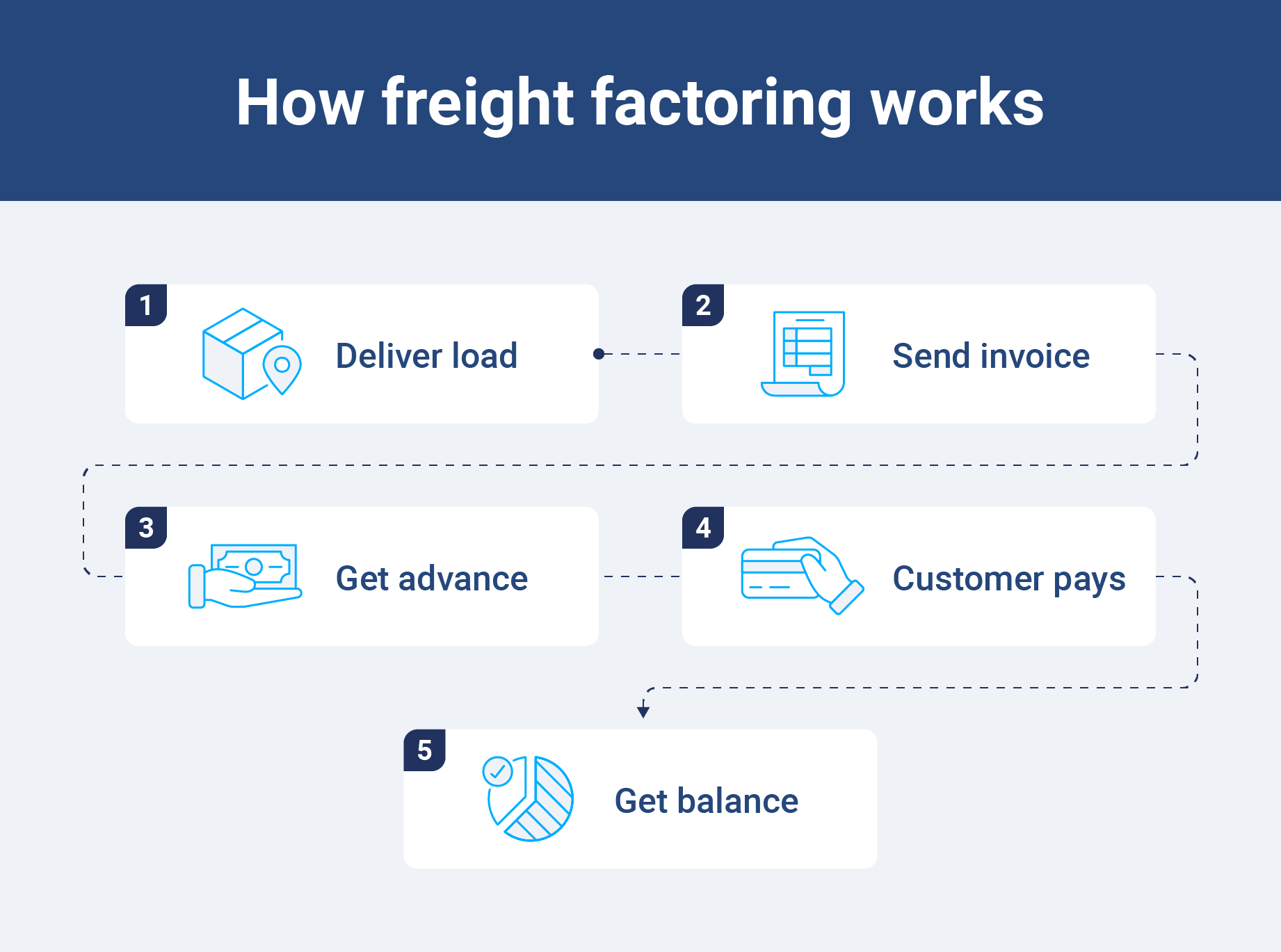
Some companies have a very low cost of capital and may decide to buy their own vehicles, while others like the advantages of leasing or borrowing. Either way, interest costs (or opportunity costs of ownership) and lease administration fees are important costs to consider.
Running costs
The costs of running a vehicle should not be overlooked. Vehicle upkeep and maintenance, as well as general day-to-day expenses, greatly contribute to your cost of ownership.
Running costs include:
- Fuel (gas or electric)
- Scheduled maintenance
- Unexpected repairs
- Scheduled and unexpected maintenance repairs
- Vehicle insurance
- Plate renewals
- Insurance deductibles
- Vehicle repairs
- Car washes
- Tolls
- Tickets
Using a trucking cost per mile calculator provides more accurate data on each vehicle and your fleet as a whole.
Resale costs
When you decide to sell a fleet vehicle, there are generally two factors to consider:
- Which vehicle attracts the highest dollars at the time of resale
- The best mileage, age or time to replace the vehicle
That said, these factors are not mutually exclusive decisions. For this reason, resale value is sometimes not considered when selecting a vehicle. However, it is one of the biggest factors in calculating total cost of ownership.
It is worth consulting the market or accessing professional resale resources to gain a better understanding of the asset's value and the optimal time to replace it.
Example TCO calculation for a fleet vehicle
To illustrate how to calculate the total cost of ownership in practice, here is a simplified example using a Class 8 long-haul truck over a five-year ownership period. All figures are illustrative and should be validated against your own fleet data and current market rates.
| Cost category | Details/assumptions | Estimated costs |
| Acquisition | Purchase price + upfitting taxes + fees | $165,000 |
| Financing | Five-year loan at 7% interest | $31,000 |
| Fuel | 100,000 mi/yr x $0.52/mi avg fuel cost | $260,000 |
| Maintenance and repairs | Scheduled + unplanned, five years | $75,000 |
| Insurance and compliance | Annual premiums + registration x 5 | $45,000 |
| Downtime | Est. 12 days/yr x $1,000/day lost productivity | $60,000 |
| Resale value (deduct) | Estimated residual at year 5 | - $55,000 |
| TOTAL FIVE-YEAR TCO | $586,000 |
Why is calculating TCO important?
Total cost of ownership is a vital part of fleet management and is not something to be ignored. Calculating it correctly means more accuracy in your financial reporting and planning, and a better understanding of each vehicle’s performance in comparison to others in your fleet.
Choosing a reliable vehicle that meets the needs of the job at the lowest possible cost is essential to fleet success. With TCO insights, fleet managers can optimize replacement timing, improve budget accuracy, support telematics data in reducing costs, benchmark performance and increase fuel efficiency.
Example use cases of TCO in fleet management
Understanding how TCO applies in real-world scenarios can help fleet managers make stronger and more strategic decisions. Here are some common situations where total cost of ownership analysis drives better choices.
Electric vs. internal combustion engine (ICE) vehicles
This analysis matters for both ICE and electric vehicles, but it is especially valuable when evaluating the total cost of ownership for an EV fleet.
While EVs usually have higher upfront acquisition costs, the total cost of ownership often proves lower over the vehicle’s lifecycle due to lower fuel costs, reduced maintenance expenses, longer vehicle lifespan and potential federal incentives like rebates and tax credits.
However, TCO calculations must also account for investing in charging infrastructure, battery degradation and operational patterns since EVs work best on predictable routes.
| Use case | EV | ICE |
| Acquisition cost | Higher upfront | Lower upfront purchase price |
| Fuel/energy cost | Lower per mile than diesel | 60% to 100% more expensive than EV and volatile; subject to fuel price swings |
| Maintenance cost | Lower due to fewer moving parts | Regular oil changes, transmission, exhaust components |
| Incentives | Federal and state credits may apply | Limited incentives |
| Best use case | Predictable urban and suburban routes | Long-haul, variable routes, regions with limited charging infrastructure |
Small vs. large fleet budgeting
Total cost of ownership scales differently depending on fleet size.
Small fleets (under 50 vehicles) should adjust their approach to TCO because they:
- Often lack dedicated fleet management staff, making simple TCO tracking essential
- May not have negotiating power for volume discounts on insurance or parts
- Should focus TCO efforts on the highest-impact cost categories like fuel and preventative maintenance
Large fleets (hundreds or thousands of vehicles), on the other hand, should focus on:
- Incremental TCO improvements that compound into substantial savings
- Investing in specialized TCO analysis tools and dedicated fleet management staff
- Leveraging better rates on financing, insurance and bulk purchasing
| Key feature | Small fleet budgeting | Large fleet budgeting |
| Staff resources | Often, no dedicated fleet manager | Dedicated fleet and finance team |
| Negotiating leverage | Limited volume discounts | Bulk pricing on parts, fuel and insurance |
| TCO focus areas | Fuel, basic maintenance, right-sizing | Compound savings, lifecycle optimization, data analytics |
| Technology investment | Simple telematics and cost tracking tools | Enterprise fleet management platform and dedicated analytics |
How telematics helps calculate TCO
Geotab’s telematics platform helps fleet managers calculate vehicle operating costs with greater accuracy. It can also identify opportunities to lower TCO with fuel optimization, maintenance cost reduction and asset usage by revealing which vehicles are underused.
Specifically, Geotab's vehicle telematics platform supports reducing the total cost of ownership by:
- Automating fuel consumption tracking and identifying idling and inefficient routing patterns
- Delivering engine diagnostic alerts that enable proactive maintenance before repairs become costly
- Tracking utilization rates so that underperforming assets can be identified and right-sized
- Providing driver behavior data like harsh braking, rapid acceleration and speeding that directly affect fuel use, wear and insurance costs
- Generating per-vehicle cost reports that feed directly into your TCO formula
Telematics also supports lowering the total cost of ownership at the fleet level by revealing patterns across vehicles that would otherwise require hours of manual analysis. For waste management fleets, for example, telematics-driven cost reduction has demonstrated measurable impact on fuel and operational efficiency.
The fleet telematics safety and efficiency guide explores how connected data visibility transforms fleet operations from reactive to proactive, a shift that directly impacts every line item in your TCO calculation.

How fleets can lower the total cost of ownership
Knowing your current TCO only helps if you act on the insights. Here are some practical strategies fleet managers can implement to lower their total cost of ownership.
Use the right-sized fleet
Identify and eliminate unused vehicles that drain resources. Fleet managers should match vehicle size and capabilities to actual job requirements rather than operating oversized assets on lighter-duty routes. Telematics data identifies opportunities for vehicle savings by surfacing utilization rates across the fleet.
Implement preventive maintenance programs
Schedule maintenance based on engine diagnostics and usage instead of arbitrary time intervals. Addressing small issues before they escalate and tracking maintenance costs per vehicle helps managers identify problematic assets before they become money pits.
Monitor and improve behavior
Coach drivers on fuel-efficient driving techniques like reduced idling and smooth braking. Use Driver Safety Scorecards to identify high-risk drivers who increase insurance premiums. Recognizing and rewarding safe, efficient drivers encourages positive behavior across the fleet.
Driver behavior is also one of the leading contributors to collision-related expenses. Collision reconstruction data helps managers identify patterns that lead to incidents and address them through coaching, reducing both human risk and the financial impact on TCO.
Optimize routes and operations
Use route optimization software to cut back on unnecessary mileage. Adjusting vehicle deployment to match capabilities with actual operational needs avoids both overuse and underuse of fleet assets.
Turn TCO insights into smarter fleet decisions
Calculating the total cost of ownership gives fleet managers the full financial picture of vehicle investment. These numbers are necessary to optimize spend and operations, but the true value of TCO comes from acting on those insights. Modern telematics platforms make TCO management practical by automating data collection.
Ready to gain control over your fleet’s total cost of ownership? Geotab’s fleet safety solutions, like Geotab Drive, provide the foundation for understanding and reducing TCO with real-time monitoring, predictive maintenance and driver behavior insights.
Subscribe to get industry tips and insights
Frequently Asked Questions
The five most important elements of TCO for fleet vehicles are:
- Acquisition cost (purchase or lease price)
- Fuel expenses
- Maintenance and repair costs
- Insurance premiums
- Depreciation/resale value
Together, these represent the majority of lifecycle expenses for fleet vehicles.
Common TCO mistakes include:
- Focusing on only purchase price while ignoring lifecycle costs
- Failing to track maintenance and fuel consumption per vehicle
- Replacing vehicles too early or too late
- Not accounting for driver behavior
Failure to account for all of these factors can lead to poor vehicle selection and missed cost optimization opportunities.
Upfront cost is the initial purchase price or down payment required to acquire a vehicle. Total cost of ownership, or TCO, encompasses all of the expenses incurred throughout the vehicle’s lifecycle, from acquisition through disposal.
To calculate the total cost of ownership, define your ownership period, then aggregate these cost categories: acquisition, financing, fuel, maintenance, insurance, compliance and downtime. Subtract the projected resale value at the end of the ownership period. The resulting figure is your TCO.
Cost per mile (CPM) is the total cost of operating a vehicle divided by the number of miles driven over a given period. It is one of the most useful metrics for benchmarking fleet efficiency and comparing vehicles.
Vehicle downtime increases the total cost of ownership in two ways: directly through repair and part costs and indirectly through lost productivity. Every day a commercial vehicle is out of service represents a revenue or service capacity that cannot be recovered. For high utilization, a single vehicle out of service for a week can cost thousands in lost productivity.
Laurie Sehl is Global Account Manager for Geotab.
Table of Contents
- What is total cost of ownership?
- The three stages of TCO
- How to calculate TCO
- What costs to include in a TCO calculation
- Example TCO calculation for a fleet vehicle
- Why is calculating TCO important?
- Example use cases of TCO in fleet management
- How telematics helps calculate TCO
- How fleets can lower the total cost of ownership
- Turn TCO insights into smarter fleet decisions
Subscribe to get industry tips and insights
Related posts
Best construction fleet management software: Features, platforms and buying tips
September 9, 2026
7 minute read
Best software for small trucking companies: 5 tools to streamline your fleet
September 4, 2026
4 minute read

Driver risk management: How public fleet managers save time with smarter video tools
September 2, 2026
3 minute read

How video telematics helps drivers trust the safety program
August 27, 2026
4 minute read