Why you need AI in your fleet operations
Your teams make hundreds of maintenance, safety and dispatch calls a week. See how fleet AI ranks what needs attention first and how to measure the return.

By Geotab Team
Oct 29, 2026
Key Insights
- With accurate, detailed vehicle data behind it, fleet AI can show teams what needs attention, what's likely to happen and what to do next.
- Before adopting AI, leaders want outcomes proven in fleets like theirs, alerts their teams can trust and a connection to the tools they already use.
- The return is easiest to prove when you pick one cost, record a baseline and track it.
Fleet costs appear in your quarterly numbers as maintenance spend, insurance premiums, labor and new vehicle purchases. The decisions behind those numbers happen much earlier, in maintenance schedules, coaching plans and dispatch boards, often made by teams who don't have time to review everything.
When a truck breaks down on the way to a job, the repair is only part of the cost. Someone pays for the tow, the driver is delayed, the customer waits, and the rest of the day’s jobs get pushed late and finished on overtime. Collisions work the same way: a claim is the cost everyone sees, but the vehicle sitting off the road for repairs and the driver who can’t work cost money too.
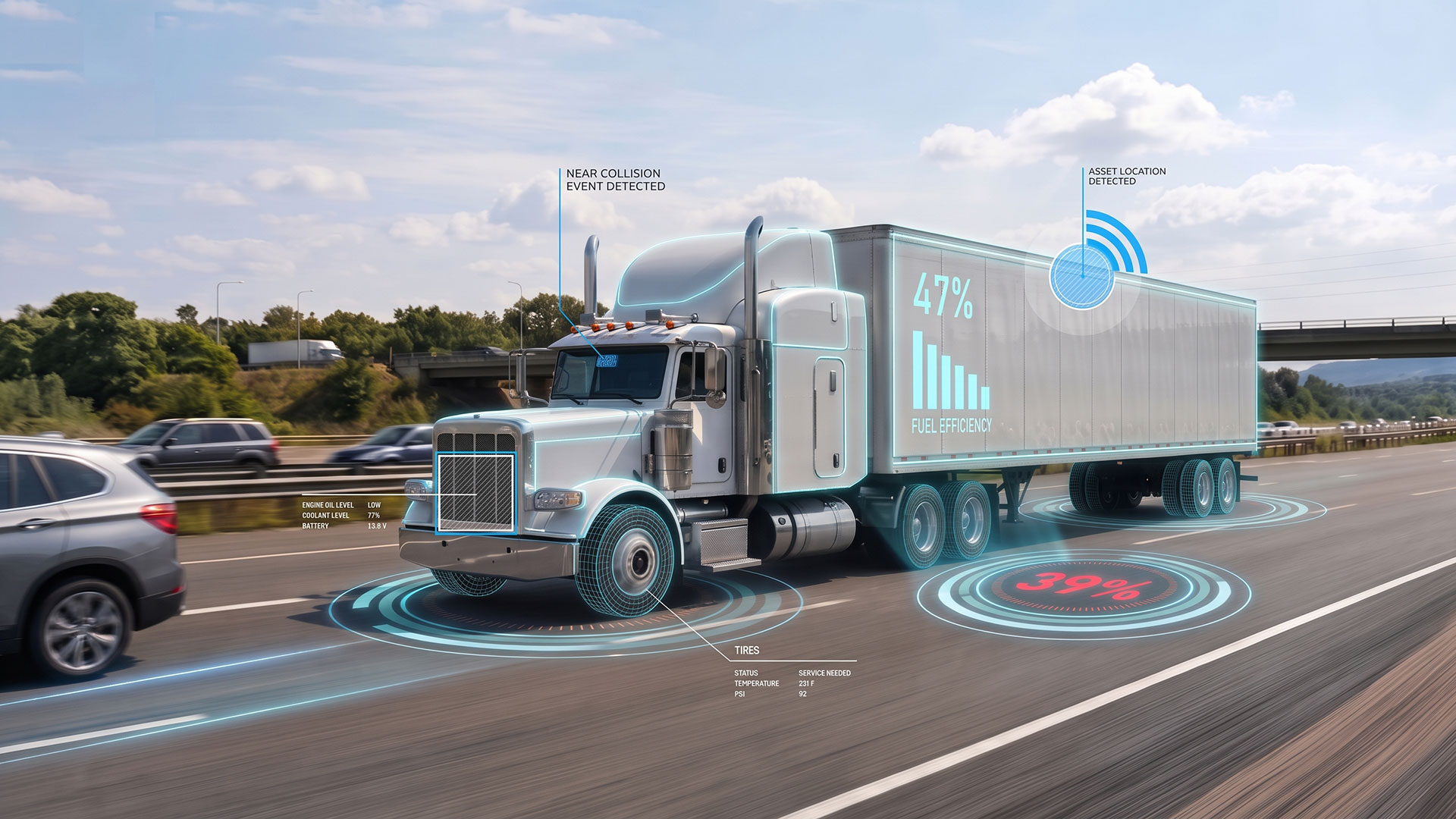
That's where fleet AI comes in. It helps your teams see which problems carry the most risk and act on those first. It can show what needs attention now, predict what's likely to happen next and recommend what to do about it. How far you can trust those predictions depends on the data behind them. The more accurately it's recorded and the more of it the models learn from, the more reliable the outcomes.
Fleet AI and data for maintenance, safety, routing and electrification
Fix vehicles before they break down
Fleet maintenance teams schedule service at set intervals and respond to warning lights. Some problems develop between visits, before a warning light appears.
Fleet AI uses machine learning to rank faults by predictive breakdown risk and can catch problems before they trigger a fault code. Your maintenance team can then bring those vehicles in for a planned repair, which is easier to budget than an emergency one. Fleet AI can track unplanned downtime automatically by detecting tows and service center visits, so you can see whether it's dropping.
What to measure: unplanned downtime and repair costs.
Coach drivers before a collision
Driver safety scorecards show who sped or braked hard last month, but they don't always show who's most likely to be in a collision next.
Machine learning can forecast that risk from driving behavior and road conditions. In Geotab's internal validation, its Collision Risk model was 20% more effective than a traditional safety scorecard at identifying the top 10% of drivers at highest risk. Your safety managers can coach those drivers first, using video of specific events where cameras are installed. The risk reports and coaching records also give you documentation to share with your insurer.
What to measure: collision rates, claims and time vehicles spend off the road.
Adjust routes for traffic, cancellations and urgent jobs
Routes planned the night before often change by mid-morning. A job cancels, traffic backs up or an urgent request comes in. Re-planning by hand takes dispatcher time, and the delays turn into overtime.
Routing that draws on live fleet data can re-plan the affected routes as soon as something changes. It weighs labor costs, technician skills and the value of each job (not just distance) and sends the updates to drivers' phones. Managers can also get an alert when a vehicle has a critical fault, so they can pull it from the plan before dispatch assigns it a route. Your dispatchers handle the exceptions instead of rebuilding the day, and your teams can complete more jobs with the same drivers and vehicles.
What to measure: overtime, fuel spend, jobs completed per day and missed appointments.
Plan electrification as a capital decision
Replacing vehicles with EVs is one of the largest capital decisions a fleet makes. An EV assigned to a route longer than its range has to charge during the day, which adds cost and downtime the business case didn't plan for.
An analysis of your fleet's trip data shows which vehicles are suited to electric replacement, based on the routes they drive, vehicle type, range and local conditions such as temperature and speed. It also estimates lifetime total cost of ownership and emissions reductions, and shows where vehicles will need to charge, at work or at home. That gives your finance and fleet teams a replacement plan they can budget.
What to measure: total cost of ownership, fuel and energy spend and emissions.
What slows fleet AI adoption
Fleet operations and safety leaders tend to raise the same concerns before they commit to AI.
- Unproven technology – Fleet leaders want results from real fleets, not experimental features. Models trained on years of data from millions of vehicles have seen more makes, routes and conditions than any single fleet's history.
- Too many alerts – When AI flags everything, teams stop acting on it. The value comes from fewer alerts, ranked by risk and tied to a specific vehicle or driver.
- Competing priorities – Leaders are balancing cost, safety, compliance and emissions targets, often across several regions. AI is easier to justify when the same data supports all of those goals, rather than one tool per problem.
- No data science team – Not every fleet team has data scientists on staff. Predictions should arrive ready to act on, inside the tools teams already use, without anyone building models or reports first.
- Lock-in – Some platforms keep the AI and the data inside their own system. Fleet data should also flow into the reporting, finance and AI tools your organization has in place.
- Security and governance – Fleet data includes driver behavior and vehicle locations, and boards and legal teams want to know how AI models are built. Data should be protected by independent certifications and anonymized before it's used to train models, and providers should follow a recognized responsible AI framework.
The most convincing answer to many of these concerns is a result from your own fleet.
How to measure the ROI of fleet AI
Pick one cost from the areas above that you can measure today, such as unplanned downtime or collision claims. Agree on the metric before rollout, record where it stands, then track it as your teams act on AI recommendations. That gives you the ROI of fleet AI in your own numbers, and one proven result makes the case for expanding to the next area.
Getting started with Geotab Intelligence
Geotab Intelligence is the data and AI layer across the Geotab platform, spanning maintenance, safety, routing and electrification. Data comes straight from the vehicle and is checked and paired with real-world details, such as road conditions and maintenance history, before the models use it.
Models are built on data from 6M+ connected vehicles and 37T+ data points a year. Geotab also brings 26+ years of fleet expertise. Teams see predictions inside MyGeotab and can ask questions about their fleet with Geotab Ace. Data and IT teams can send the same data to their own tools through the Geotab Data Connector and APIs, or connect it to AI assistants such as ChatGPT and Claude through the Geotab MCP Connector.
The platform is backed by ISO 27001 and SOC 2 Type II certifications, and Geotab's AI practices align with the NIST AI Risk Management Framework, as outlined in our Responsible AI commitment.
See how Geotab addresses the concerns raised earlier, from how data is collected and checked to who in your organization can access it. Learn more about Geotab Intelligence.
Subscribe to get industry tips and insights
Frequently Asked Questions
AI fleet management uses vehicle and driver data to rank what needs attention, predict problems such as breakdowns and collisions, and recommend next steps. For example, fleet teams use it to plan repairs and decide which drivers to coach first.
No. AI sorts through vehicle and driver data and identifies the highest risks. Fleet managers can decide what to do about it and spend less time managing data.
Telematics collects data about where vehicles go and how they're driven. AI looks across that data to find patterns, predict what's likely to happen and suggest what to do next.
No. Telematics data on driving behavior and vehicle health is enough to rank breakdown risk and predict collision risk. Cameras add context and video of specific events, which helps with coaching.
Pick one cost that fleet AI is meant to reduce, such as unplanned downtime or collision claims. Record where it stands before rollout, then track it as your teams act on AI recommendations.
The Geotab Team write about company news.
Table of Contents
Subscribe to get industry tips and insights
Related posts

How fleet data gets you from what happened to what to do next
October 27, 2026
4 minute read

How private haulers can help prepare their fleets for new waste management contracts
October 23, 2026
4 minute read

A 95% location rate in 2026: what Geotab brings to rental, leasing and mobility fleets
October 22, 2026
2 minute read


Unlocking more jobs per day: How smart dispatch management improves tech performance
October 13, 2026
3 minute read

Fleet maintenance software for small business: 8 top tools and guide
September 29, 2026
7 minute read