Collision avoidance systems: How fleets prevent incidents and improve safety
As advanced safety technologies evolve, collision avoidance systems have become essential for reducing incident rates and improving driver performance.

Vice President, Connected Car and Platform Solutions
Dec 23, 2025

Key Insights
- A collision avoidance system is a vehicle safety technology that detects and helps prevent potential incidents using vehicle sensors and cameras.
Compared to the rapid evolution of the IT industry, auto manufacturers have traditionally been slower in incorporating advanced safety technology into new models.
Automakers have accelerated their shift toward technology and data in recent years as customer expectations and safety regulations have pushed the industry to innovate faster. This focus isn’t just about enhancing safety. It has also become a competitive race to release the latest safety technology first.
New technology like collision avoidance systems, assisted driving and autonomous driving will help reduce incidents, lessen the severity of injuries and help prevent fatalities.
In this post, we’ll explore how collision avoidance systems and advanced driver assistance systems (ADAS) work, the benefits they deliver for fleets and how to choose a setup to improve safety across your vehicles.
What is a collision avoidance system?
A collision avoidance system is a vehicle safety technology that detects and helps prevent potential incidents using vehicle sensors and cameras. These systems monitor a vehicle’s surroundings, alert drivers to possible hazards and, in some cases, apply braking automatically to reduce impact.
When integrated with ADAS and telematics platforms, they become part of a broader fleet safety strategy that helps managers identify risks and coach drivers with more consistent data.
According to the National Highway Traffic Safety Administration (NHTSA), automatic emergency braking (AEB) alone can save at least 360 lives a year and prevent an estimated 24,000 injuries, showing just how powerful modern collision warning systems can be in protecting drivers and reducing fleet risk.
How collision avoidance systems work
Collision avoidance systems combine detection systems and telematics data to detect and respond to hazards in real time. These technologies continuously monitor a vehicle’s surroundings, analyzing speed, distance and object movement to anticipate possible collisions:
- Visual or audio warnings prompt the driver to slow down or steer away from danger when a threat is detected.
- Automatic braking activates if a collision is imminent to reduce impact.
- Adaptive cruise control adjusts vehicle speed to maintain a safe following distance.
Integration with telematics platforms gives fleet managers visibility into how often these alerts occur, which helps identify risk patterns and improve driver safety programs.
Key components
Modern collision avoidance systems rely on multiple components working together. Radar sensors measure key indicators such as:
- Distance
- Relative speed
Light detection and ranging (LiDAR) provides detailed mapping of nearby objects.
Cameras help identify:
- Lane markings
- Vehicles
- Pedestrians
Control modules process this combined data to decide when to alert the driver or engage braking.
Together, these components create a safety network that helps vehicles detect and respond to threats in every direction.
Real-time data integration
Paired with telematics, collision avoidance data feeds into a larger fleet safety ecosystem. Geotab dashboards display real-time sensor and alert data to track performance and highlight recurring safety issues.
Fleet managers can view event trends, such as frequent forward collision alerts or harsh braking, through driver scorecards to coach drivers and adjust routing or vehicle selection as needed. This data-driven approach turns on-road activity into actionable insights that improve fleet-wide safety outcomes.

Types of collision avoidance systems
A traffic collision avoidance system includes several subsystems that target specific on-road hazards. Each uses a combination of sensors, radar and cameras to detect risks and assist the driver.
Together, they form an integrated network that helps fleets lower incident rates and strengthen overall safety performance.
Forward collision warning (FCW)
Forward collision warning systems alert drivers when the vehicle ahead slows or stops suddenly. Using radar or cameras, they calculate the distance and relative speed between vehicles.
If a collision risk is detected, the driver receives a visual or audio warning, allowing time to react and avoid impact.
Automatic emergency braking (AEB)
Automatic emergency braking activates when a driver does not respond to an imminent incident warning. The system applies the brakes automatically to reduce speed and limit impact severity.
Many fleets pair AEB with forward collision alerts to create a layered safety approach that helps reduce rear-end collisions.
Lane departure warning (LDW)
LDW systems monitor lane markings using cameras mounted near the windshield. When a vehicle begins to drift without signaling, the system issues a gentle steering vibration or audible alert to prompt correction.
This feature helps reduce sideswipe collisions and fatigue-related accidents on highways.
Pedestrian and cyclist detection
Pedestrian and cyclist detection systems recognize vulnerable road users near crosswalks, intersections, and busy city streets. Combining camera and radar data, they identify movement patterns and trigger alerts or braking when a collision risk arises.
This technology helps protect pedestrians, cyclists, and other road users in dense urban environments and prevent collisions.
Benefits of collision avoidance technology
Safety features are playing a stronger role in determining which vehicles rise to the top for new orders. Fleet and safety managers should understand what incident avoidance technologies are available when considering safety strategies and new vehicle selectors and how these tools shape overall fleet performance.
By integrating collision avoidance systems into your fleet safety programs, you can significantly reduce the number and severity of collisions while improving driver behavior and reinforcing accountability.
Collision avoidance systems deliver measurable benefits across every stage of fleet operations, including:
- Fewer on-road collisions and fewer near-miss incidents
- Lower insurance claims and liability costs
- Reduced vehicle downtime and related maintenance expenses
- Improved CSA scores and safety compliance
- Higher driver confidence and retention
The result is a safer, more resilient fleet that not only protects drivers but also supports long-term cost savings and operational efficiency.
How to tell if collision avoidance systems are right for your fleet
Given all the research on incident investigations and the continued increase in distracted driving behind the wheel, how can you afford not to use a collision avoidance system?
Today, fleets have an abundance of options available for real-time safety prevention.
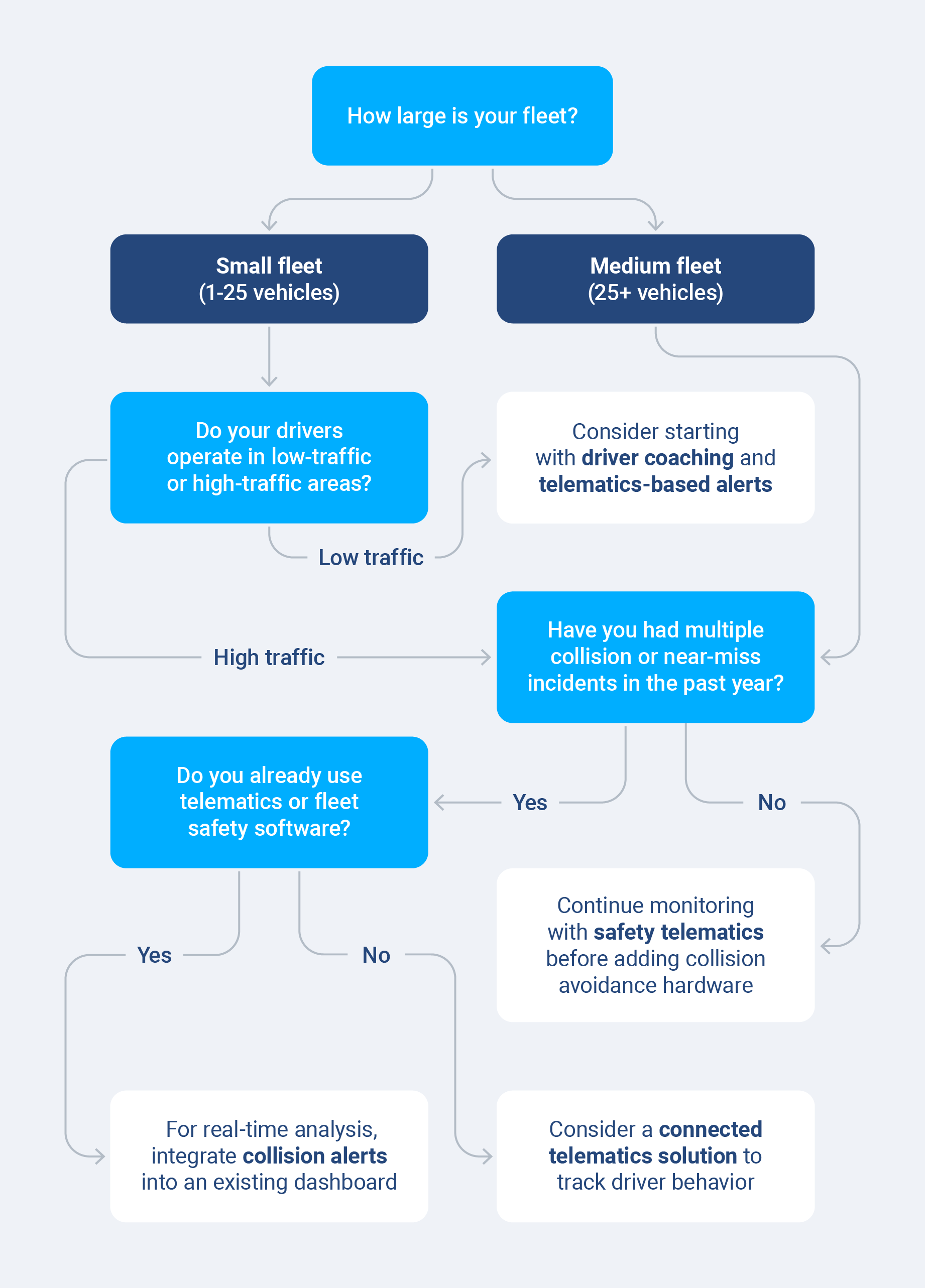
Determining whether to invest in vehicle collision avoidance systems depends on several key factors, including fleet size, driver routes and historical accident data.
Fleets operating in high-traffic regions or managing larger vehicle counts often see the greatest ROI from these technologies.
Start by evaluating your collision trends to identify the vehicles, routes or regions that contain the highest risk. Introducing collision avoidance technology in these high-risk segments first can help establish a measurable performance baseline before scaling fleet-wide.
Pro tip: Use your telematics and fleet safety insights to pinpoint areas with frequent braking, speeding or near-miss events.
This data will help you target where vehicle collision avoidance systems can have the most immediate safety impact. |
Common collision avoidance system integrations and tools
Today’s vehicle collision avoidance systems work best when paired with connected fleet technology. Geotab-compatible solutions help safety managers collect, analyze and respond to driver behavior data in real time.
By combining in-vehicle safety features with robust analytics, fleets can create a closed-loop safety program that continuously improves performance.
Top integrations and tools for connected fleet safety include:
- Driver safety reporting: This tool tracks speeding, harsh braking and collision alerts to identify coaching opportunities.
- AI dash cameras: Dash cameras, like Geotab’s GO Focus Plus, use computer vision to detect risky behaviors such as distraction or tailgating before they lead to an incident.
- Driver coaching: These systems provide real-time feedback to reinforce safer driving habits and positive behavior.
- Collision prediction: This feature uses combined telematics data and predictive models to flag high-risk routes or drivers for proactive intervention.
Fleets like Plastic Express use Geotab’s connected safety tools and reported a 13% decrease in driver safety alerts year over year, highlighting the value of combining collision avoidance system data with telematics insights to prevent collisions.
When fleets align vehicle-based collision avoidance features with data-driven tools, they gain a clearer view of driver performance, reduce operational risk and move closer to achieving long-term safety goals.
Make every mile safer with connected technology
By incorporating new technology and educating your drivers, you move closer to the long-term goal of reducing at-fault collisions and keeping roadways safer for everyone. Through the use of modern safety and telematics tools, there is a safer future on the horizon.
For fleets ready to take the next step, connecting your collision avoidance system with telematics and driver data provides stronger insight into on-road activity. Ensuring your team is fleet safety certified adds another level of safety awareness and accountability. This integration allows fleet managers to detect risk earlier, respond faster and make data-backed decisions that protect drivers and assets.
Explore how Geotab’s fleet safety solutions help fleets strengthen compliance, reduce collisions and improve performance across every vehicle.

Subscribe to get industry tips and insights
Frequently Asked Questions
A collision warning light turns on when your fleet vehicle’s sensors detect a potential hazard or when the system needs maintenance. It can also activate if sensors are obstructed by dirt, ice, or physical damage.
Check for blocked sensors and consult your fleet maintenance provider if the light stays on to confirm the issue.
Radar uses radio waves to detect objects and measure distance, performing well in poor weather and low light.
LiDAR uses laser pulses to create precise 3D maps of surroundings, offering higher accuracy in object detection but reduced performance in heavy rain or fog. Many fleets use a mix of both to improve reliability across different conditions.
Pedestrian detection improves when fleet vehicles combine multiple sensors, including forward-facing cameras, radar, and LiDAR.
Camera systems identify shapes and movement, while radar and LiDAR confirm distance and speed, helping systems recognize pedestrians more accurately and respond sooner.
Vice President, Connected Car and Platform Solutions
Sherry Calkins has been involved in the global Fleet, Mobility and Automotive industry for over 20 years, working both nationally and globally.
Table of Contents
- What is a collision avoidance system?
- How collision avoidance systems work
- Types of collision avoidance systems
- Benefits of collision avoidance technology
- How to tell if collision avoidance systems are right for your fleet
- Common collision avoidance system integrations and tools
- Make every mile safer with connected technology
Subscribe to get industry tips and insights
Related posts

Building a coaching culture: How to end the ‘gotcha’ game in your fleet
March 4, 2026
3 minute read


The Simple Truth: Why Rewarding Safe Driving is Your Fleet’s Smartest Business Decision
February 25, 2026
4 minute read

How to stop wasting mechanic hours on ‘ghost codes’ and low-priority repairs
February 2, 2026
2 minute read

Best dash cams for fleet vehicles to improve driver safety and behavior
January 22, 2026
5 minute read