What is a fleet manager and what do they do?
Learn what a fleet manager does, the skills and tools required for the role and how fleet managers use technology to improve safety and fleet performance.

Senior Partner Account Manager, My Geotab Reseller at Geotab
Aug 27, 2026

Key Insights
- A fleet manager oversees a company's vehicles to keep fleet operations running efficiently.
- Fleet managers use technology and data to optimize fleet performance and support business goals.
- Success in the role requires operational, financial and technical expertise.
- As fleet technology evolves, fleet managers play an increasingly strategic role in improving performance and maintaining compliance.
Behind every on-time delivery is a fleet manager coordinating drivers, vehicles, schedules, and operations to keep goods moving efficiently. Fleet managers balance long-term strategy with day-to-day operations, helping control costs, improve safety, and keep deliveries on schedule. This guide explains what fleet managers do, the skills they need, and how technology can help them operate more efficiently.
What is a fleet manager?
A fleet manager is responsible for overseeing a company's vehicles and the people who operate them. Their role is to help fleets run safely, efficiently, and in compliance with applicable laws and regulations. To achieve those goals, fleet managers typically:
- Manage vehicle acquisition, maintenance, and lifecycle costs
- Develop policies for vehicle use and driver safety
- Monitor driver behavior and fleet performance
- Coordinate driver schedules and vehicle availability
- Help maintain compliance with applicable regulations
Because these responsibilities are closely connected, fleet managers must balance day-to-day operations with long-term planning. Their work helps reduce costs, improve safety, maximize vehicle uptime, and keep the fleet running efficiently.
What is the role of a fleet manager?
As discussed above, fleet managers oversee a wide range of operational and strategic responsibilities. Below is a closer look at the core duties that help keep fleets safe, efficient, and compliant.
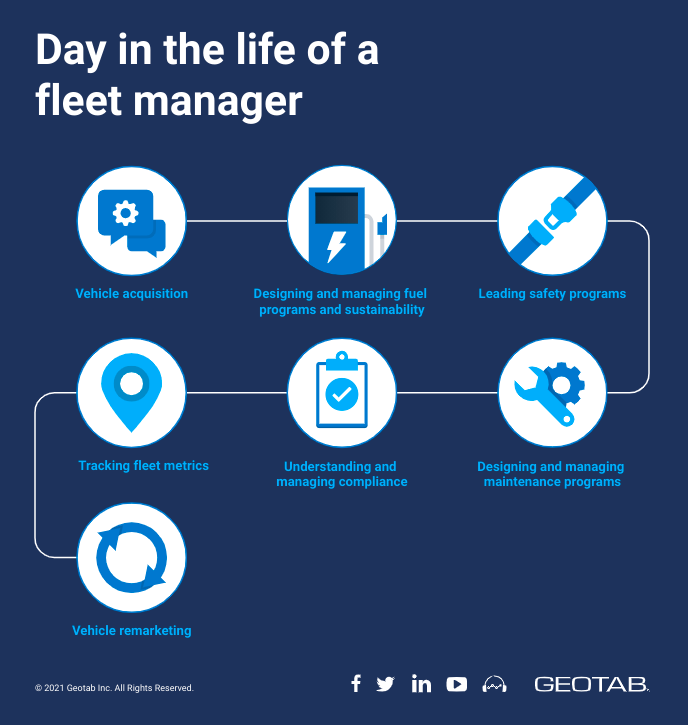
Vehicle acquisition
Negotiating pricing and demands with manufacturers, as well as engineering technical solutions (particularly with trucks and equipment) is an important part of reducing costs.
Designing and managing fuel programs
Fuel makes up the largest portion of a fleet budget. Managing a preferred fuel network, fleet card program and/or on-site fueling with suppliers directly impacts a fleet’s cost per mile. Various tools, including telematics, fuel reporting and gamification influence drivers to purchase fuel according to their policy.
Designing and managing maintenance programs
Fleet managers set preventive maintenance policies based on vehicle type. They also set policies based on vocation and geography. These factors impact driver safety and optimize resale value.
Leading safety programs
Fleet managers are passionate about safety. When an incident occurs, potential negligence and brand damage come with staggering costs to organizations.
Working with the executive team and/or health and safety office, the fleet manager has the responsibility to improve safety within the communities they operate and positively impact the lives and well-being of their drivers.
A program that proactively improves driving behaviors and reduces incidents will also result in reducing fuel and maintenance costs.
Tracking fleet metrics
To monitor fleet activities, fleet managers typically use GPS fleet tracking devices. Their work routine includes reviewing daily, weekly and monthly reports, and measuring performance in areas such as idling, routing, asset utilization, fuel consumption and driver safety.
Understanding and managing compliance
Keeping up-to-date with legislation changes and new regulations allows companies to maintain fleet compliance and avoid heavy fines.
Examples include commercial trucks, buses, vehicles transporting hazardous materials, and trucks used to transport food. Many heavier commercial vehicles conduct driver vehicle inspections and report on them.
Vehicle remarketing
Managing vehicle life and coordinating replacements are important for achieving optimal remarketing value. Keeping the vehicle in a clean, well-maintained condition with all the accessories it was delivered with (extra key fobs, mats, seats, headrests) help sell the vehicle at a better price.
Essential skills every fleet manager needs
While a fleet manager's day-to-day responsibilities vary by organization, success in the role requires a combination of operational expertise, business acumen and technical knowledge. The following skills help fleet managers reduce fuel spend and keep fleets operating safely.
Digital analysis
Knowing how to use software and fleet technology such as telematics and dash cams is critical to tracking performance trends, predicting mechanical failures, minimizing downtime and providing valuable insight into the vehicle’s replacement cycle.
Keeping on top of reports, understanding systems and following up on the insights provided helps when managing assets.
Business management
Maintaining collaborative relationships with both internal and external stakeholders that impact fleet management operations, staying up-to-date with regulatory requirements and company and driver policies helpsavoid fines and maximize safety.
Financial comprehension
Fleet managers are required to create fleet budgets, which requires an understanding of the business, careful analysis and benchmarking within the industry and current economic conditions.
Cybersecurity knowledge
Cybersecurity is an important responsibility for executives, including fleet managers. Fleet managers need to know how to evaluate security requirements when integrating data into the companies' environments, including partnering with key stakeholders who oversee data security and privacy for their organization.
Key metrics that fleet managers watch
Fleet managers track key performance metrics to understand how vehicles, drivers and operations are performing. This helps identify inefficiencies, control costs, improve safety and support more informed fleet decisions.
| Metric | What it measures | Why it matters |
| Vehicle utilization | Asset usage | Improve productivity |
| Fuel consumption | Fuel efficiency | Reduce operating costs |
| Driver safety score | Driving behavior | Lower collision risk |
| Preventive maintenance compliance | Maintenance completion | Reduce downtime |
| Vehicle downtime | Out-of-service time | Improve fleet availability |
| Idle time | Engine idling | Reduce fuel waste |
| Cost per mile | Fleet operating cost | Measure profitability |
| On-time delivery | Delivery performance | Improve customer satisfaction |
What tools do fleet managers use?
Fleet managers rely on a range of technologies to improve visibility, increase fleet efficiency, reduce costs and support regulatory compliance. The right tools simplify day-to-day operations and surface insights for better decision-making.
Fleet management software
Fleet management software centralizes vehicle, driver and asset data in one platform, so managers can monitor performance and optimize operations.
GPS tracking and telematics
GPS tracking and telematics provide real-time visibility into vehicle locations, driver behavior, fuel usage and asset utilization, enabling more efficient fleet operations.
AI dash cameras
AI dash cameras improve driver safety by detecting risky driving behaviors and supporting driver coaching with video evidence.
Fleet maintenance software
Vehicle maintenance software helps schedule preventive maintenance and reduce unplanned downtime by keeping vehicles in optimal condition.
Fuel management tools
Fuel management tools monitor fuel purchases and idling to help fleets control one of their largest operating expenses.
Compliance and reporting software
Compliance and reporting software simplifies regulatory reporting and helps fleets stay compliant with industry and government requirements.
How to become certified as a fleet manager
Professional certification can help demonstrate your expertise and advance your career in fleet management, although it is not required for every role. Depending on the country you live in, there are different programs for becoming a certified fleet manager.
In the U.S., the National Association of Fleet Administrators (NAFA) offers Certified Automotive Fleet Manager (CAFM) and Certified Automotive Fleet Specialist (CAFS) programs. NAFA also partners with the Brazilian light-duty fleet association Instituto PARAR to provide a certification program in South America. Program courses cover topics from management of:
- Assets
- Business
- Finance
- Maintenance
- Information technology (IT)
- Professional development
- Risk management
- Fuel management
How the role of a fleet manager is evolving
Evolving technologies and vehicle types push fleet managers' skill sets to a new level. There is an increased demand for knowledge of technology and data uses, analytics and strategic forecasting. Beyond overseeing day-to-day operations, fleet managers are increasingly expected to use data to make strategic decisions, improve efficiency and support long-term business goals.
As the role continues to evolve, fleet managers should be able to:
- Use analytics and telematics data to optimize fleet performance and support data-driven decision-making.
- Collaborate across departments, working with executives and other stakeholders.
- Adopt emerging technologies, including connected vehicles, AI-powered fleet management tools and electric vehicle solutions.
- Support sustainability initiatives by improving fuel efficiency, and reducing emissions.
- Stay ahead of regulatory changes that affect fleet safety, compliance and vehicle operations.
Top challenges fleet managers face
Fleet managers face a range of challenges as they balance safety, efficiency, compliance, and costs across their operations. While controlling costs, managing fuel expenses, and improving driver safety remain top priorities, today's fleet managers must also adapt to new technology and evolving regulations. Common challenges include:
- Reducing cost: Analyze and make suggestions while taking into account fluctuating vehicle costs, a volatile fuel market and unexpected expenses that arise.
- Minimizing fuel consumption: Managing fuel costs and identifying ways to decrease this expense is critical. Fuel prices are difficult to forecast and make planning a budget challenging.
- Increasing driver safety/productivity: Enabling driver productivity through technology can lead to challenges with driver safety, making driver education on proper uses of technology imperative.
Why fleet managers are more important than ever
MarketsandMarkets, projects the market size of global fleet management will grow to 52 billion by 2027. Fleet managers will continue to play a bigger and more vital role in companies as electrification and OEM and fleet sustainability efforts rise.
As fleets adopt connected technologies, electrification, and sustainability initiatives, fleet managers will play an increasingly strategic role in improving efficiency, maintaining compliance, and controlling costs.
To meet these growing demands, many fleet managers rely on telematics to gain real-time visibility into their vehicles, drivers, and operations. Geotab's fleet management platform helps organizations monitor fleet performance, improve safety, streamline compliance, and identify opportunities to reduce operating costs.
Learn more about Geotab's fleet management solutions and how they can help simplify fleet operations.
Subscribe to get industry tips and insights
Frequently Asked Questions
Fleet management is the process of overseeing a company's vehicles and fleet operations to improve safety, efficiency, compliance and cost control. It encompasses the full vehicle lifecycle, from acquisition and maintenance to performance monitoring, while helping organizations optimize operations through fleet management software and telematics.
Fleet manager salaries vary based on factors such as industry, fleet size, location and experience. While compensation can differ widely, transportation and distribution managers in the U.S. earn a median annual salary of about $102,000, according to the U.S. Bureau of Labor Statistics.
Professional certifications can demonstrate expertise and help advance your career.
In the U.S., NAFA offers the Certified Automotive Fleet Manager (CAFM) and Certified Automotive Fleet Specialist (CAFS) credentials, which cover topics such as asset management, finance, maintenance, fuel management, risk and professional development.
A background in logistics planning provides many transferable skills, including route optimization, scheduling, budgeting and supply chain coordination. To transition into fleet management, build experience with fleet operations, vehicle maintenance, regulatory compliance and telematics platforms.
You can also consider earning a fleet management certification to strengthen your qualifications.
Fleet managers commonly use fleet management software to monitor vehicle performance, GPS tracking and telematics systems to improve visibility, maintenance management software to schedule preventive service, fuel management tools to control operating costs and compliance software to help meet regulatory requirements.
Senior Partner Account Manager, My Geotab Reseller at Geotab
Leanne Johnson is a Senior Partner Account Manager at Geotab. She is constantly focused on fitting customers with fleet solutions that use technology to facilitate data-driven decisions. She is also a contributing author to the Geotab blog.
Table of Contents
- What is a fleet manager?
- What is the role of a fleet manager?
- Essential skills every fleet manager needs
- Key metrics that fleet managers watch
- What tools do fleet managers use?
- How to become certified as a fleet manager
- How the role of a fleet manager is evolving
- Top challenges fleet managers face
- Why fleet managers are more important than ever
Subscribe to get industry tips and insights
Related posts

Lone worker safety for utility fleets: A checklist for the sites beyond cellular reach
August 24, 2026
3 minute read
Five data-driven strategies to optimize your utility fleet management
August 17, 2026
4 minute read
Beyond location: How asset trackers measure equipment utilization
August 4, 2026
3 minute read
Construction fleet management software: What mixed fleets should look for
July 29, 2026
5 minute read

From video archives to active prevention: The case for AI dash cams
July 22, 2026
4 minute read

Closing blind spots in cargo security with a 360 fleet camera system
July 22, 2026
3 minute read