Reefer trailer temperature monitoring: How it works, systems, and fleet benefits
Reefer trailer temperature monitoring uses sensors, telematics and cloud software to track and manage cargo conditions in real time. Read on to learn how these systems work, the different types available and key features to evaluate.

By Geotab Team
Aug 24, 2026

Key Insights
- Reefer trailer temperature monitoring gives fleets real-time visibility into cargo conditions, reducing spoilage and load rejections.
- Modern reefer trailer temperature monitoring systems replace manual checks with automated and more accurate continuous data logging.
- Real-time alerts and telematics integrations allow for faster intervention, improving operational efficiency.
- The best trailer temperature monitoring system should combine reliable sensors, compliance-ready reporting and seamless integration with pre-existing fleet management tools.
When a temperature-sensitive load is rejected at delivery, the financial impact is far greater than a single lost shipment. Lost product, compliance risks and strained customer relationships can add up quickly. But since many fleets still rely on manual checks, there is little opportunity to catch a temperature problem before it escalates.
Reefer trailer temperature monitoring changes that. It gives fleet managers and owner-operators real-time visibility, enabling them to shift from reactive cooling to proactive climate management, improving cargo protection while ensuring compliance. This guide breaks down how reefer temperature monitoring works and how to choose the best solution for your fleet.
What is reefer trailer temperature monitoring?
Reefer trailer temperature monitoring uses sensors, telematics gateways and cloud-based software to continuously track the temperature inside refrigerated trailers during transit and storage. Modern systems do not need to rely on manual driver checks and can instead automatically log and transmit temperature data at regular intervals.
This shift from manual 'clipboard' checks to automated, continuous data logging results in greater accuracy and less room for human error. For fleets hauling food and facing rising regulatory stakes as of 2026, automated reefer-trailer temperature-monitoring systems generate timestamped, continuous records that meet stricter FSMA requirements.
How reefer monitoring systems work
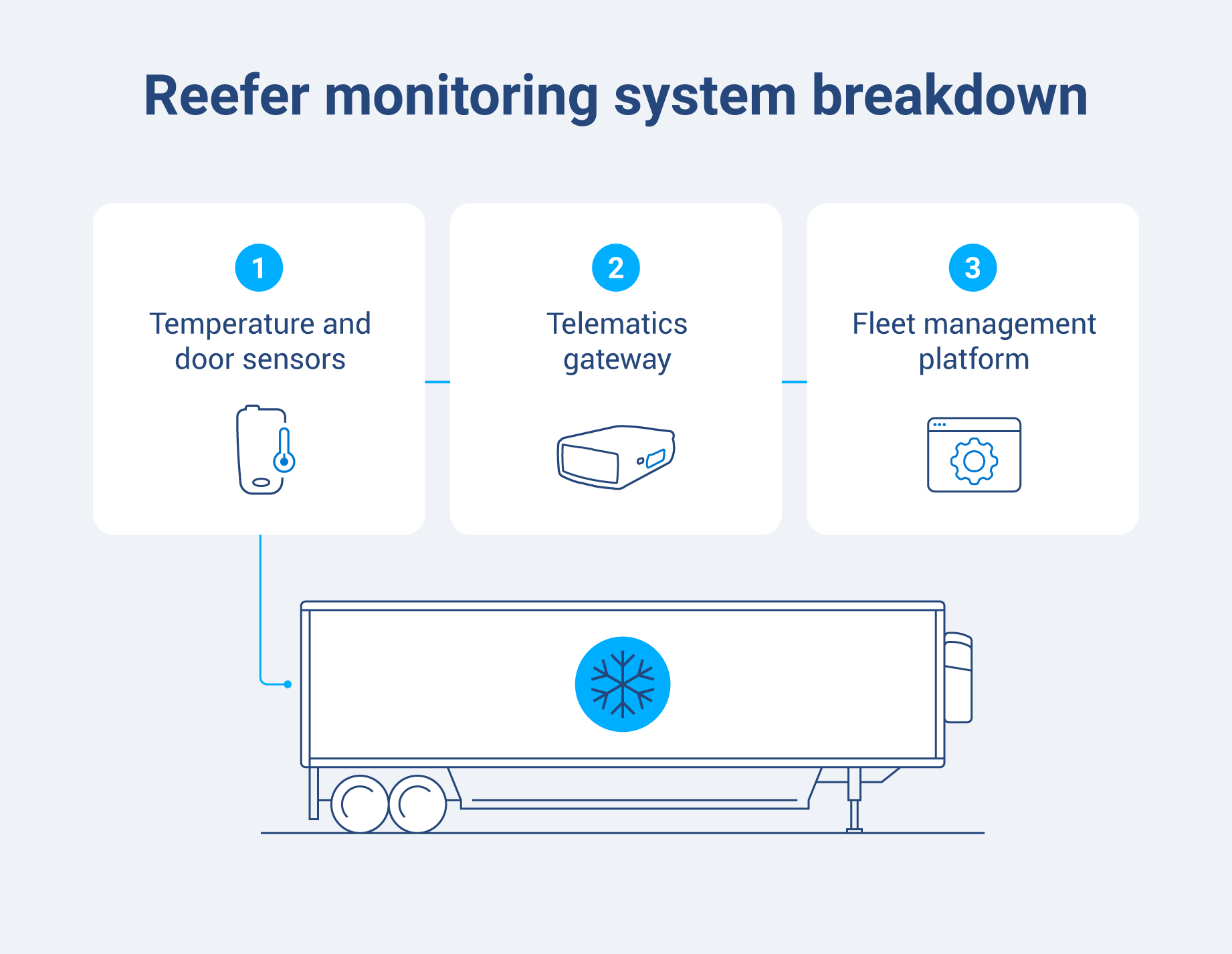
Modern trailer temp monitoring systems combine trailer telematics hardware installed in the trailer with a cloud platform accessible from any device. Here is how each component works together:
- Hardware components: These components include temperature sensors, door-open sensors, and a telematics gateway to capture readings throughout the trailer and transmit them to the fleet management platform.
- Data flow: This is how sensor readings are captured inside the trailer and transmitted through the telematics gateway to the cloud platform for real-time readings.
Power and maintenance: Common power options include solar-powered gateways that reduce maintenance requirements and long-life battery sensors that provide continuous monitoring even when the trailer is unhooked from the tractor.
Real-time alerts and geofencing
Alerts turn monitoring systems from passive record-keepers into active management tools. When something changes in the trailer environment, the right people need to know immediately.
- Threshold settings: Fleet managers configure custom temperature thresholds for each load type so the moment a reading deviates from the set range, an automated alert is triggered.
- Notification process: Alerts are sent via SMS, email or in-platform notification to dispatchers and fleet managers when a unit deviates from its set point, loses power or experiences an unexpected shutdown.
- Geofencing triggers: Geofences around distribution centers and delivery points automatically trigger status updates when a trailer enters or exits a defined area, providing arrival and departure data without requiring a check-in call.
Types of reefer monitoring systems
There are three main approaches to monitoring temperature in refrigerated trailers. Each suits different fleet needs, sizes and compliance requirements.
| Real-time visibility | Alerts | Compliance logs | Cost | |
| Manual temperature monitoring | ❌ | ❌ | Limited | Low |
| Data loggers | ❌ | ❌ | ✅ | Low-Medium |
| Real-time telematics monitoring | ✅ | ✅ | ✅ | Medium-High |
Manual temperature monitoring
Manual monitoring is the most basic approach, commonly used by smaller operations as a fallback method. The driver checks the reefer unit's built-in display and logs the reading, typically on a paper form or digital spreadsheet. This type of visibility is far more limited for fleet dispatch and management teams.
Pros | Cons |
| Low cost | Dependent on driver compliance |
| No additional hardware needed | Difficult to use in audits |
| Simple to implement | Gaps in data between driver checks |
Data loggers
Data loggers are standalone devices that record temperature at set intervals throughout a shipment. Data is downloaded at delivery and reviewed, often as part of food safety program documentation under the Food and Drug Administration (FDA) regulations.
Pros | Cons |
| Affordable | No real-time alerts |
| Provides documented temperature records | Data not available until delivery |
| Widely accepted for compliance | Problems are only found after the fact |
Real-time telematics monitoring
Real-time telematics monitoring is the most advanced and comprehensive option, combining live temperature readings, GPS location data and automated alerting. This is the standard for fleets with active compliance requirements or high-value cargo.
Key features include:
- Live temperature readings
- Automatic alerts for temperature deviations
- Door open/close alerts
- GPS tracking
- Compliance reporting
Several platforms offer real-time telematics monitoring for refrigerated fleets:
- Geotab: Provides an open platform for cold chain management with flexible sensor integration, customizable alerts and compliance reporting, all designed to work with a fleet's pre-existing telematics setup.
- Thermo King: A major refrigeration unit manufacturer that offers its own telematics and data connectivity solutions tied to reefer equipment.
- Carrier Transicold: A leading reefer unit OEM offering connected fleet solutions such as temperature tracking and remote diagnostics for refrigeration systems.
Pros | Cons |
| Real-time visibility for dispatch and management | Higher upfront and subscription cost |
| Immediate alerts enable fast intervention | Requires hardware installation |
| Continuous compliance-ready logs | Cellular connectivity is needed for real-time data |
| GPS and temperature data combined | |
| Supports driver coaching and accountability |
Key factors when choosing a monitoring provider
Before selecting a trailer temperature monitoring system provider, carefully review these critical capabilities against your fleet's operational needs and compliance obligations to make the best investment.
- Real-time alerts: Look for configurable notifications for temperature-out-of-range events, reefer unit shutdowns and door openings, delivered via SMS, email or app.
- Compliance documentation: The system should automatically generate timestamped temperature logs and produce downloadable reports in a format suitable for regulatory audits.
- Sensor accuracy: Precision of ±0.5°F to ±1°F is the industry standard.
- Integration: Open platform systems that connect seamlessly with existing Transportation Management Systems (TMS), ELD solutions and routing software eliminate data silos and reduce manual entry.
- Battery backup: Solar-powered gateways work well for trailers that spend extended time in yards, while long-life internal batteries provide monitoring even when the trailer is unhooked from the tractor.
- Hardware durability: Sensors should be rated IP69 K. It is the standard for withstanding high-pressure power washing and extreme weather conditions.
- Integration depth: Look for systems that support bidirectional data flow so temperature data can trigger workflows in your TMS, alert drivers via mobile apps, and sync with compliance reporting tools.
Offline data logging: Internal sensor memory should log data when trailers travel through cellular dead zones, ensuring no gaps in temperature records.
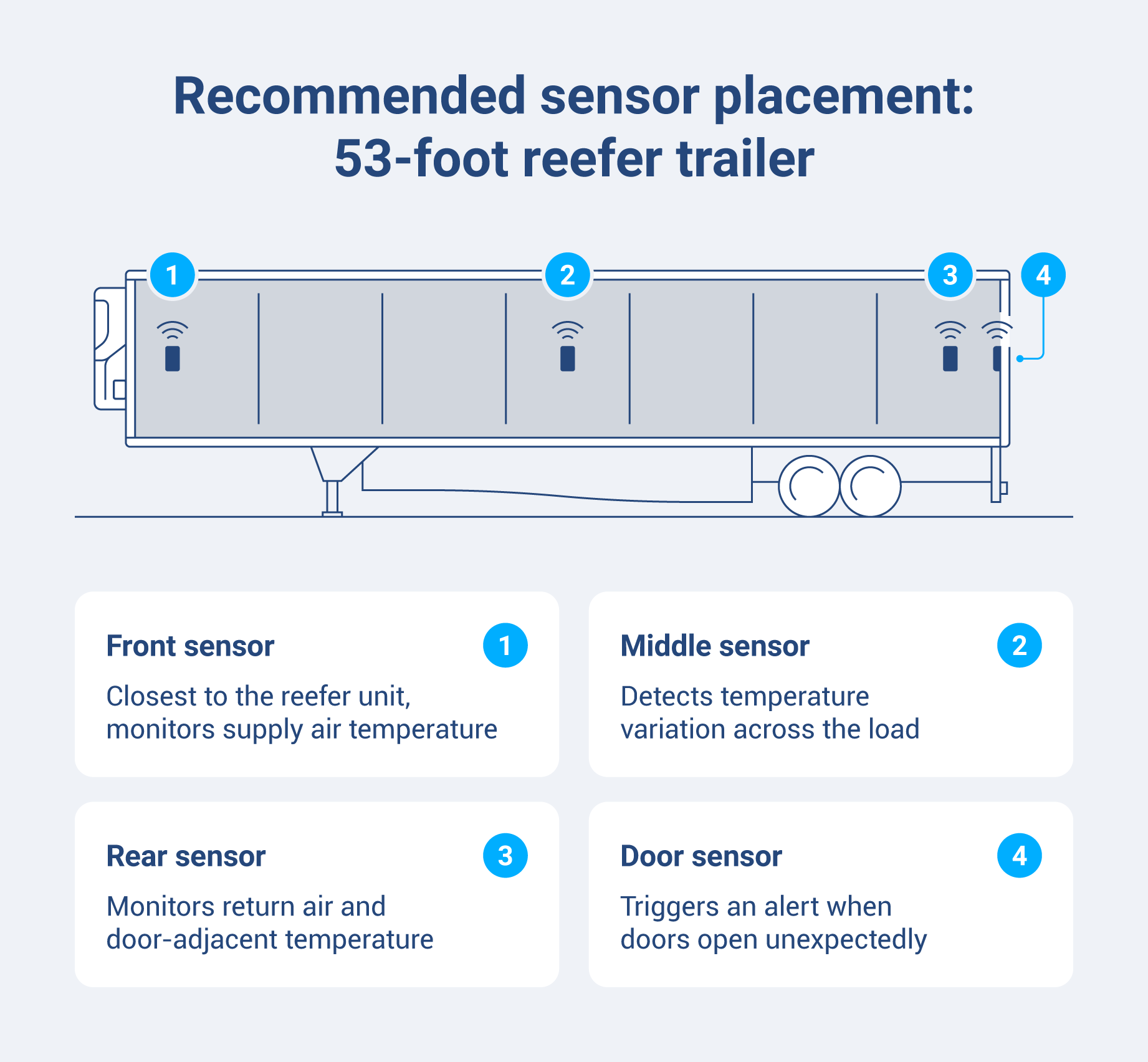
![Cross-section diagram of a 53-foot refrigerated trailer showing recommended temperature sensor placement at the front, middle, and rear of the cargo area.]()
Benefits of reefer monitoring systems
Investing in the right trailer temperature monitoring systems delivers measurable results. Here are the key benefits fleet managers report:
Prevents cargo spoilage
Real-time alerts mean dispatchers have time to intervene before a temperature deviation becomes a full load loss. Early notification is the difference between a reefer unit malfunction or a door left ajar turning into a ruined delivery and a complete load rejection.
Reduces insurance claims
Continuous temperature documentation provides clear evidence of proper cargo handling from start to finish. In the event of a spoilage claim, timestamped logs demonstrate due diligence and can substantiate or refute it.
Helps meet FSMA compliance requirements
FSMA Rule 204 requires shippers and carriers of certain foods to maintain detailed records of temperature conditions during transit. Automated reefer temperature tracking provides continuous, audit-ready logs that manual systems simply cannot, keeping fleets ahead of regulatory requirements instead of scrambling to keep up.
Provides proof of temperature control to customers
Shippers increasingly require carriers to demonstrate documented temperature control as a contract condition. Real-time telematics systems allow fleets to share temperature reports directly with customers, strengthening trust and increasing the odds of contract renewals.
Improves operational visibility
A trailer temperature monitoring system gives fleet managers a centralized view of all refrigerated assets, whether they are in transit, in the yard or staged at a distribution center. Combined with reefer tracking and GPS data, this visibility allows for smarter dispatches and reduces idle time.
Optimize your cold chain
Reefer-trailer temperature monitoring performs best when integrated with a broader fleet management strategy and cold chain monitoring approach. When temperature data flows into the same platform as your ELD data, routing information and vehicle diagnostics, you gain a complete operational picture.
Geotab's open platform approach lets fleets integrate reefer monitoring with their existing telematics setup
Subscribe to get industry tips and insights
Frequently Asked Questions
The ideal temperature range for a reefer trailer depends on the cargo. Fresh produce typically requires temperatures between 34°F and 40°F (1°C and 4°C), while frozen goods require 0°F (-18°C) or below. Pharmaceuticals often have strict ranges defined by the manufacturer or regulatory guidelines. Your monitoring system should allow you to set a custom threshold for each load type.
Yes, you can monitor temperature if the trailer is unhooked from the tractor, but only with the right hardware. Solar-powered gateways and long-life battery sensors are designed specifically to maintain monitoring continuity when trailers are unhooked in a yard or staged at a facility. This provides continuous monitoring even when the trailer is idle or disconnected from the tractor.
Most fleets use at least one sensor per temperature zone. For a standard 53-foot trailer, two to three sensors are common — one near the front, one near the rear and sometimes one in the middle — to detect temperature variations across the cargo area. Your system provider can recommend placement based on trailer configuration and cargo type.
Indirectly, yes, temperature monitoring does help with fuel efficiency. Monitoring data can identify reefer units running harder than they should to maintain a set temperature, which can indicate a maintenance issue, a door-seal problem, or an inefficient loading pattern. Catching these issues early reduces unnecessary fuel consumption and extends equipment life.
Most systems are designed for simple OBD installation or for installation with telematics gateways and can be set up in under an hour per trailer by a trained technician. Wireless sensor designs reduce wiring complexity compared to older hardwired solutions. Ask your provider about installation support and if remote activation is offered.
The Geotab Team write about company news.
Table of Contents
Subscribe to get industry tips and insights
Related posts


Fleet accident management: How to improve safety and reduce costs
September 4, 2026
5 minute read

Driver risk management: How public fleet managers save time with smarter video tools
September 2, 2026
3 minute read

How video telematics helps drivers trust the safety program
August 27, 2026
4 minute read

Lone worker safety for utility fleets: A checklist for the sites beyond cellular reach
August 24, 2026
3 minute read

Before the storm call: Five ways to know your utility fleet is ready
August 6, 2026
3 minute read