Government fleet software: A guide for public sector fleet management
Advanced tools are transforming the ways that public agencies manage their fleets, enabling them to help extend vehicle longevity, improve driver safety and decrease costs.

Aug 4, 2026

Key Insights
- Government fleet software centralizes vehicle spending, maintenance, fuel management and compliance reporting into a single platform.
- Telematics integrations give government fleet managers real-time visibility into vehicle location, driver behavior and diagnostic data.
- Motor pool management and multi-department reporting are essential features for public agencies operating across multiple sites.
- Geotab is trusted by more than one million public sector vehicles worldwide and holds FedRAMP authorization for federal deployments.
Government fleet management software is a digital system that collects, aggregates and displays rich telematics data from department or agency vehicles. Public sector fleet leaders can analyze the insights like fuel consumption and overall utilization to increase fleet visibility, reveal inefficiencies and act on them.
Unlike commercial fleet tools, government fleet software is made to handle the distinct demands of the public sector, like multi-department structures, public accountability requirements and procurement restraints. This article will dive into what government fleet management software is, how it is typically leveraged in day-to-day public sector processes and the benefits.
What is government fleet software?
A government fleet management software is a centralized digital system that gathers and visualizes telematics data from department or agency vehicles. Fleet leaders in the public sector use this data to improve visibility and identify and address inefficiencies.
These solutions track data points like vehicle faults, driving characteristics, fuel consumption and overall utilization, giving you unparalleled visibility into your government fleet.
How is government fleet management software used?
Governments use fleet tracking software and telematics platforms to maintain visibility into vehicle operations and driver behavior. They can use findings from their connected vehicle data to optimize their fleet’s usage, better prevent costly repairs and reduce fuel costs, all while helping employees drive more safely.
Using hardware like Geotab’s GO vehicle tracking device, which actively collects and reports instances of harsh accelerations, jarring braking and excessive idling, driver tendencies behind the wheel can be monitored for safety. Through compatible solution add-ons, drivers can be coached on better driving practices while they are in-cabin.
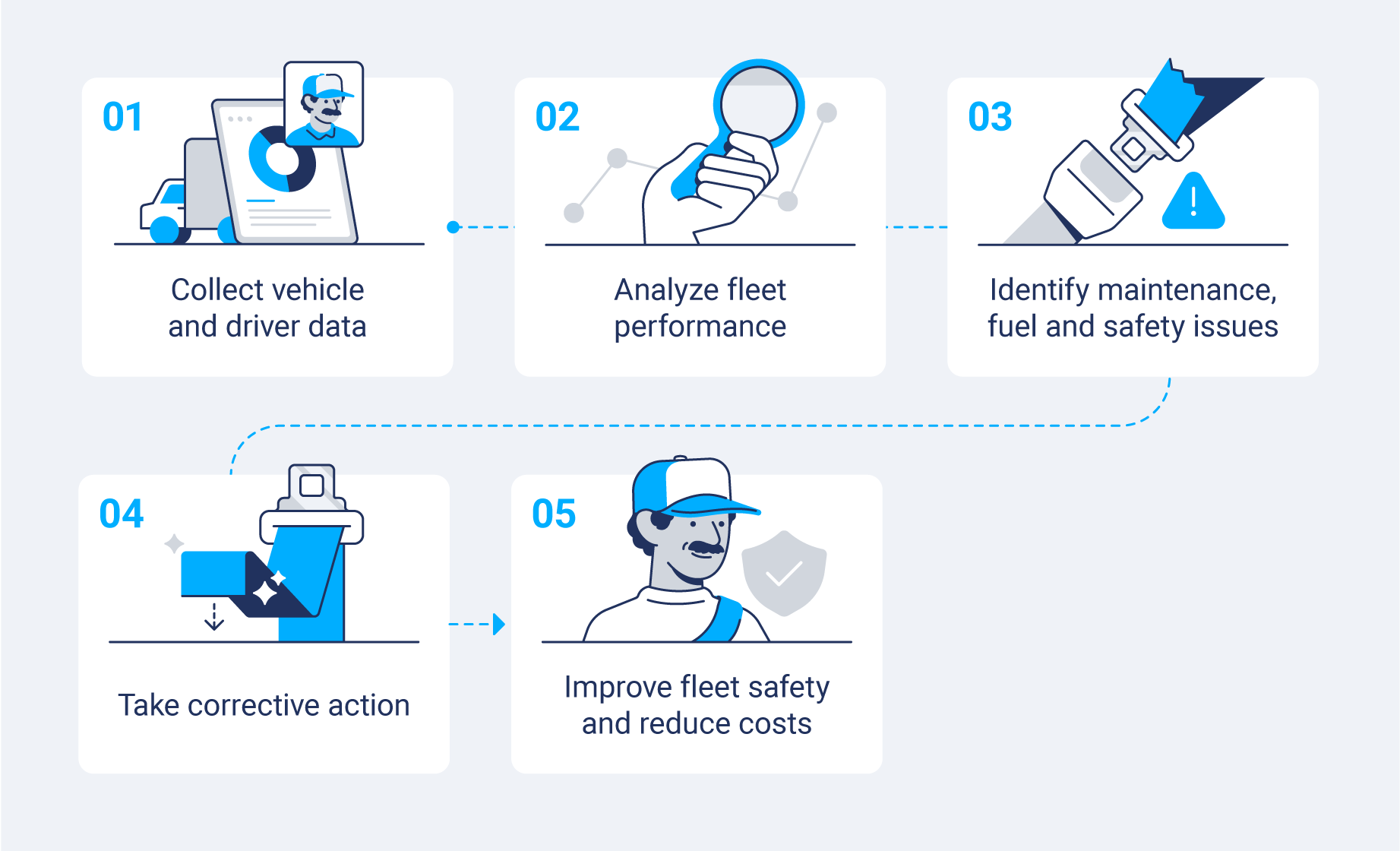
In addition to improving fleet visibility and safety, government telematics platforms can also help reduce fleet management software cost over time by consolidating systems and minimizing the need for multiple data tools across departments.
Learn more: See why we were awarded a sole-source contract with the General Services Administration (GSA) to provide robust telematics capabilities.
Key benefits of government fleet software
Using compliant government fleet tracking solution can solve multiple pressing challenges for your organization within a single platform. Challenges like limited employee accountability, budget overages, safety concerns and inefficient reporting are all solvable with the support of rich telematics data. Several ways include:
Longer vehicle life
By studying data around individual vehicle maintenance schedules, being alerted to mechanical faults and monitoring driving characteristics, you can keep your vehicles in prime condition and extend their longevity.
Providing your vehicles with the right care at the right time with government fleet maintenance software helps you optimize usage and expenditures.
Reduced costs
Save money against your departmental budget by tracking fuel or materials usage accurately. Use detailed data to identify opportunities in your fleet’s processes and cut unnecessary expenses, then reinvest the savings into more impactful areas of operations.
Enhanced safety
Tracking the locations of your government fleet vehicles and the ways they are being driven by employees enables your team to prioritize safety each step of the way in your fleet journey. Use in-cabin coaching to optimize employees’ driving habits and monitor vehicle activity to prevent unauthorized usage.
Optimized reporting
Automating fleet data reports keeps leaders in your agency or department more informed and reduces the possibility of errors affecting key decisions. Scheduled reports that are free of irrelevant information empower your organization’s leaders to study purer fleet diagnostics and reduce day-to-day inefficiencies.
Better public service
Monitoring all your fleet operations with a single government telematics solution alerts your team more quickly to possible risk and issues in your fleet activities. By spotting potential maintenance issues and vehicle usage disparities faster, you can keep your vehicles available and usable for consistent public service.
Meeting sustainability mandates
Many state and federal agencies face formal sustainability targets, from emissions-reduction goals to Electric Vehicle (EV) fleet transition timelines. Government fleet software gives you the data foundation to plan and report against these mandates with confidence.
Key capabilities include:
- Emissions reporting and driver qualification files for regulatory submissions
- Department of Transportation (DOT) inspection records for state-specific compliance documentation
- Federal fleet reporting support, including requirements under the Energy Policy Act (EPAct)
Telematics integration
Connecting GPS and diagnostics data directly into your fleet management platform eliminates the need to toggle between multiple systems. When telematics fleet software works together, managers get a real-time picture of every vehicle showing where it is, how it is being driven and if any maintenance alerts require attention.
Geotab's data visualization tools make it easy to turn raw telematics data into decision-ready dashboards.
When evaluating telematics integrations, look for platforms that support:
- Real-time vehicle location tracking and idle time reporting to identify inefficiencies
- Driver behavior monitoring, including harsh braking and acceleration, with diagnostic trouble code (DTC) alerts for maintenance issues
- Open platform architecture built on open integrations that give agencies the flexibility needed to connect existing hardware and avoid vendor lock-in
Motor pool and vehicle reservation management
Government agencies run shared-vehicle programs where a central fleet of vehicles is available for booking by employees across departments, called motor pool management. Effective motor pool software helps agencies right-size their fleets by revealing which vehicles are being used, by whom and how often.
Strong motor pool features include:
- Online booking systems and automated usage policy enforcement to reduce administrative overhead
- Utilization tracking that identifies underused vehicles, offering a direct path to fleet reduction and cost savings
- Driver's license verification workflows before booking confirmation, supporting safety and liability requirements
Multi-department and multi-site management
Government agencies rarely operate as a single unit. Vehicles are shared across police, fire, public works, parks, utilities and transit departments, often all spread across multiple facilities. Fleet software needs to support this complexity without creating administrative silos.
Essential multi-department capabilities include:
- Role-based access controls so each department sees only the data relevant to their operations
- Department-level cost allocation and inter-department vehicle sharing with chargeback billing
- Consolidated reporting across multiple sites, giving leadership a single view of a total fleet performance
Features required for public sector fleets
Not all fleet management tools are built for the government. When evaluating platforms, prioritize these capabilities. Each addresses a distinct challenge that public agencies face regularly.
- Motor pool scheduling: Motor pool software allows employees to reserve shared vehicles online, reducing manual coordination. Look for automated policy enforcement, calendar-based booking interfaces and utilization reports that show which vehicles are sitting idle.
- Internal chargebacks and markups: Government fleets often need to bill departments for vehicle use. Built-in chargeback billing lets fleet managers allocate costs accurately across internal stakeholders, which is essential for budget transparency and audit compliance.
- Lifecycle costing and replacement planning: Tracking total cost of ownership like purchase price, maintenance history, fuel costs and depreciation gives agencies the data they need to make defensible vehicle replacement decisions and plan capital budgets with confidence.
- Fuel management integration: Connecting fuel card data directly into the fleet platform eliminates manual reconciliation, flags unauthorized transactions and gives managers a clear picture of fuel spend by vehicle, department or driver.
- Public accountability tools: Government agencies are responsible to taxpayers. Features like proof-of-service documentation, GPS-verified route completion, exportable audit logs and citizen transparency maps help agencies demonstrate that public resources are being used responsibly.
Modernize your operations with government fleet software
The right government fleet software gives you the tools to run a more efficient, transparent and accountable fleet, all without requiring a large in-house IT team or complex implementation project.
As the current provider of telematics for over one million public sector vehicles, Geotab is an undisputed leader in government fleet visibility. Get your agency or department on the path to better fleet management with our platform today.
Subscribe to get industry tips and insights
Frequently Asked Questions
The GSA (General Services Administration) Schedule is a long-term government-wide contract that pre-negotiated pricing and terms with vendors on behalf of federal, state and local agencies. When a fleet software provider holds a GSA contract, public agencies can purchase through the vehicle without running a full competitive bid process.
The types of fleet management software used for governments include:
- County governments managing public works, parks, utilities and other municipalities use fleet management
- Police and fire departments with specialized emergency response vehicles
- Transit authorities operating passenger vehicle fleets
- State agencies overseeing motor pools and shared-vehicle programs
- Federal departments with large, geographically dispersed fleets
Fleet sizes vary widely, from small municipalities with 25 to 50 vehicles to state programs managing thousands of assets across multiple departments.
Government fleet software supports compliance by automating the documentation that agencies are required to maintain. This includes digital DVIR records, driver qualification files, DOT inspection logs and emissions data for state or federal reporting.
Yes, government fleet software can integrate with existing telematics and fuel card systems. Geotab is built on an open platform that connects with a wide range of hardware and third-party systems.
The implementation process varies based on the agency's size, the number of departments involved and the complexity of existing systems. Smaller deployments with a single department can go live in four to six weeks. Larger, multi-site implementations with custom integrations and data migrations usually take three to six months.
Content Marketing Manager at Geotab
Table of Contents
Subscribe to get industry tips and insights
Related posts


Top seven best fleet fuel cards: How to choose the right one for your business?
October 1, 2026
7 minute read

Four ways to transform garbage fleet efficiency with data and video tools
September 28, 2026
4 minute read

Why the OEM versus device-level telematics debate misses the point for mixed-fleet operators
September 25, 2026
2 minute read

6 benefits of an open, AI-powered fleet data platform
September 17, 2026
8 minute read