How to start a trucking business: Step-by-step guide for owner operators
This guide walks through how to start a business, explaining the licensing, registration and funding steps required to launch and run a fully compliant operation.

By Geotab
Oct 28, 2026

Key Insights
- Starting a trucking business begins with a solid business plan, federal registration through the FMCSA and the right legal structure.
- New carriers need a USDOT number, an MC operating authority and a CDL before hauling freight for hire.
- Startup costs vary depending on the type of equipment you invest in, insurance and registration fees.
- Owner-operators who track costs per mile and diversify their customer base often build a more resilient business.
Trucking moved more than 72.7% of domestic freight tons in the United States, and demand for reliable carriers only continues to climb. For drivers with commercial experience looking to start a trucking business, learning how to write your business plan and invest in the correct equipment is the first step.
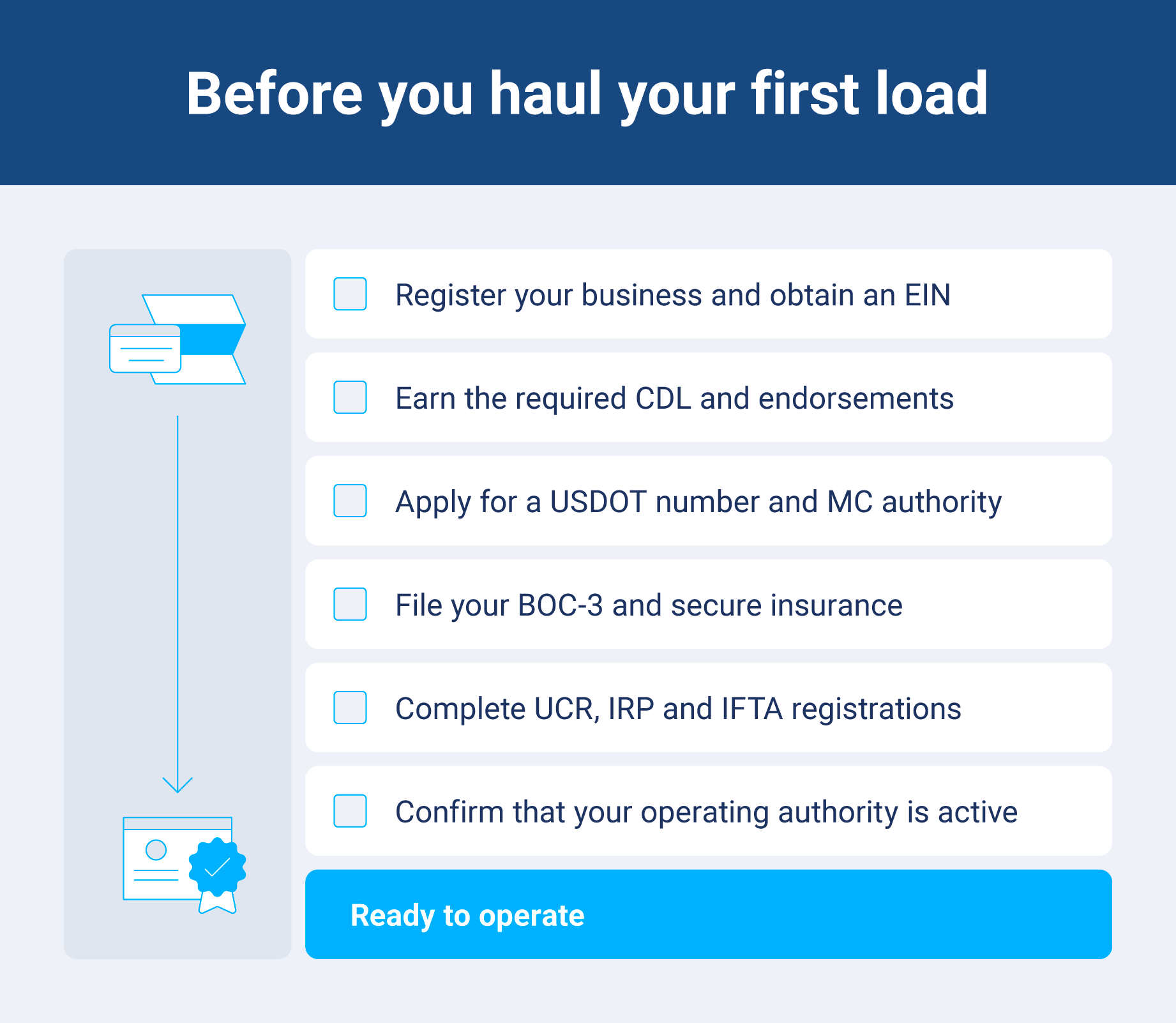
New owner-operators must address core requirements, including business registration, insurance, licensing and equipment funding. This guide explains how to start a trucking business owner-operator style. Some steps run in parallel. But steps like insurance shopping need to start well before the truck purchase closes.
1: Write a business plan
A written business plan is how an idea turns into a working roadmap. Strong plans should include:
- An executive summary
- A target freight niche, such as dry van, refrigerated, flatbed or less-than-truckload
- A revenue model
- A startup cost estimate
- A competitive analysis
- A break-even projection
Lenders, investors and freight factoring companies request this document before approving financing, which is why you should treat this plan as a working tool. The U.S. Small Business Administration offers free templates and planning resources for new carriers to make getting started easier.
2: Choose a business structure and register your company
New carriers must pick between a sole proprietorship, partnership, limited liability company (LLC) or corporation. For owner-operators researching how to start a trucking business, LLC formation is the strong choice. This option separates personal assets from business liabilities without heavy corporate administration.
Registration involves:
- Checking your business name availability
- Filing articles of organization with the state
- Obtaining an Employer Identification Number (EIN) from the IRS
A business attorney or CPA can confirm your state-specific requirements and note if trademark registration makes sense for long-term brand protection.
3: Get your commercial driver's license (CDL)
Regulations may require a CDL depending on the vehicle or combination you operate. Federal requirements generally apply to Group A combination vehicles with a gross combined weight rating or gross combination weight of at least 26,001 pounds when the towed vehicle exceeds 10,000 pounds, as well as Group B vehicles with a GVW starting at 26,001 pounds.
Drivers earn a Commercial Learner's Permit (CLP) by:
- Passing a written knowledge test
- Completing Entry-Level Driver Training (ELDT) via an FMCSA-registered provider
- Passing the CDL skills test
Non-driving fleet owners still need to understand these requirements when hiring qualified drivers and maintaining safety standards. Testing procedures and fees vary by state DMV.
4: Obtain your USDOT number and motor carrier authority
A USDOT number identifies a carrier for federal safety monitoring. A Motor Carrier (MC) operating authority provides legal permission to haul regulated freight for hire across state lines. Both filings run through the FMCSA registration system.
You can obtain USDOT numbers at no cost. MC authority costs $300 per application under current FMCSA fee schedule and carries a mandatory protest period before activation. If you plan to operate within only one state, you should check DOT registration requirements instead of MC authority.
5: File your BOC-3 form and designate a process agent
Form BOC-3 designates a process agent, or an authorized representative in every state of operation, who can accept legal documents on a carrier's behalf. The FMCSA will not activate MC operating authority until this filing is complete. Most new carriers will use a blanket filing service that covers every state at once.
6: Complete required compliance filings (UCR, IRP, and IFTA)
Interstate carriers need to renew Unified Carrier Registration (UCR) every year. 2027 fees will start around $55 for zero to two trucks.
The International Registration Plan (IRP) allows carriers to operate across multiple states and provinces under apportioned plates based on fleet mileage, and the International Fuel Tax Agreement (IFTA) consolidates quarterly fuel tax reporting across jurisdictions.
Missing any of these filings or lapsing in hours of service compliance can lead to fines, out-of-service orders or a suspended MC authority. Make sure to track renewal dates carefully from day one.
7: Open a business bank account and establish startup funding
Single-truck operations need between $10,000 or more in working capital beyond a truck down payment. This covers the gap before freight payments arrive. Funding sources include SBA 7(a) working capital loans, commercial vehicle loans, equipment financing and freight factoring services, which advance cash against unpaid invoices.
A dedicated business bank account simplifies bookkeeping, builds credit history for vendors and freight brokers and maintains personal liability. Use this account to track fuel, maintenance, insurance, permits, driver pay and loan payments separately.
8: Buy or lease your truck and trailer equipment
New Class 8 semi-trucks run $170,000 to over $400,000. Used trucks range from $40,000 to $90,000. Operating lease or lease-purchase programs can lower upfront costs in exchange for contract terms that require careful review. When shopping, make sure to evaluate engine horsepower, fuel efficiency, cab type and maintenance history.
Trailer choice depends on your freight niche:
- Dry van for general enclosed freight
- Flatbed for oversized or construction loads
- Refrigerated for temperature-sensitive cargo
- Tanker for liquids and gases
- Lowboy for heavy machinery
New owner-operators researching how to start a hotshot trucking business typically pair a heavy-duty pickup with a gooseneck or flatbed trailer instead of a full Class 8 rig, which reduces the investment requirements. The key here is to match equipment to regional freight demand, driver endorsements and startup budget. Do not buy first and settle on a niche later.
9: Get commercial trucking insurance
The FMCSA requires a minimum of $750,000 in primary liability coverage for general freight and $1,000,000 or more for hazardous materials. Cargo insurance protects freight in transit. You will find that brokers and shippers have an industry requirement of at least $100,000 in cargo coverage before booking a load with a new carrier.
Truck insurance can include several different types of coverage, each designed to protect against different risks:
- Physical damage coverage: Protects the truck and trailer against covered losses like collisions or theft.
- Bobtail insurance: Covers liability when driving without a tractor without a trailer, typically when you are not under dispatch.
- Usage-based insurance: Some carriers qualify for usage-based insurance programs built on telematics driving data, which can lower premiums for drivers with a clean safety record.
First-year premiums for a single owner-operator range from $10,000 to $20,000, depending on driving history. When reviewing options, make sure to get quotes from several commercial transportation insurance brokers before settling on a policy.
10: Find loads and build a customer base
New carriers can get loads for their new trucks from load boards like DAT or Truckstop.com. Freight brokers, on the other hand, offer ongoing relationships once a carrier completes an onboarding packet. Direct shipping often pays higher margins but requires more outreach to secure. Independent dispatchers manage load booking for a small percentage of gross load revenue.
A transportation management system helps track loads, invoices and driver hours in one place as your business scales. On-time performance and a clean safety record are what matter most from day one, especially since the FMCSA will rate new carriers as unrated until they complete 18 months of operation.
How much does it cost to start a trucking business?
Total startup costs depend on whether you decide to purchase or lease a truck, the type of freight hauled and overall operation size. Also, one-time formation and registration expenses differ from the ongoing costs of running the business, so budget for those startup expenses separately from your recurring operating costs.
Costs vary enough by market and credit profile that a single universal figure is often more misleading than helpful. The table below breaks down common categories new carriers should budget for, based on current industry averages and filing fees.
| Expense | What it may include |
| Business formation |
|
| Truck and trailer |
|
| Registration and authority |
|
| Insurance |
|
| Operating reserve |
|
Common mistakes to avoid when starting a trucking business
New carriers run into trouble long before the first truck breaks down. Common mistakes that strain cash flow in the first year include:
- Underestimating operating capital
- Overlooking state-specific requirements
- Reviewing compliance needs
- Creating a safety program
- Accepting loads without calculating true cost per mile
- Buying equipment before settling on freight niche
- Leaning on a single broker or customer
- Skipping maintenance planning
- Expanding before the first truck turns a consistent profit
- Mixing personal and business finances
These mistakes can put pressure on cash flow and make it harder to build a stable operation. Make safety and compliance part of your regular operating process, instead of treating them as one-time requirements. Fleet management tools like Geotab give operators the tools and vehicle data they need to keep up with compliance standards and other issues.
Start your trucking business with the right tools
To start a trucking business, owner-operators must pay attention to licensing, registration and funding. Running that business well depends on visibility into what happens on the road.
Small business fleet management tools like Geotab give carriers real-time vehicle data, maintenance alerts and driver safety reporting from the first truck onward. That visibility helps operators run their fleets more efficiently, making it easier to manage costs and drivers safely as the fleet continues to scale.
Subscribe to get industry tips and insights
Frequently Asked Questions
Yes, you can start a trucking business with one truck. Before operating, determine which USDOT registration, operating authority, insurance and state requirements apply to your type of operation. Cash flow management and a maintenance reserve matter more with one truck, since there is no second unit to cover a breakdown or slow week.
No, you do not need a CDL to own a trucking company if someone else is driving the truck. A non-driving business owner can operate a trucking company without a CDL as long as every hired driver holds the appropriate CDL class and endorsements. Owner-operators who drive their own truck do need their own CDL, though.
Owner-operators generally average over $200,000 in gross revenue. Net income commonly lands between $100,000 to $150,000 after fuel, insurance, maintenance and loan payments. Freight type, deadhead miles and fuel cost control all affect where operators land. Truck driver salary data offers a useful comparison point.
While an LLC is not legally required when learning how to start a trucking company, it is strongly encouraged over a sole proprietorship. It separates personal assets from high-liability risks and debt obligations that come with commercial trucking.
Yes, it is possible for a high-mileage owner-operator running specialized or reefer freight with low deadhead miles to make $5,000 a week. However, many drivers average less. Weekly earnings depend heavily on freight rates, miles run and expense control, not just base pay alone.
Most new carriers get loads for their new trucks from load boards like DAT or Truckstop.com, then build relationships with freight brokers and direct shippers as they establish a safety and service record.
Geotab team
Table of Contents
- 1: Write a business plan
- 2: Choose a business structure and register your company
- 3: Get your commercial driver's license (CDL)
- 4: Obtain your USDOT number and motor carrier authority
- 5: File your BOC-3 form and designate a process agent
- 6: Complete required compliance filings (UCR, IRP, and IFTA)
- 7: Open a business bank account and establish startup funding
- 8: Buy or lease your truck and trailer equipment
- 9: Get commercial trucking insurance
- 10: Find loads and build a customer base
- How much does it cost to start a trucking business?
- Common mistakes to avoid when starting a trucking business
- Start your trucking business with the right tools
Subscribe to get industry tips and insights
Related posts

Garbage truck safety: Three questions for your video review process
October 28, 2026
4 minute read

How private haulers can help prepare their fleets for new waste management contracts
October 23, 2026
4 minute read



Top seven best fleet fuel cards: How to choose the right one for your business?
October 1, 2026
7 minute read

Four ways to transform garbage fleet efficiency with data and video tools
September 28, 2026
4 minute read