Commercial truck insurance cost: Rates, factors and how to save
Understanding commercial truck insurance helps fleet managers and owner-operators control expenses and keep operations running safely and in compliance.

By Geotab Team
Aug 20, 2026
Key Insights
- Annual commercial truck insurance premiums can range from under $4,000 for a leased owner-operator to well over $20,000.
- Mississippi offers some of the lowest annual premiums, averaging around $3,552 for local routes, while other states like Louisiana and New Jersey have higher rates.
- Implementing telematics systems can help lower premiums by helping you monitor driver behavior and vehicle performance.
- Dashcams, GPS tracking and real-time driver coaching are among the most effective tools available for fleets looking to strengthen their semi-trailer insurance profile.
Commercial truck insurance protects businesses that rely on trucks for their operations, whether carrying long-haul freight as part of a semi-truck operation or handling last-mile delivery in urban areas. Costs vary significantly because no two fleets are alike.
This fleet insurance covers potential financial losses from accidents and property damage and ensures that your fleets continue operating even after unexpected setbacks. Read on to learn the average premium by fleet type, cost ranges by truck category and what fleet managers can do to lower costs over time.
How much does commercial truck insurance cost?
| Fleet type | Estimated annual premium |
| Owner-operator (leased) | $3,600 to $5,000 |
| Owner-operator (authority) | $9,000 to $17,000 |
| Small fleet | $10,800 to $18,000+ |
| High-risk operation | $15,000 to $35,000+ |
The average of how much commercial auto insurance costs varies significantly depending on factors like the type of truck, the coverage options selected and the state where your business operates. You can expect to pay between $3,500 to more than $20,000 for premium coverage.
While these costs may seem steep, remember that the investment protects your fleet from costly repairs, legal liabilities and other potential risks. Less fleet maintenance means less money spent.
Commercial truck insurance cost by truck type
| Truck type | Cost (per year) |
| Box truck/straight truck | $3,000 to $11,000 |
| Dump truck | $2,500 to $8,000 |
| Semi/tractor (leased on) | $9,000 to $15,000 |
| Owner operator (own authority) | $12,000 to $20,000+ |
| Specialty trucks | $15,000 to $35,000+ |
The type of vehicle you operate is one of the strongest signals insurers use to price a policy. Larger trucks create greater potential for damage and injury in a collision. Trucks carrying hazardous materials introduce environmental and regulatory risk. High-value cargo increases the cost of a cargo claim.
Box truck insurance
Box truck insurance is generally less expensive than semi-truck and trailer insurance because box trucks typically operate locally, carry lower-value cargo and pose less liability in a collision. That said, the cost of commercial auto insurance for a box truck varies considerably with the vehicle size. A smaller 16-foot box truck operating within a single metro area may fall well below industry average, while a 26-foot truck with full cargo operating in a high-cost state can cost significantly more.
Dump truck insurance
Dump truck insurance rates are shaped by the unique risks of construction site operations. Vehicles must travel over unpaved roads, operate around heavy equipment and are frequently exposed to falling debris and site hazards. Vehicle weight also plays a role since heavier trucks cause more damage in a collision and are more expensive to repair.
Dump truck insurance averages about $3,300 per year for a single-axle dump truck or $6,750 for a triple-axle dump truck. Coverage typically includes primary liability, physical damage and hired and non-owned auto coverage, though this varies depending on the operation. Rates vary significantly by state, with Alabama charging as low as $384 per month and California up to $587.
Semi truck and trailer insurance
Semi truck and trailer insurance is consistently among the most expensive categories of commercial trucking insurance. The combination of high liability exposure, long-haul interstate routes, large cargo values and higher vehicle replacement costs all increase.
A standard tractor-trailer operation requires several layers of coverage:
- Primary liability (federally required for interstate carriers)
- Physical damage coverage for tractor and trailer
- Motor truck cargo insurance to cover freight in transit
For owner-operators wondering how much insurance costs for a semi truck, expect to budget about $750 to $1,250 for leased on, or $1,000 to $1,667 for own authority fleets.
Factors that increase premiums include:
- High annual mileage
- Interstate operating authority
- Specialized or high-value freight
- New operating authority status
Note: Carriers with fewer than two years of operating history often pay significantly more while they build a claims track record.
Specialty trucking operations
Tanker trucks, flatbeds, refrigerated trucks, hazmat carriers and oversized-load operators are all priced individually because risks are highly specific to cargo and operation.
Transporting hazardous materials requires FMCSA-mandated coverage levels and introduces environmental liability that standard cargo policies do not cover. Refrigerated freight adds cargo spoilage risk. Oversized loads require special permitting and route complexity that insurers factor into the rate.
As a result, specialty operations rarely fit neatly into published average tables. A hazmat tanker operation can reach over $2,000 per month, while a flatbed averages $569 per month. If your fleet includes specialty vehicles, expect insurers to underwrite each unit individually rather than applying a standard fleet policy.
Commercial truck insurance cost by operating structure
How your trucking business is legally structured and who holds operating authority are some of the biggest drivers of commercial truck insurance costs. The difference between a leased operator and an independent authority holder can be $6,000 to $12,000 per year per truck.
| Operating structure | Cost per year |
| Leased owner-operator | $3,000 to $6,000 |
| Owner-operator with authority | $10,800 to $21,600 |
| Small fleet operator | $10,800 to $18,000 |
Leased owner-operator
Leased owner-operators run their truck under a motor carrier's operating authority instead of their own. In this arrangement, the carrier typically provides primary liability coverage while the truck is under dispatch, which reduces the insurance burden for the individual carrier.
Leased operators generally pay $250 to $500 per month for their own coverage. Protection typically includes physical damage to their tractor, non-trucking liability (coverage for when the truck is not under dispatch) and, in some cases, occupational accident coverage.
An important gap to note here is that when a leased operator is running bobtail, driving the tractor without a trailer and outside of dispatch, they may need bobtail truck insurance to maintain continuous coverage. Without it, there can be a coverage gap between the carriers' policy and the operator's personal policy.
Owner-operator with authority
Owner-operators who hold their own USDOT number and operating authority are responsible for obtaining and maintaining their own insurance coverage. This includes primary liability, which is a federal requirement for interstate carriers. Though this independence comes at much higher costs, with monthly premiums ranging $900 to $1,800.
According to ATRI's 2025 Operational Costs of Trucking, insurance premiums across the industry have hit a record $0.102 per mile in 2024. This is largely driven by the rise of nuclear verdicts in trucking-related lawsuits.
For independent owners, this market pressure makes maintaining a clean safety record, investing in driver training and documenting safe operating practices more important than ever.
Small fleet operators
Fleet insurance is priced differently from individual owner-operator coverage. Insurers evaluate the fleet as a whole, looking at:
- Combined claims history
- Range of driver experience
- Vehicle maintenance records
- Overall safety programs
That means a fleet with consistent driver turnover, multiple recent claims or no formal safety program will pay more than one with stable, experienced drivers and documented safety programs.
Some carriers offer discounts for larger fleets with strong risk management programs, though qualifications typically require proof of safety investment. Fleets that use GPS tracking to monitor driver behavior, maintain detailed records and demonstrate low claims frequency are in a stronger position to negotiate renewal rates.
For fleet managers looking to understand the full picture of fleet operating costs, insurance is one of the more controllable line items. But only if you actively manage the risk factors that drive premiums.
What affects commercial truck insurance rates?
Sixty-six percent of truckers find insurance costs and liability the second biggest industry challenge — and for good reasons.
For one, several factors can influence the cost of commercial truck insurance, making it a complex process. Understanding these elements can help you manage and potentially reduce your insurance expenses.
Here are the main factors that can influence your truck insurance cost:
- Type and value of cargo: Transporting high-value or sensitive goods, such as electronics or pharmaceuticals, can lead to higher premiums due to increased theft or damage risks.
- Driver experience and record: Employing experienced drivers with clean driving records can lower insurance costs, as some providers perceive them as lower risk.
- Fleet size and management: Effective fleet management practices, including regular maintenance and safety programs, can positively impact insurance rates. Larger fleets may benefit from economies of scale, but can pose higher risks without proper management.
- Vehicle type and condition: The make, model, age and condition of your trucks, especially Class 8 trucks, affect insurance premiums. Newer, well-maintained vehicles with advanced safety features may attract lower rates.
- Operational radius: Trucks operating over long distances or in high-traffic urban areas may face higher premiums due to increased exposure to potential accidents.
- Coverage requirements and deductibles: Higher coverage limits provide more protection but result in higher premiums. Conversely, choosing higher deductibles can lower premium costs but increase out-of-pocket expenses in the event of a claim.
- Claims history: A history of frequent claims can signal a higher risk to insurers, leading to increased premiums. Maintaining a low claims record is beneficial.
- Location and routes: Operating in regions with higher accident rates or severe weather conditions can elevate insurance costs due to the increased likelihood of claims. Use route optimization to find the most optimal routes for operation.
What is not covered by truck insurance
While commercial truck insurance offers extensive protection, it has its limitations — and understanding them is crucial. Certain scenarios and conditions can lead to claim denials, leaving you vulnerable to unexpected expenses. Below are some main exclusions you should know about.
Unauthorized drivers
Allowing an unauthorized or unqualified individual to operate your truck can have serious insurance implications. If such a driver is involved in an accident, the insurance company may deny the claim, holding your business accountable for all associated costs.
Ensure only properly licensed and authorized personnel operate company vehicles to maintain coverage validity. Conduct proper driver training and build a fleet safety program to prevent collisions.
Normal wear and tear
Insurance policies cover unforeseen damages, not the inevitable deterioration that comes with regular use. Coverage typically excluded routine maintenance issues and mechanical failures resulting from normal wear and tear.
Implementing a robust fleet maintenance program and adopting predictive maintenance can help avoid collisions and unexpected repair costs. For example, a fleet management solution like Geotab uses preventative maintenance insights that can help you reduce vehicle downtime.
Commercial truck insurance rates by state
The average cost of commercial truck insurance varies significantly depending on factors like the type of truck, coverage options and which state you operate in.
Rank | State | Average local premium rate |
|---|---|---|
| 1 | Mississippi | $3,552 |
| 2 | Wyoming | $4,927 |
| 3 | Massachusetts | $5,447 |
| 4 | Iowa | $5,615 |
| 5 | Arizona | $6,102 |
| 6 | Nebraska | $6,259 |
| 7 | North Dakota | $6,456 |
| 8 | Montana | $6,501 |
| 9 | Kansas | $6,645 |
| 10 | South Dakota | $6,689 |
| 11 | Wisconsin | $6,714 |
| 12 | New Hampshire | $6,817 |
| 13 | Idaho | $6,887 |
| 14 | Alaska | $6,915 |
| 15 | Vermont | $6,937 |
| 16 | Ohio | $7,094 |
| 17 | Colorado | $7,294 |
| 18 | New Mexico | $7,298 |
| 19 | North Carolina | $7,450 |
| 20 | Pennsylvania | $7,536 |
| 21 | Missouri | $7,646 |
| 22 | Illinois | $7,704 |
| 23 | Indiana | $8,430 |
| 24 | Oregon | $8,484 |
| 25 | Washington | $8,484 |
| 26 | Michigan | $8,910 |
| 27 | Utah | $9,121 |
| 28 | Oklahoma | $9,376 |
| 29 | South Carolina | $9,390 |
| 30 | Maine | $9,535 |
| 31 | Tennessee | $9,592 |
| 32 | Minnesota | $9,669 |
| 33 | Virginia | $9,957 |
| 34 | Alabama | $10,284 |
| 35 | Texas | $10,533 |
| 36 | Nevada | $10,681 |
| 37 | Arkansas | $10,973 |
| 38 | Maryland | $11,112 |
| 39 | Kentucky | $11,555 |
| 40 | West Virginia | $11,687 |
| 41 | California | $11,834 |
| 42 | Florida | $12,872 |
| 43 | Rhode Island | $14,046 |
| 44 | Georgia | $15,200 |
| 45 | Connecticut | $16,946 |
| 46 | New York | $16,949 |
| 47 | Delaware | $17,351 |
| 48 | Louisiana | $19,736 |
| 49 | Hawaii | $20,000 |
| 50 | New Jersey | $20,763 |
| Source: Cover Wallet | ||
How to lower commercial truck insurance costs
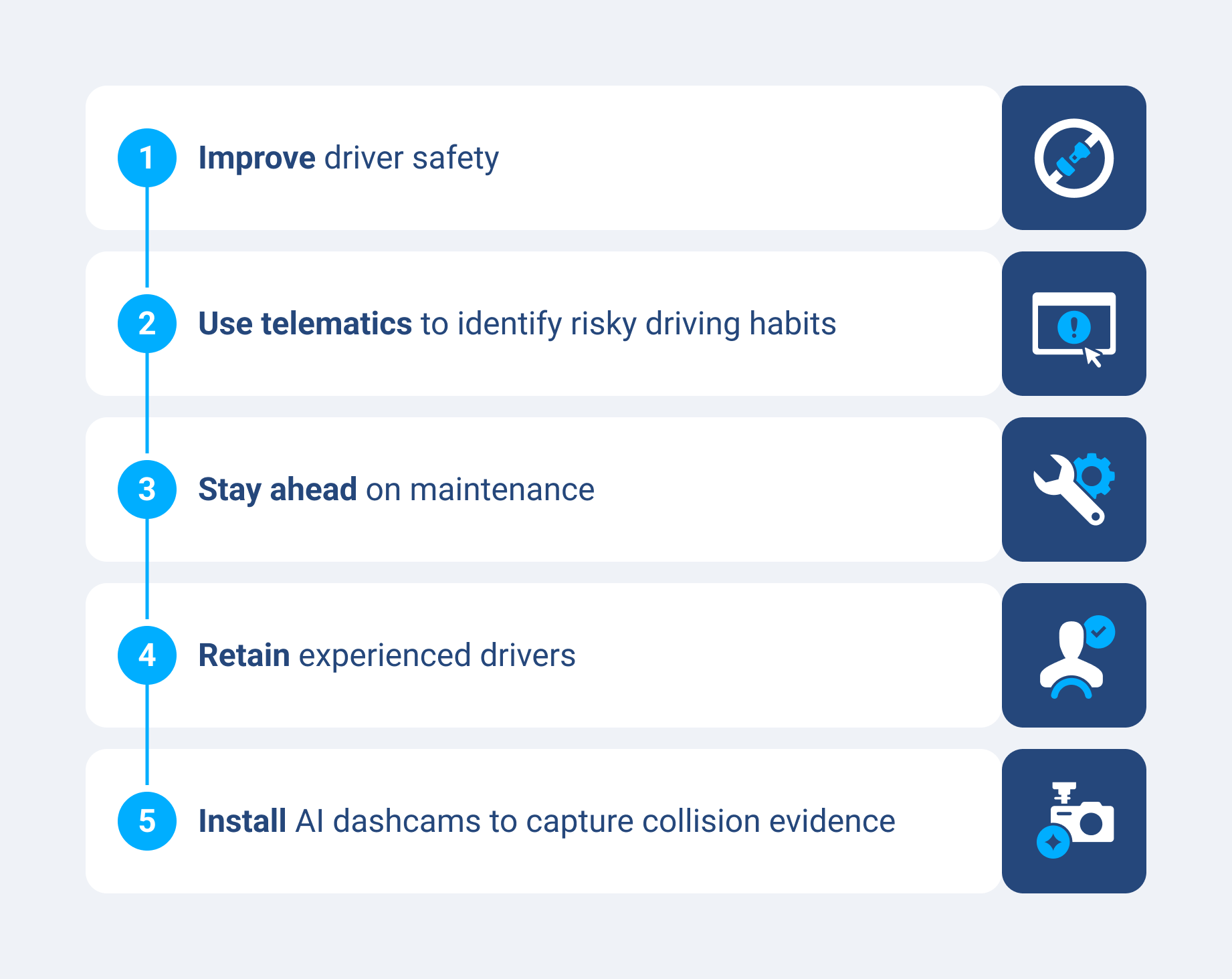
Managing fleet insurance expenses helps optimize operational costs. Here are some strategic measures that can lead to significant savings on premiums.
Improve driver safety
Driver behavior is one of the strongest predictors of collision frequency, and collision frequency is one of the best indicators of insurance cost. Fleets that invest in structured driver safety programs that offer regular performance reviews, safety scorecards and ongoing defensive driver training tend to build lower-risk driver profiles over time.
The practical connection here is clear: fewer collisions equal fewer claims, and fewer claims mean lower premiums. Insurers that offer usage-based or behavior-based pricing may allow fleets to document their safety programs directly to receive better rates.
Reduce claims through telematics
Telematics systems give fleet managers visibility into driver behavior in real time. That visibility allows insight into speeding, harsh braking, rapid acceleration, seatbelt use and distracted driving habits. When these behaviors are identified early and addressed through coaching, the result is fewer incidents on the road.
Fewer incidents directly translate into fewer claims, and, over time, a stronger insurance profile. Geotab's GPS vehicle tracking devices and fleet management platform provide fleet managers with the data they need to understand driver performance, identify patterns and take action before risks become costly claims.
Maintain vehicles proactively
Insurers are well aware that vehicle condition directly affects safety. A truck that experiences a brake failure or a tire blowout is a potential liability claim. Preventive fleet maintenance reduces the risk of mechanical failures that lead to collisions by proactively scheduling brake system inspections and tire management.
Predictive maintenance takes this a step further, using vehicle diagnostic data to identify which components are likely to fail before they do. Fleets that maintain detailed maintenance records are also better positioned during DOT audits, which can affect compliance standing.
Retain experienced drivers
Insurers generally view experienced drivers with clean records as lower-risk profiles than newer or less tenured drivers. High driver turnover forces fleets to onboard new drivers, who are less predictable from an insurance underwriting perspective.
Improving truck driver retention through better pay, recognition programs and positive working conditions reduces recruiting and training costs and keeps experienced, lower-risk drivers on the road. It also benefits your claim history and your renewal rate.
Install dashcams
Dashcams have become one of the most cost-effective tools available to commercial fleets for managing insurance risk. In the event of a collision, video footage provides objective evidence that helps resolve claims quickly. This reduces legal costs, shortens the claims cycle and protects the fleet from fraudulent or exaggerated claims.
AI-powered dashcams go further by monitoring in-cab behaviors like phone use, enabling real-time alerts and post-trip coaching. Research shows that dashcams can lower insurance costs over time by reducing both claim frequency and claim severity.
Lower fleet costs with the help of telematics
Understanding the cost of commercial truck insurance can help you manage expenses effectively. Premiums can vary significantly based on factors such as location, type of cargo and driving history, with owner-operators paying approximately $17,000 annually for comprehensive coverage.
Telematics helps reduce accidents and claims for your fleet, so you can get the best commercial trucking insurance at reasonable insurance rates. Geotab's fleet maintenance solutions are designed to help fleets reduce the risk factors that drive commercial truck insurance costs. Learn how Geotab supports safer, more efficient and cost-effective operations now.

Subscribe to get industry tips and insights
Frequently Asked Questions
The average monthly cost of commercial truck insurance varies based on factors such as coverage type, driving history and cargo. For instance, semi-truck insurance costs for owner-operators with their own authority range between $1,000 and $1,800.
Mississippi is recognized as the state with the lowest commercial truck insurance rates, averaging approximately $3,500 annually for local operations.
Commercial truck insurance is generally more costly due to the increased risks of operating large vehicles. Factors contributing to higher premiums include the potential for significant damage in accidents, expensive cargo and elevated repair costs.
According to the Federal Motor Carrier Safety Administration (FMCSA), you need a minimum liability coverage of $750,000 for interstate commercial trucks. However, there may be higher coverage limits depending on the cargo type and state regulations.
Yes, you can get commercial truck insurance with a bad driving record. However, you are likely to pay more and may need to access the non-standard market (surplus lines) instead of standard commercial carriers. Surplus lines insurers specialize in higher-risk accounts and can typically offer coverage where standard markets decline.
No, commercial truck insurance does not automatically cover cargo. Cargo insurance, also called motor truck cargo insurance, is a separate policy that covers the freight you haul in the event of loss or damage during transit. Standard commercial auto liability covers bodily injury and property damage to third parties, but it does not cover the liability of your load.
Bobtail insurance, also called non-trucking liability, covers a leased owner-operator when they are driving their tractor without a trailer and outside of a carrier's dispatch. That difference between dispatched trips can leave an operator without coverage unless they have a bobtail policy.
The Geotab Team write about company news.
Table of Contents
- How much does commercial truck insurance cost?
- Commercial truck insurance cost by truck type
- Commercial truck insurance cost by operating structure
- What affects commercial truck insurance rates?
- What is not covered by truck insurance
- Commercial truck insurance rates by state
- How to lower commercial truck insurance costs
- Lower fleet costs with the help of telematics
Subscribe to get industry tips and insights
Related posts



Top seven best fleet fuel cards: How to choose the right one for your business?
October 1, 2026
7 minute read

Four ways to transform garbage fleet efficiency with data and video tools
September 28, 2026
4 minute read

Why the OEM versus device-level telematics debate misses the point for mixed-fleet operators
September 25, 2026
2 minute read

6 benefits of an open, AI-powered fleet data platform
September 17, 2026
8 minute read