EV fleet transition: How to plan a successful fleet electrification strategy
Planning an EV fleet transition takes more than buying new vehicles. This guide covers assessment, infrastructure, funding and phased rollout so fleet managers can build a plan that fits their operations.

By Geotab Team
Sep 11, 2026

Key Insights
- A successful EV fleet transition starts with a clear assessment of vehicle usage, routes and charging needs before any vehicles are ordered.
- Phased rollouts, beginning with a small pilot group, reduce risk and give fleet managers real performance data before scaling.
- Charging infrastructure planning, including site assessment and utility coordination, is often the longest lead-time item in a transition plan.
- Telematics data helps fleet managers identify EV-ready routes, monitor charging and battery health and demonstrate the return on investment of electrification.
Fleet electrification is no longer a distant consideration for commercial fleets. The International Energy Agency projects that nearly half of new commercial vehicle sales will be electric by 2030. This makes it increasingly important for fleet managers to assess how electrification could affect their operations.
An EV fleet transition involves replacing internal combustion engine (ICE) vehicles with electric vehicles while updating procurement, charging infrastructure and daily operations. Most fleets move through a multi-year transition to EV operations, starting with a small pilot group and scaling up.
This guide walks through how to plan an EV fleet transition step by step, including cost analysis, infrastructure planning, funding options and phased rollout strategies.
Why fleets are making the switch to EVs
The transition to fleet electrification has three main drivers: rising fuel and maintenance, tightened emissions regulations and corporate sustainability targets.
Rising fuel and maintenance costs
Higher fuel and maintenance costs can increase the total cost of ownership for conventional vehicles, making EVs worth evaluating for fleets with high mileage or predictable routes.
Tightening emissions regulations
The EPA has introduced tighter emissions standards for medium- and heavy-duty vehicles, and a growing number of states have adopted zero-emission vehicle mandates that affect vehicle purchases.
Public-sector requirements
Public-sector fleets, including municipal and school district vehicles, may need to account for government requirements, funding deadlines and procurement rules when planning an EV transition. For example, EPA Clean School Bus funding programs establish specific application, purchasing and project deadlines for eligible public school districts.
Corporate sustainability targets
Beyond compliance, many fleets are pursuing a zero-emission fleet as part of broader environmental, social and governance (ESG) commitments to customers, investors and communities. Sustainability partnerships, such as the Geotab Sustainability Alliance, can help fleet managers evaluate vehicle and infrastructure options against verified performance data.
Read the sustainability report
Benefits of EV fleet transition planning
A well-planned electric fleet transition can help organizations manage costs, infrastructure needs and operational changes while reducing emissions. A thoughtful implementation plan can help fleets:
- Lower fuel costs, since electricity generally costs less per mile than gasoline and diesel
- Reduced maintenance, as EVs have fewer moving parts and no oil changes
- Quieter, smoother operation that can improve driver comfort
- Eligibility for federal, state and local incentives that offset upfront costs
How to create an EV fleet transition plan
A successful EV fleet transition plan starts with data, not vehicle orders. A disciplined, six-step approach helps fleet managers avoid common pitfalls and build a business case that holds up to budget scrutiny. Reviewing current mileage, routes, duty cycles and charging needs gives operations and finance teams a common foundation.

1. Assess your current fleet
Before selecting a single vehicle, review the vehicles already in the fleet. Review vehicle age, duty cycles, average daily mileage and current fuel costs for each vehicle class. Identify which vehicles are approaching the end of their replacement cycle, since these are natural candidates for electrification over another ICE purchase.
Route data from fuel cards, driver logs or telematics can show which vehicles already operate within the current EV range and charging capabilities. This baseline data becomes the foundation for every later planning stage, including how to optimize a fleet for EV arrival.
Objective: Build a clear baseline of fleet performance and identify the vehicles approaching replacement that could be good candidates for electrification.
2. Identify which vehicles should transition first
Not every vehicle needs to switch at once. The strongest early candidates are typically return-to-base fleets with predictable routes and light-duty vehicles, since these applications are best matched to EV range and charging capabilities.
Before adding heavier-duty or longer-range options to the plan, fleet managers can use Geotab's EV make and model support resources to compare specifications across a growing list of commercial EVs.
Objective: Create a prioritized list of vehicles for the first phase of electrification based on route requirements, vehicle capabilities and replacement timing.
3. Plan charging infrastructure
Charging infrastructure planning covers depot charging, workplace charging, public charging and utility coordination. This part of the transition often has the longest lead time because electrical upgrades, site upgrades, permitting and utility coordination can take months to complete.
Start by confirming the electrical capacity at each depot or facility, since upgrades can take months to complete. Decide if the vehicles will charge exclusively at a central depot or if drivers will also need access to public or workplace charging for longer routes.
Early conversations with the local utility help fleet managers understand available capacity, rate structures and any programs that support commercial charging installations.
Objective: Determine where vehicles will charge, what infrastructure each location requires and if you need electrical upgrades or utility coordinations before deployment.
4. Evaluate total cost of ownership (TCO)
A complete TCO comparison accounts for more than the sticker price of an EV. Include fuel savings, reduced maintenance, available incentives, charging costs and potential downtime during the transition. EVs often carry a higher upfront cost, but fuel and maintenance savings can narrow that gap within a few years for high-mileage vehicles.
Model TCO by vehicle class and duty cycle rather than relying on fleet-wide averages, since delivery vans and a long-haul truck reach cost parity on different timelines.
Objective: Determine the expected cost of ownership for each vehicle class and identify where EVs can deliver the strongest financial case.
5. Launch a pilot program
Begin with a pilot program instead of converting the entire fleet at once. A pilot program of a handful of vehicles allows fleet managers to test charging schedules, measure real-world range and collect direct feedback from drivers.
Track performance against the metrics identified during the assessment phase and use pilot data to refine routes, charging times and maintenance schedules before scaling. This is also the stage to address driver concerns directly, since early advocates within the pilot group can help build support for a broader rollout.
Objective: Validate vehicle performance, charging requirements and driver readiness in real-world conditions before expanding the program.
6. Scale using fleet data
Expand the program once pilot fleet data shows that additional vehicles and locations are ready. Ongoing monitoring of charging patterns, vehicle utilization, energy consumption, maintenance needs and route efficiency helps fleet managers decide which vehicle classes and locations are ready for the next phase.
Fleet management software can provide a single view of EV and ICE vehicles as the fleet changes over time, making it easier to compare performance across vehicle types.
Objective: Use real-world fleet data to determine which vehicles and locations are ready for the next phase and establish metrics for ongoing performance monitoring.
Common EV fleet transition challenges
Most EV fleet transition challenges fall into a few predictable categories, and planning for them early reduces disruptions later on. These common sticking points include:
| Challenge | What to do |
| Range anxiety and route planning | Match vehicle range to typical routes and prioritize predictable routes for early EV deployments. Use route and vehicle data to identify where range may become a restraint. |
| Upfront costs | Compare total cost of ownership instead of looking at purchase price alone. Factor in available incentives, fuel savings, maintenance costs and other operating expenses when evaluating the cost barrier to fleet electrification. |
| Driver adoption and training | Give drivers hands-on training and clear guidance on vehicle operation, charging procedures and route planning before deployment. |
| Charging infrastructure limitations | Start utility coordination and site planning early. Electrical upgrades and site work can take six to eighteen months, so build infrastructure timelines accordingly. |
Charging strategies for electric fleets
Charging infrastructure is one of the most complex and time-intensive parts of an EV fleet transition, often requiring lead times of many months. The strategies below can help fleets plan around depot capacity, vehicle dwell times and utility requirements.
Depot charging vs. public charging
Most commercial fleets rely primarily on depot charging because it offers greater cost control, reliability and scheduling flexibility than public networks. Vehicles that return to a central location overnight can charge during off-peak hours at lower electricity rates, without competing for space at public stations.
Public charging becomes necessary mainly for long-haul routes or vehicles that cannot return to a base within a single shift. For these cases, route planning should account for charging stops the same way it accounts for fuel stops today.
Choosing the right charging equipment
Charger selection should match vehicle dwell time. Level 1 charging is slow and generally limited to light-duty applications with long parking windows. Level 2 charging suits vehicles parked overnight at a depot, typically adding 12 to 80 miles of range per hour.
DC fast charging (DCFC) is faster but more expensive to install and is best reserved for vehicles with short dwell times or tight schedules. Look for hardware with load management, remote monitoring and software integration, since these features help fleets avoid unnecessary electrical upgrades as the fleet grows.
Site assessment and electrical upgrades
A proper site assessment reviews electrical capacity, conduit routing and physical layout before technicians install chargers. Utility-side electrical upgrades can take six to eighteen months, depending on the scope of work and the local utility's process. Fleet managers should start this step as early as possible in the transition timeline.
Engage the electrical contractor and the utility provider at the same time instead of sequentially. This helps avoid unnecessary delays and gives fleet managers a more realistic installation timeline to plan around.
Managed and smart charging strategies
Scheduling charge sessions during off-peak hours can meaningfully reduce electricity costs, particularly for fleets with many vehicles charging at once. Vehicle-to-grid (V2G) technology is still limited in commercial availability, but it may eventually benefit fleets with predictable overnight downtime and compatible vehicles.
Many fleet management platforms can automate charge scheduling based on a vehicle's planned departure time and current electricity prices, reducing the manual work of coordinating a growing charging network.
EV fleet transition considerations by fleet size
Fleet size affects how an EV fleet transition should be sequenced. The following are priorities that can help fleet managers of different sizes decide where to start. The following table summarizes key priorities for fleet managers of sizes.
| Fleet size | Key considerations |
| Small fleets | Start with a small pilot on predictable routes and confirm depot charging capacity before expanding. A smaller infrastructure investment can also support a faster transition. |
| Mid-sized fleets | Phase vehicle replacement and charging infrastructure together to spread capital costs over several years while building toward a zero-emission fleet. |
| Large fleets | Coordinate charging management, telematics, utility capacity and multiple depots to support a larger and more complex transition. |
Small fleets
Small fleets are well-positioned to move quickly. Piloting one or two vehicles on a predictable, low-mileage route limits financial exposure while still generating useful performance data.
When the scale of infrastructure investment is smaller, small fleets can often complete a full transition to EV fleet operations in a shorter timeframe than larger organizations, provided depot charging capacity is available.
Mid-sized fleets
Mid-sized fleets need to balance charging infrastructure expansion with a phased vehicle replacement schedule. Rather than upgrading electrical capacity all at once, many mid-sized fleets add charging capacity in stages that match their vehicle replacement cycle, spreading capital costs over several years while still working toward a zero-emission fleet goal.
Large fleets
Large fleets require more sophisticated planning across charging management, telematics and utility coordination.
With multiple depots and vehicle classes involved, large fleets benefit from centralized software that can track charging status, energy use and vehicle readiness across every location. They also benefit from early and ongoing coordination with utility providers to secure enough electrical capacity for future expansion.
How telematics supports EV fleet transition
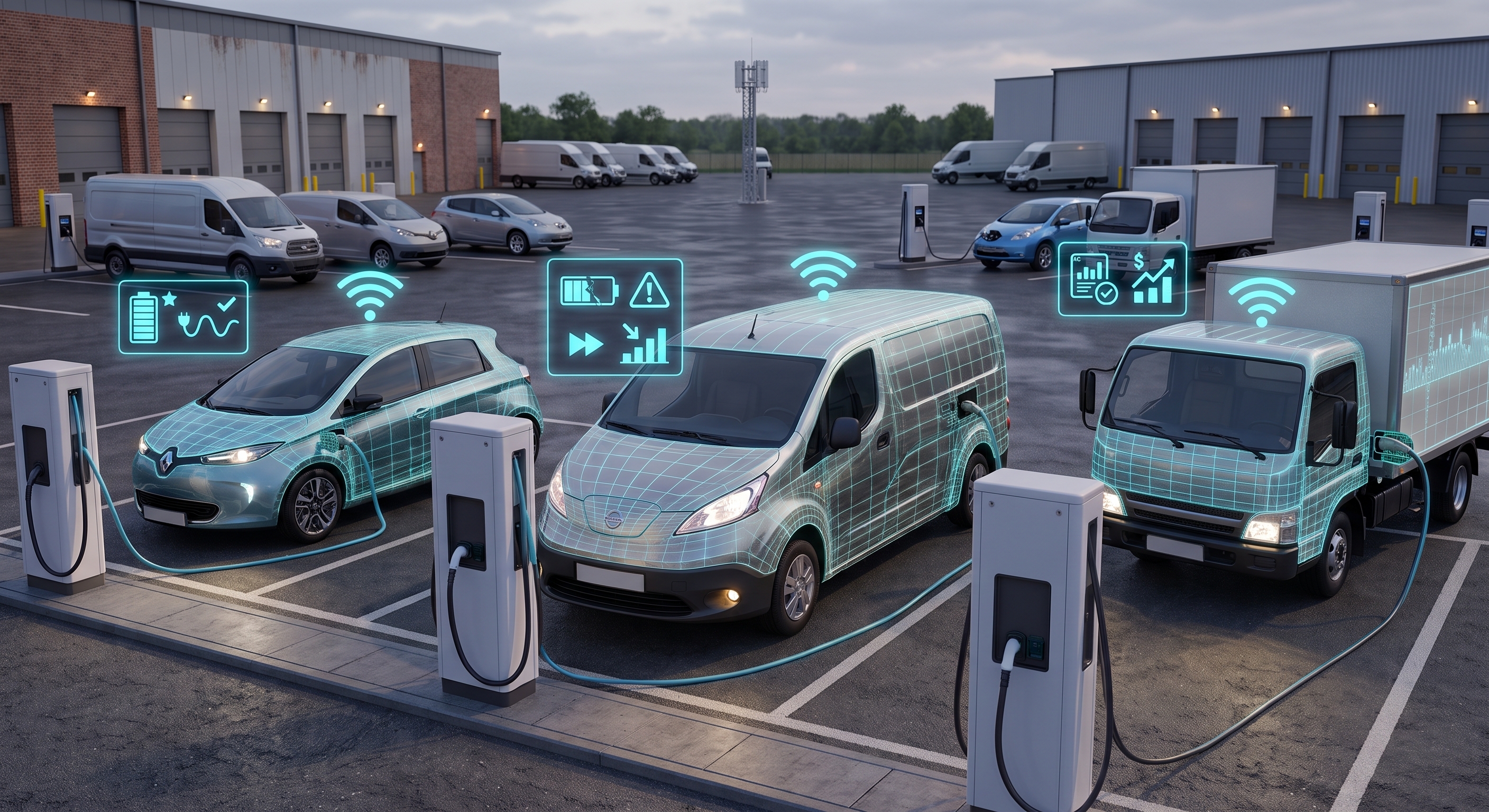
Telematics data plays a role at every stage of an EV fleet transition, starting well before the first EV arrives. Historical routes and duty cycle data help identify which vehicles are strong candidates for electrification, while post-transition data tracks charging behavior, battery health, energy usage and route efficiency.
Geotab's platform pulls vehicle data through the J1939 protocol common in commercial vehicles, alongside EV-specific data such as state of charge and charging session details. This gives fleet managers visibility into EV and ICE vehicles side by side as the fleet composition changes.
Geotab's Electric Vehicle Suitability Assessment (EVSA) uses existing vehicle data to model which vehicles in a fleet are ready for electrification before a single EV is purchased, helping fleet managers build a data-backed business case rather than relying on estimates. Ongoing reporting after the transition confirms savings are realized.
Take the next step in your EV fleet transition
Planning an EV fleet transition involves many moving parts, but fleet managers do not need to start from scratch. Route and vehicle data can show which assets are ready for electrification and help establish a realistic rollout timeline.
Geotab's Electric Vehicle Suitability Assessment uses existing fleet data to identify which vehicles are ready for electrification today.
Subscribe to get industry tips and insights
Frequently Asked Questions
The best vehicles to electrify first are those with predictable routes under several hundred miles and access to overnight depot parking. Light-duty models are also a strong starting point because of wider availability across manufacturers.
An EV fleet transition can take anywhere from six to twelve months for an initial pilot to three to seven years for a full fleet conversion. Utility-side electrical upgrades are often the largest factor affecting the overall timeline.
Calculating the total cost of ownership for electric trucks means comparing fuel, maintenance, incentives, charging and downtime costs against a comparable diesel vehicle over its expected lifespan.
The charging infrastructure a fleet needs depends on vehicle dwell time and route length. Level 2 charging is generally sufficient for vehicles parked overnight at a depot, while DC fast charging suits vehicles with shorter dwell times. A professional site assessment can confirm the right charger-to-vehicle ratio for a specific location.
Grants and incentives are available for EV fleet transitions at the federal and state levels, including programs tied to the Inflation Reduction Act (IRA). The U.S. Department of Energy's Alternative Fuels Data Center maintains an updated list of programs by state.
Getting driver buy-in for an EV fleet transition starts with early communication and hands-on training well before vehicles arrive. Involving drivers in the pilot phase and addressing range and charging concerns directly helps build advocates who can support a wider rollout.
Telematics helps with an EV fleet transition by supporting both pre-transition analysis and post-transition management. Before the switch, telematics data identifies which vehicles and routes are strong candidates for electrification. After the switch, it tracks battery health, energy use and charging patterns to confirm the transition is delivering expected results.
The Geotab Team write about company news.
Table of Contents
- Why fleets are making the switch to EVs
- Benefits of EV fleet transition planning
- How to create an EV fleet transition plan
- Common EV fleet transition challenges
- Charging strategies for electric fleets
- EV fleet transition considerations by fleet size
- How telematics supports EV fleet transition
- Take the next step in your EV fleet transition
Subscribe to get industry tips and insights
Related posts

EV fleet transition plan: Step-by-step guide for U.S. fleets 2026
September 17, 2026
6 minute read

Fleet electrification ROI: How to calculate and maximize savings
September 11, 2026
5 minute read

What an EV battery is actually worth at the end of a lease
August 20, 2026
2 minute read
Charged up: 6 data-driven strategies to maximize EV range in summer
June 19, 2026
2 minute read