Fleet management software cost: Top 5 factors that impact pricing
Explore the top factors that affect fleet management software costs, from features and integrations to hardware needs and fleet size.

By Geotab Team
Nov 3, 2025

Key Insights
- Pricing varies based on key factors such as fleet size, required software capabilities, hardware needs and integration complexity.
- Evaluating total cost of ownership — including setup, maintenance and support — helps fleets budget accurately and avoid hidden expenses.
- Choosing a scalable, modular platform like Geotab ensures fleets pay only for the tools and data they need while maintaining flexibility as operations grow.
Fleet managers often face uncertainty when comparing fleet management software options because pricing can vary widely across providers. Understanding fleet management software cost is not just about finding the lowest rate — it is about knowing what drives that price. Factors such as fleet size, hardware requirements, feature complexity and integration needs all influence how much a system costs over time.
This guide breaks down the main cost drivers so you can plan your investment strategically. By focusing on total cost of ownership rather than headline pricing, you can choose solutions that align with operational goals, minimize hidden expenses and unlock measurable value.
How much does fleet management software cost?
The average cost of fleet management software depends on a fleet’s size, required features and hardware setup, though most solutions range from $20 to $60 per vehicle per month. Fleets that choose more advanced capabilities pay toward the higher end of that range.
Hardware costs vary based on the devices and sensors required. Basic telematics units often start at around $100 per vehicle, while advanced systems can reach $600 per unit. Some vendors include hardware in bundled subscriptions, which can simplify billing and reduce upfront investment.
Key factors of fleet management software cost
Fleet management software pricing depends on each fleet’s operational structure and technology needs. Understanding these elements helps fleet managers build accurate budgets and identify where to invest for the greatest long-term value.
1. Fleet size and composition
The number and type of vehicles in a fleet directly influence software subscription and hardware costs. Most software providers price their plans on a per-vehicle basis, so larger fleets naturally pay more each month.
However, fleet management software for small business users often comes with flexible pricing or entry-level plans designed to make adoption more affordable. Larger fleets may qualify for volume discounts that help offset total spend.
Vehicle composition also matters. Light-duty vehicles often require standard tracking devices, while heavy-duty trucks or specialized assets may need more advanced sensors or compliance-ready equipment. Mixed fleets can face higher overall costs due to additional installation needs or specialized configurations.
2. Required software features
Vehicle maintenance software varies widely in functionality. Basic plans typically include GPS tracking, trip history and driver behavior monitoring.
As fleets add features, software complexity increases, and so can monthly fees. Common features include:
- Route optimization
- Maintenance scheduling
- Fuel management
- Electronic logging device (ELD) compliance
Advanced features can deliver strong returns through improved safety and efficiency, but they can raise subscription pricing due to higher data demands and ongoing updates.
| Pro tip: When comparing options, fleets should assess which tools align directly with their goals and eliminate features that add cost without measurable value. |
3. Hardware requirements
Hardware has a significant impact on total fleet management costs. Most systems require transportation management system (TMS) software, like telematics devices that plug into vehicle diagnostic ports to capture performance data. Additional components, such as sensors, dash cams or asset trackers, may also be necessary, depending on fleet priorities.
Installation can add to the overall expense. Some devices are simple to install, while others require professional setup or calibration. Identifying which hardware is essential versus optional helps control cost without compromising functionality.
4. Integration and implementation complexity
Integrating fleet management software with existing systems such as enterprise resource planning (ERP) or accounting tools can increase implementation costs. Custom workflows, data migration and user training add time and resource requirements during rollout.
Fleets that need advanced integrations or multiple user permissions may incur higher upfront expenses, though the payoff comes in better efficiency and long-term data visibility. A structured implementation plan helps ensure smooth adoption and reduces downtime.
5. Vendor support and contract terms
Vendors that prioritize reliable support, timely maintenance and software updates can help lower total costs by preventing costly downtime.
Pricing models vary between providers. Some offer monthly subscriptions, while others use annual or multi-year contracts. Tiered or per-vehicle pricing structures allow flexibility, and many vendors offer discounts for larger fleets or bundled features.
Understanding contract terms in advance can help you plan for fleet management costs and limit unplanned fees later.
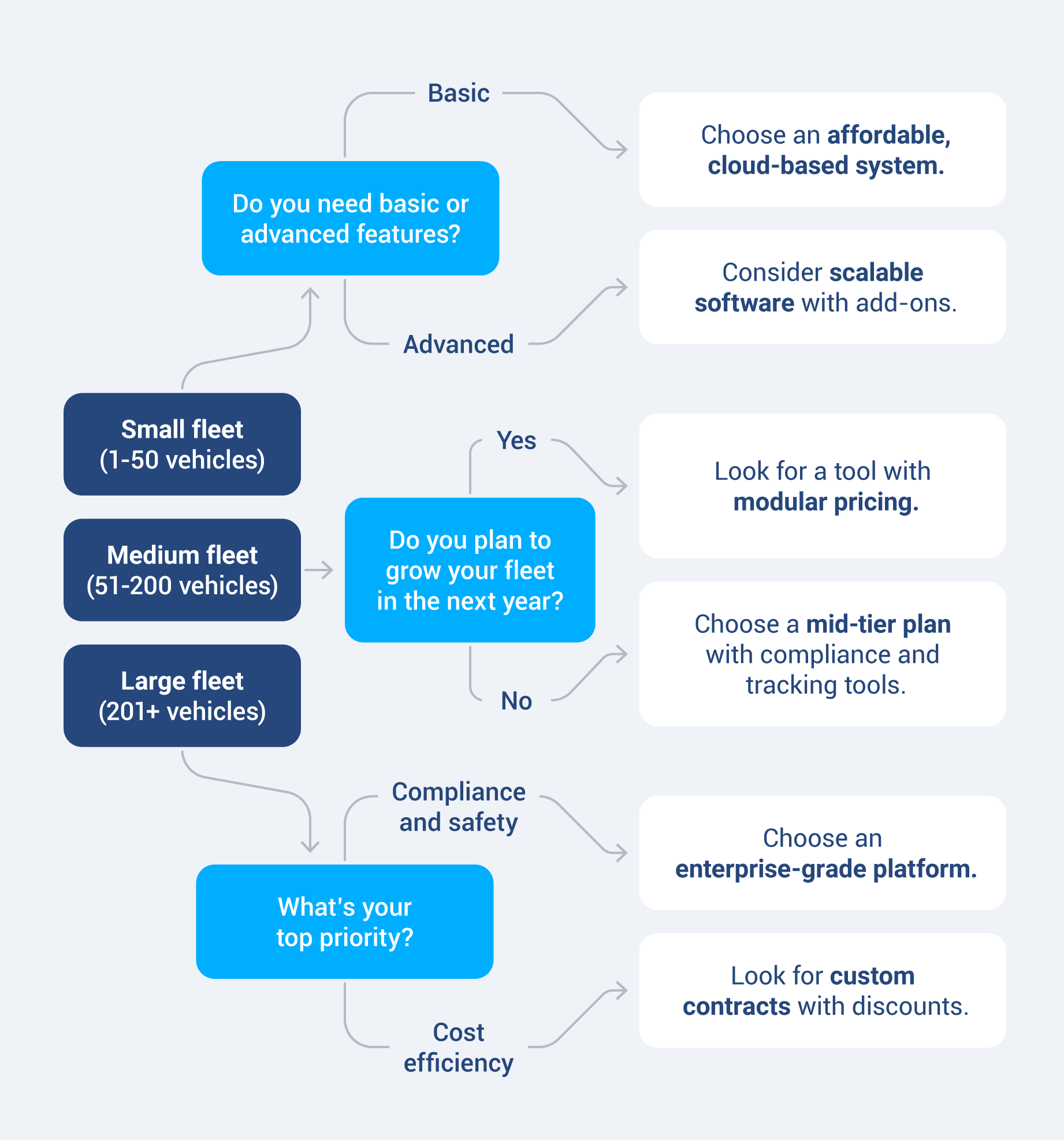
How to choose the right solution for your budget
Selecting the right fleet management system requires balancing cost with functionality. Understanding how different features, pricing models and support options affect total investment will help you choose a system that aligns with both your goals and your budget.
1. Define your fleet’s core needs
Start by identifying what you want to accomplish through a management system. The scope of operations, technology depth and system setup will determine which capabilities are essential.
For example, a small light-duty fleet might prioritize GPS tracking devices and driver behavior monitoring, while a heavy-duty operation might focus on ELD compliance and maintenance scheduling.
| Pro tip: List your top three pain points, such as driver safety, fuel costs or compliance. Choose a platform that directly addresses those issues to avoid paying for unnecessary tools. |
2. Compare features vs. value
Not every feature adds equal value. Core equipment tracking software, such as GPS tracking, maintenance alerts and compliance tools, helps create the foundation for efficiency and visibility.
Advanced options like AI fleet management, predictive maintenance and sustainability analytics add complexity and raise costs but can deliver strong returns for larger fleets.
When comparing vendors, look beyond pricing alone. Evaluate how each feature supports measurable results, like reduced downtime, fewer collisions or lower fuel consumption.
| Feature | Must have | Nice to have | Notes |
|---|---|---|---|
| GPS tracking | ✅ | Core visibility | |
| Dash cams | ✅ | Safety ROI if collisions are frequent | |
| Predictive maintenance | ✅ | Best for large fleets |
3. Understand pricing models and scalability
Fleet management system cost structures vary widely. Most providers use a per-vehicle pricing model with optional tiers or bundled plans. Scalable pricing helps fleets adjust easily as vehicles are added or removed.
Geotab’s modular approach offers flexibility by allowing fleets to pay only for the tools and data they use. This prevents overspending while maintaining access to advanced telematics and analytics when needed.
4. Factor in the total cost of ownership
Evaluating price alone can be misleading. The total cost of ownership (TCO) includes hardware, installation, add-ons, training, customer support and contract terms.
A lower-priced plan that limits data access or requires multiple integrations can ultimately cost more than a slightly higher plan that consolidates tools and simplifies management.
5. Evaluate ROI and data-driven impact
Fleet management software should generate measurable savings. Data insights can reduce fuel consumption, lower maintenance expenses and decrease insurance claims by improving driver safety.
Benchmarking and performance analytics make ROI visible across departments. Before committing, consider pilot testing or requesting a vendor demo to confirm that the platform delivers the outcomes your fleet needs.
6. Choose a provider that scales with your business
The right partner will grow with your fleet and adapt to future technology. Look for providers that integrate easily with emerging tools such as EV data, sustainability metrics and AI analytics. Reliable customer support and flexible data plans are also essential to long-term success.
Plan your fleet management investment strategically with Geotab
Understanding the true cost of fleet management requires looking beyond subscription fees. By considering TCO, including hardware, setup, maintenance and support, fleet managers can make more informed budgeting decisions.
Evaluating these factors helps ensure your investment in fleet management software cost delivers measurable returns, not just lower monthly rates.
Geotab’s fleet management software provides flexible tools that help fleets manage expenses, improve safety and unlock data-driven efficiency.
Subscribe to get industry tips and insights
Frequently Asked Questions
Yes. Fleet management software is a proven investment that helps reduce costs, improve safety and simplify compliance. Fleets that adopt telematics solutions often see 10%-15% lower fuel and maintenance expenses within the first year.
Advanced tools such as AI dash cams, predictive maintenance and route optimization can raise monthly costs because they require more data processing and integration.
These features, however, often deliver measurable returns through improved safety, fewer breakdowns and better fuel efficiency.
A fleet of 50 vehicles can expect to spend between $1,000 and $3,000 per month, depending on configuration, level of technology and support needs. This estimate includes telematics devices, software subscriptions, installation, maintenance and customer service.
The Geotab Team write about company news.
Table of Contents
Subscribe to get industry tips and insights
Related posts

Beyond the hype: Real AI priorities for field service leaders
March 26, 2026
6 minute read

Unified data: The key to fleet liability reduction for government agencies
March 19, 2026
9 minute read


Building a proactive government fleet safety program with data and AI
March 9, 2026
5 minute read

Building resilient school bus operations through four student transportation trends
February 24, 2026
6 minute read

Telematics trends for 2026: What is changing and how fleets can respond
January 30, 2026
6 minute read