AI in fleet management: How to improve efficiency & reduce costs
AI is changing how fleets operate, from smarter routes and predictive maintenance to real-time driver coaching. Here's how it works and which tools are leading the way.

Content Marketing Manager • Corporate Marketing
Sep 2, 2026

Key Insights
- AI in fleet management combines telematics, machine learning and predictive analytics to help fleet managers cut costs, improve safety and streamline decisions.
- AI supports predictive maintenance, route optimization, driver coaching and compliance tracking across everyday fleet operations.
- Leading tools include Geotab Routing and Optimization, GO Focus Plus, Revvo API and Uptake, each suited to different priorities.
- Successful adoption depends on clean data, system integration and ongoing performance tracking, not on technology alone.
Fleet managers must juggle driver safety, operating costs and a steady stream of vehicle data, all while keeping the day-to-day business operating smoothly. AI in fleet management addresses these pressures directly within a broader fleet management strategy.
This guide covers how artificial intelligence fits into a fleet management platform, the most common applications, key benefits, leading tools and best practices for a smooth rollout. From small delivery fleets or large commercial trucking operations, these tools can help teams get more value from data they already collect.
How does AI in fleet management actually work?
When it comes to fleet operations, AI collects data from telematics devices, GPS, dash cameras, vehicle sensors and other tools, then applies machine learning to identify patterns that humans often overlook. Instead of only reporting what has already happened, AI in fleet management uses data to predict what is likely to happen next.
Unlike traditional fleet management software, which reports historical trends, AI adds predictive analytics and automation to support real-time decisions like:
- Rerouting around traffic
- Flagging a driver for coaching
- Scheduling a repair before a vehicle breaks down
The technology stack behind this typically includes telematics, GPS, onboard cameras, vehicle sensors and connected vehicle systems working together.
Benefits of AI fleet management
AI transforms fleet management through automated monitoring, real-time route optimization and driver behavior analytics. Here are some key benefits of AI in fleet management and how they help with fleet optimization
Optimized loads and route efficiency
AI can help improve route planning by analyzing traffic patterns, road conditions and delivery schedules so your vehicles take the best routes, improving efficiency.
Anticipated maintenance needs
Unexpected breakdowns can be a nightmare. They disrupt schedules, rack up repair costs and can even result in lost business. AI-powered predictive maintenance can help you avoid these issues. By analyzing data from vehicle sensors and maintenance records, you can predict when a vehicle will need servicing.
With this level of foresight, you can address an issue before it becomes a major problem. For instance, when an AI system detects unusual engine vibrations, it will send an alert, allowing you to schedule a maintenance check, fix the issue early and avoid a potential breakdown.
Improved driver safety
AI-powered dash cams and driver monitoring systems detect unsafe behaviors like distracted driving and following too closely. These tools deliver real-time in-cab coaching that helps fleets prevent collisions, build individual driver risk profiles and target training where it matters most.
Automated compliance
Compliance is a major concern for corporate fleet management teams, particularly when it comes to meeting safety standards, reducing emissions and adhering to electronic logging device (ELD) regulations. Modern solutions that use AI for fleet management automatically collect and analyze data, helping you run fleets within regulatory guidelines and avoid costly penalties.
AI tools help you proactively identify potential issues early by automating the tracking of key compliance metrics. This enhances driver safety and operational reliability and ensures that your fleets follow environmental standards and ELD requirements.
Improved sustainability
Running a greener fleet is good for the planet and smart for your business. AI helps by reducing fuel consumption and emissions, making your operations more sustainable. By continuously analyzing routes and promoting efficient driving habits, AI helps your fleet contribute to a healthier environment while trimming unnecessary costs.
Implementing AI in fleet management also aligns your business with increasing regulatory demands and consumer expectations for greener practices. Companies that integrate these technologies are better positioned to meet future sustainability requirements and enhance their reputation in an environmentally conscious market.
Improved operational efficiency
AI also helps allocate resources more intelligently. By carefully monitoring vehicle usage and driver performance, you can identify underutilized assets and find ways to improve. This way, you’re able to keep up with demand with precision and foresight.
Common applications of AI in fleet management
AI can be applied across nearly every stage of fleet operations. Below are some of the top use cases of AI in fleet management that teams rely on most to improve safety, dispatch, fuel efficiency and maintenance, ranging from driver coaching to fuel efficiency.
Driver behavior monitoring and coaching
AI-powered video telematics detects risky driving behaviors, such as:
- Fatigue
- Phone use
- Tailgating
- Distracted driving
- Harsh braking
- Speeding
- Accelerating
- Cornering
These metrics give fleet managers a broader view of driving choices, helping them identify high-risk behaviors and provide training where it is needed. Real-time coaching gives drivers an opportunity to correct unsafe habits, while ongoing reporting helps managers track changes over time. This creates a more consistent approach to driver safety.
Fleet maintenance
AI supports predictive maintenance by analyzing vehicle diagnostics and sensor data. This helps teams schedule services before small issues become costly repairs instead of having to rely on fixed maintenance schedules. Early warnings give maintenance teams more time to schedule repairs before an issue turns into a roadside service call.
Preventive maintenance can also reduce unnecessary repairs, improve vehicle uptime and extend asset life by addressing problems before they become more serious. For fleet managers, this means fewer disruptions and a clearer picture of which vehicles require attention first.
Route optimization and dispatch
AI can evaluate factors like traffic, delivery windows, vehicle capacity and driver availability to help fleets build more efficient routes. Real-time tracking means managers can see where vehicles are and respond when traffic delays or other conditions disrupt the original plan.
Routes can be adjusted as needed, helping reduce unnecessary mileage, fuel use and missed delivery windows. Route optimization can also help balance driver workloads and provide more accurate ETAs to customers.
Fuel management and sustainability
AI identifies inefficient driving behaviors and fuel waste by analyzing factors like idling, driving behavior, vehicle use and route efficiency. These insights give managers a clearer picture of where fuel is being consumed unnecessarily and where changes could reduce costs.
Monitoring fuel and emissions trends can also help fleets measure progress toward sustainability goals. More efficient routing, reducing idling and better driving habits can lower both fuel consumption and emissions. Over time, combining fuel data with other fleet information can help managers balance cost control with environmental goals.
With so many ongoing advancements in tech, especially in AI, it can be challenging to identify useful trends and how to use the technology responsibly. Check out our white paper to learn how generative AI can help you optimize fleet management.
Top AI fleet management tools
The AI-powered fleet management software market is booming, and there are so many tools out there.
The best tools integrate diverse AI disciplines to transform operations and enhance decision-making. These include machine vision for real-time monitoring and predictive algorithms like collision detection models to anticipate risks. Generative AI for insightful data analysis is also available, alongside deep learning (DL), machine learning (ML) and even robotics for automation.
| Recommendation | Best for | Key AI capabilities |
| Geotab Routing and Optimization | Route and delivery planning | Dynamic route optimization, predictive analytics, scheduling |
| GO Focus Plus | Driver safety and coaching | Risk detection, in-cab coaching, driver behavior analysis |
| Revvo API | Tire data and fleet insights | AI-enhanced analytics, real-time data processing, custom reporting |
| Uptake | Predictive maintenance and asset health | Failure prediction, asset monitoring, maintenance recommendations |
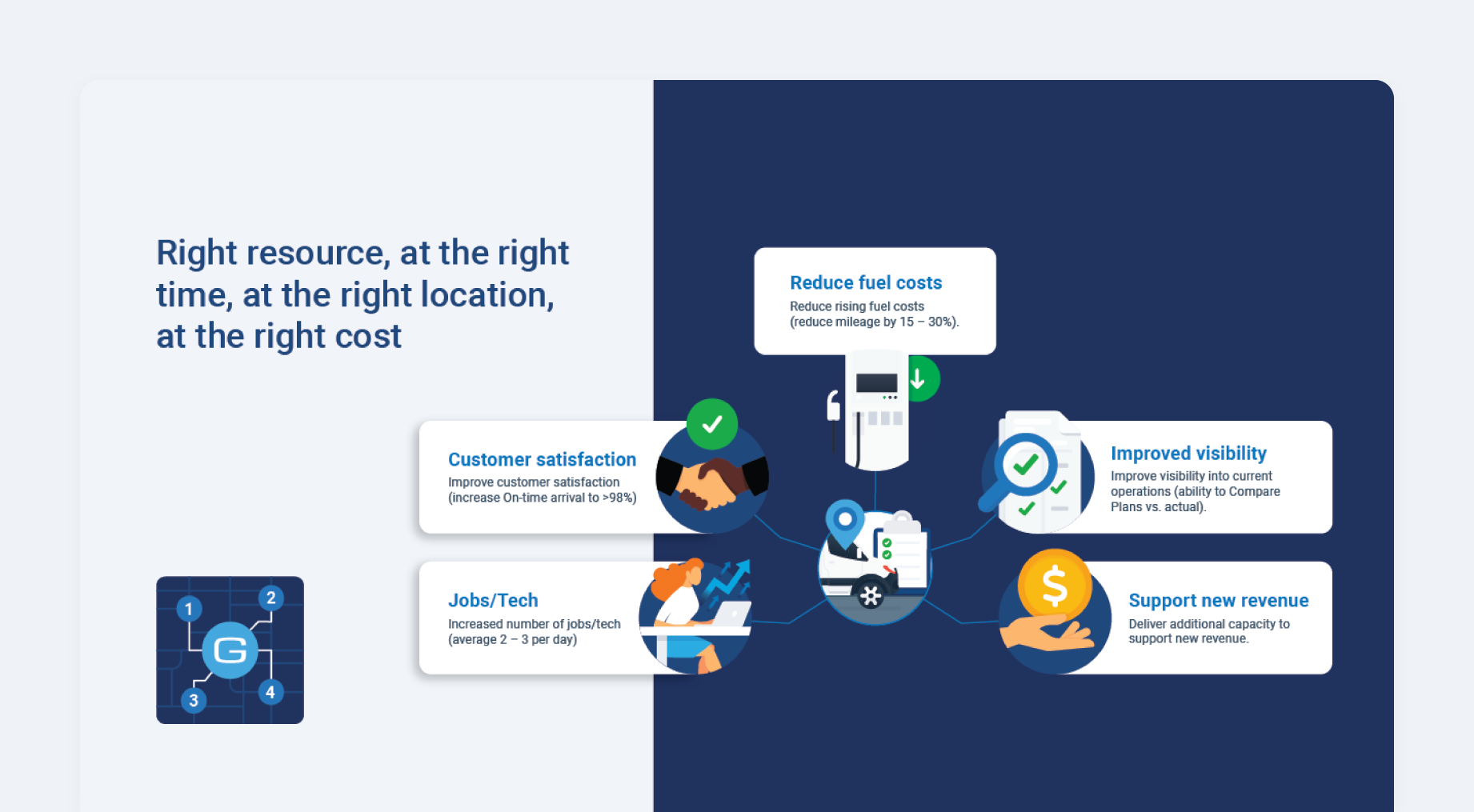
1. Geotab Routing and Optimization
Used for: Efficient route and delivery planning.
Geotab Routing and Optimization helps you streamline route planning and dispatch operations, integrating advanced ML and DL techniques to deliver predictive insights. It uses AI components to analyze real-time data, such as traffic patterns and weather conditions, optimizing routes and enhancing overall fleet vehicle maintenance.
While it uses AI in fleet maintenance, the solution is not entirely AI-driven. It also incorporates traditional analytics and human oversight for balanced, reliable decision-making.
Key features:
- Real-time route optimization: Continuously adjusts routes based on dynamic data to reduce delays and fuel consumption
- Predictive analytics: Utilizes AI components to forecast maintenance needs and potential issues, reducing downtime
- Dynamic scheduling and dispatch: Enhances operational efficiency by adapting schedules to current conditions and fleet requirements
2. Geotab GO Focus Plus
Used for: Video fleet safety.
GO Focus Plus is a dual-lens AI dash cam designed and built natively for Geotab, running on the same platform as the GO telematics device already installed in the vehicle. AI models run directly on the device itself for real-time detection and in-cabin coaching.
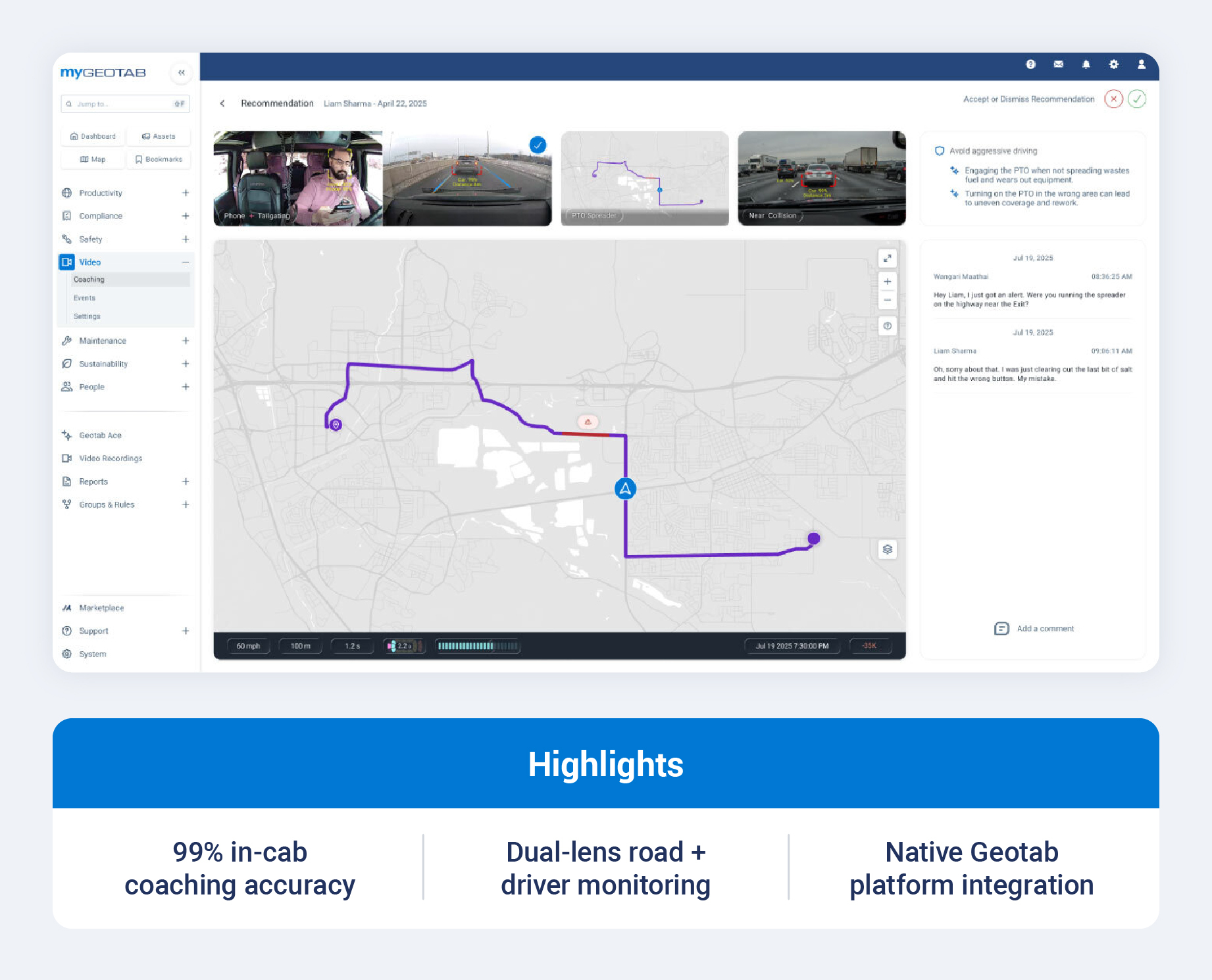
The camera monitors the road and the driver simultaneously, detecting risky behaviors like distracted driving, phone use, tailgating and signs of fatigue. The moment a risk is detected, the system delivers a voice alert in the cab, with in-cabin coaching accuracy of up to 99 percent. All detections feed into a Driver Distraction Score within the Video Coaching Platform, building a risk profile for each driver over time.
Key features:
- Smart Driver ID: Uses AI to identify and recommend driver assignment for each flagged event, so coaching reaches the right person every time
- Smart Sequence™ event review: Surfaces full event context – video, speed, location and trigger - in a single view, so managers can review and act without scrolling through hours of footage
- High severity and pattern detection: AI pattern recognition flags emerging high-risk behaviors and enables targeted coaching for drivers with persistent unsafe habits.
3. Revvo API
Used for: Seamless tire data integration.
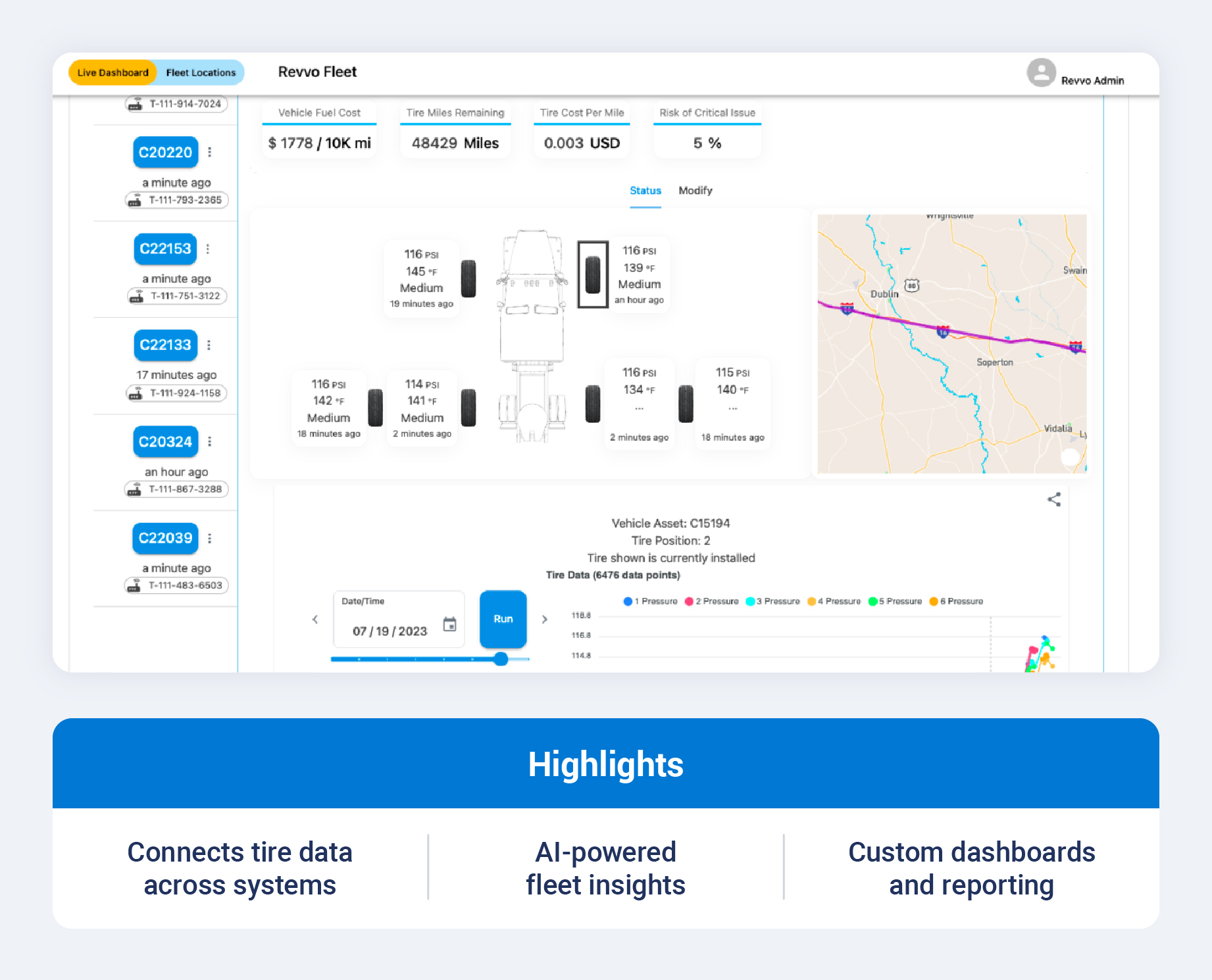
Revvo API is a tire management solution that enables you to connect your telematics data with other business systems and applications, enabling enhanced operational insights.
The tool uses AI components to process large volumes of data, offering useful analytics and improved decision-making while relying on established data integration techniques. This hybrid approach ensures reliable performance with a touch of intelligent automation.
Key features:
- Seamless connectivity: Integrates vehicle telematics data with third-party platforms and devices, such as Geotab GO, to streamline operations
- Real-time data processing: Uses AI-enhanced analytics to convert raw data into actionable insights
- Customized analytics: Allows for tailored solutions that meet specific fleet management needs
4. Uptake
Used for: Predictive asset optimization.
Uptake leverages advanced ML and AI algorithms to deliver predictive insights for fleet operations. It primarily focuses on asset performance and maintenance needs. Uptake combines historical data with real-time telemetry to forecast potential issues, enabling quick maintenance and reducing downtime.
.jpg)
- Predictive maintenance: AI in fleet management forecasts asset issues before they occur, helping you to minimize unplanned downtime and reduce repair costs
- Asset performance monitoring: Continuously tracks vehicle health and performance for better resource management
- Risk analytics: Analyzes operational data to identify potential risks and recommend preventive actions
Best practices for implementing AI in fleet management
Successful AI adoption depends on both the technology and the process behind it. Keep these best practices in mind when it comes to implementation:
- Identify the operational challenges you want AI to solve, be that reducing fuel costs, improving safety or increasing vehicle uptime.
- AI models are only as effective as the data they analyze, so prioritize accurate, consistent data collection.
- Connecting AI tools with telematics, maintenance and dispatch platforms provides a more complete operational picture.
- Successful adoption depends on users understanding how AI recommendations are generated and how to act on them.
- Monitor metrics like fuel efficiency, collision rates and maintenance costs to measure ROI and identify opportunities for improvement.
Challenges of implementing AI in fleet management
AI implementation takes planning to deliver long-term value. Common challenges include data quality, system integration, driver and manager adoption, privacy considerations and upfront costs. When evaluating AI in fleet management services from a vendor, ask the provider how to address each of these areas.
Another tip for AI for fleet management is to use AI to inform human decision-making, not replace it To avoid the biggest challenges of implementing AI, fleet managers should:
- Regularly review AI recommendations for accuracy
- Validate results
- Refine workflows over time to continue to improve efficiency
Taking a phased approach to implementation helps teams build confidence while maximizing long-term value.
The future of fleet management
As we look toward the future, the role of AI in fleet management is only set to expand. What was once considered cutting-edge is now standard, giving fleet managers the tools to stay ahead in a fast-paced industry. Advancements in predictive analytics, real-time data and AI-driven safety are making future fleets more efficient, safer and environmentally friendly.
As these developments take hold, the fleets that adapt will be best equipped to meet the challenges ahead. Prepare your fleet for what’s next. Explore how Geotab’s AI-driven solution can help your fleets — and how our customers are using our AI solutions.
Subscribe to get industry tips and insights
Frequently Asked Questions
Fleet management technology combines telematics systems, GPS tracking, onboard sensors and cloud-based software to collect and analyze data about vehicle operations and driver behavior.
AI in fleet management uses machine learning, deep learning and predictive analytics to optimize routes, forecast maintenance, enhance driver safety and reduce operational costs with real-time insights.
An API in fleet management is a set of protocols that allows different software systems to communicate, enabling seamless integration of telematics, routing and other fleet management functions.
The best AI use cases for trucking fleets include predictive maintenance, real-time route adjustments, driver safety coaching and automated ELD compliance tracking.
AI safety coaching for long-haul truck drivers works by using in-cab cameras and sensors to detect risky behaviors like fatigue and distraction and deliver real-time voice alerts along with post-trip coaching data.
AI helps with trucking compliance by automatically tracking Hours of Service (HOS), inspections and ELD data, reducing manual paperwork and flagging potential violations before they become costly.
Content Marketing Manager • Corporate Marketing
.
Table of Contents
Subscribe to get industry tips and insights
Related posts

Top seven best fleet fuel cards: How to choose the right one for your business?
October 1, 2026
7 minute read
Four ways to transform garbage fleet efficiency with data and video tools
September 28, 2026
4 minute read

Why the OEM versus device-level telematics debate misses the point for mixed-fleet operators
September 25, 2026
2 minute read

6 benefits of an open, AI-powered fleet data platform
September 17, 2026
8 minute read