Top fleet accident prevention software for safer fleets
Compare the leading fleet accident prevention software platforms, learn how the technology works and find out which features and strategies actually reduce collisions.

By Geotab
Nov 12, 2026

Key Insights
- Fleet accident prevention software combines telematics, AI-powered video and predictive analytics to reduce collision risk.
- The best platform for you depends on fleet size, safety goals and existing technology.
- Fleets that pair safety technology with structured coaching often see lower insurance costs, less vehicle downtime and stronger compliance reporting.
- Artificial intelligence is expanding what safety technology can do, from real-time in-cab alerts to identify risk patterns before a collision occurs.
Preventable collisions cost fleets in ways that extend well past the initial repair bill. Vehicle downtime, rising insurance costs and legal exposure can all follow an incident, and the financial impact adds up quickly. For many organizations, these costs extend well beyond the initial damage.
Fleet accident prevention software addresses this by combining telematics with AI-powered video, driver behavior monitoring and predictive analytics. These systems give fleets visibility beyond simply tracking vehicles and help identify potential risks before they result in a collision.
This article compares the top platforms, explains how the technology works and outlines the features, benefits and challenges fleet managers should weigh before choosing a solution.
Best fleet accident prevention software
The best fleet accident prevention software depends on fleet size, safety goals, current technology stack and budget. Rather than comparing every general fleet management feature, the platforms below are evaluated specifically on how well they help fleet managers prevent collisions, including AI-powered video, driver risk scoring and predictive analysis.
Geotab
Geotab helps fleets identify risky driving, intervene in the moment and use incident data to prevent repeat problems. Its telematics platform tracks behaviors such as harsh braking and speeding, while driver safety reports show managers which drivers need coaching and where risky patterns are emerging.
Geotab’s native GO Focus family adds video to that safety data. GO Focus captures road-facing footage during key driving events, while GO Focus Plus detects road and driver risks and gives drivers immediate in-cab voice alerts. Fleet managers can review prioritized video events alongside trip data in MyGeotab, then assign and track targeted coaching.
As safety needs grow, fleets can choose from more GO Focus cameras or add third-party dash cameras and collision avoidance systems through Geotab’s Marketplace. That combination of real-time intervention, video evidence and flexible coverage makes Geotab a strong choice for fleets focused on reducing collisions across different vehicle types and safety needs.
Samsara
Samsara is a broad operations platform with strong video-based safety tools. Its AI dash cams detect distracted driving, tailgating and other risk behaviors in real time, sending in-cab alerts to correct them. Fleet managers get driver leaderboards, automated coaching workflows and video evidence for incident review.
Samsara integrates safety data with broader fleet operations, including maintenance and compliance. This solution tends to suit larger fleets that want tightly integrated hardware and software with minimal setup.
Motive
Motive combines AI dash cameras, electronic logging devices and driver scorecards on a platform designed to simplify compliance and safety. Its AI models detect events such as hard braking, following distance violations and phone use, then route the highest-risk events to safety teams for review.
Automated coaching workflows assign follow-up based on driver risk scores, helping the teams that need it the most. Pricing and packages are geared toward small and mid-size fleets that want compliance and safety tools bundled together.
Fleetio
Fleetio is primarily a maintenance management platform, but its inspection and incident-tracking tools support fleet accident prevention efforts as part of a broader safety program. Digital vehicle inspections can flag mechanical issues before they contribute to a collision, and incident reporting tools centralize documentation after an event occurs.
Fleetio does not include built-in AI video or predictive risk scoring, so fleets that want deeper behavioral analytics often pair it with a dedicated safety or telematics tool.
Chevin FleetWave
Chevin FleetWave is an enterprise fleet management system built for large, complex fleets, including government and mixed-vehicle operations. Its accident management module tracks incidents from first report through resolution, including cost tracking, claims and root cause analysis.
FleetWave is highly configurable, allowing fleets to build workflows around their existing safety processes, and is generally better suited to organizations with dedicated fleet administration staff, given its longer implementation timeline.
How fleet accident prevention software works
Fleet accident prevention software continuously collects and analyzes driver and vehicle data to identify risk before a collision occurs, instead of waiting to respond after an incident happens. This process generally moves through three stages:
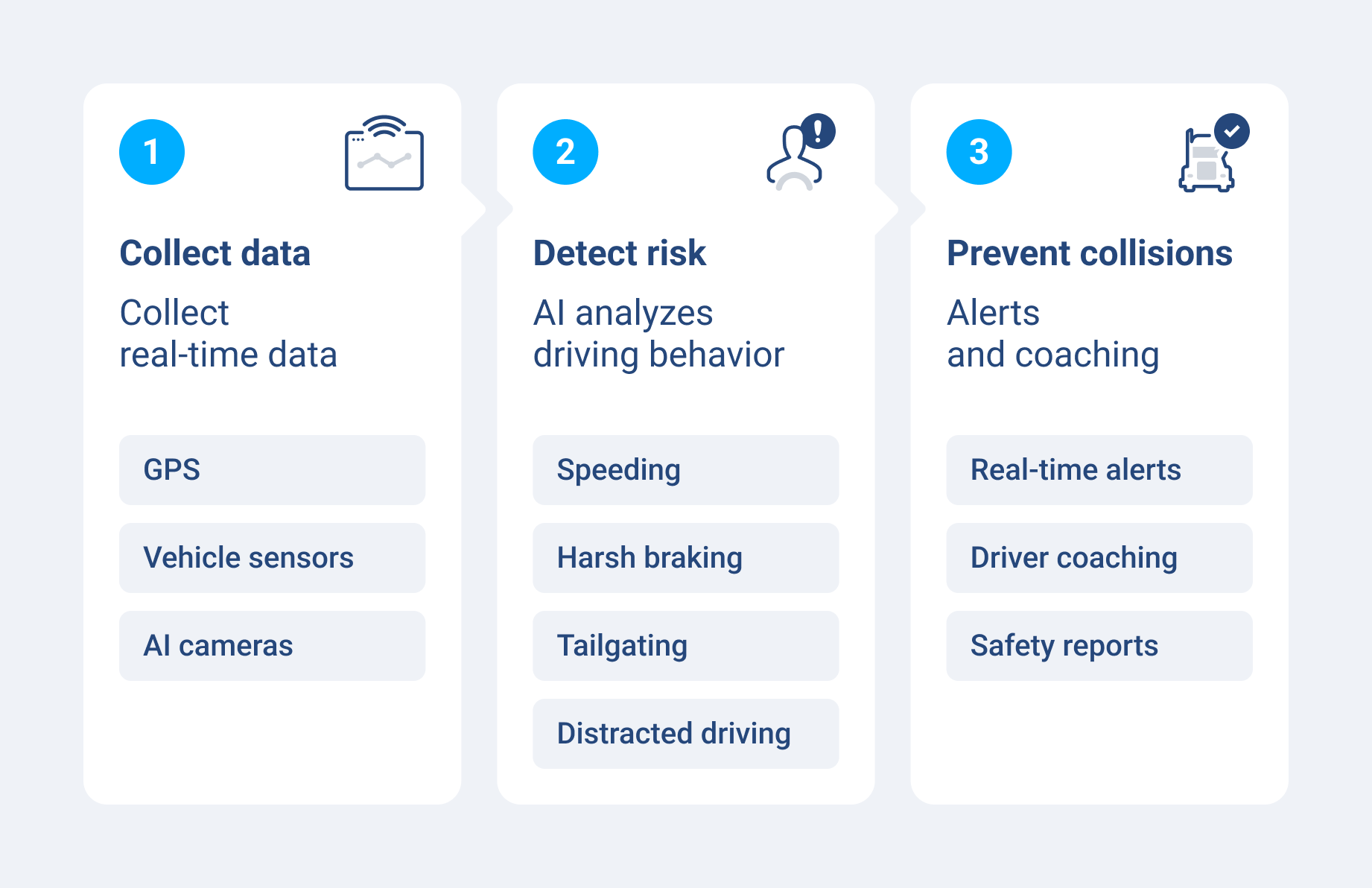
First, the system captures real-time data from GPS, vehicle sensors and, in many cases, AI-powered cameras facing the road and cabin. Then AI and telematics analyze this data to detect unsafe driving behaviors, like harsh braking, speeding, tailgating and distracted driving as they occur.
Finally, the platform delivers alerts, coaching resources and reporting that help fleet managers and drivers act on the data.
The goal across all three stages is to prevent rather than document. Fleet managers gain continuous visibility into risky behaviors and can address them before they lead to a collision.
Features to look for in fleet accident prevention software
The following features have the greatest impact on reducing collisions and are worth prioritizing when evaluating fleet safety technology.
AI dash cameras and video evidence
Dual-facing cameras record both the road and the driver, capturing context on both sides of an event. Event-triggered recording captures footage automatically when the system detects a harsh braking event, collision or other risk event, so safety teams do not have to review hours of footage.
Video verification supports faster claims resolution and can help exonerate drivers from false claims. AI dash cameras also play a central role in distracted driving detection, one of the most common contributors to preventable collisions.
Driver risk scoring and reporting
Driver scorecards translate raw telematics data into a clear picture of driver performance. Managers can use them to review behaviors like speeding, harsh braking and phone use, then compare across individual drivers or routes against fleet-wide averages to identify outliers.
Trends over time can show if coaching is changing driver behavior and where additional adjustments might be needed. Managers can then focus on coaching the drivers and behaviors most closely linked to collision risk, while using the data to track broader safety KPIs.
Predictive safety analytics
Predictive analytics uses AI to identify behavioral patterns that tend to precede a collision instead of only flagging risk after an event has already occurred. This allows fleet managers to intervene with a driver before a pattern turns into an incident, shifting the safety program from reactive to proactive.
Some platforms model this using a predictive safety model for fleet collisions, which weighs multiple risk factors together instead of relying on a single behavior in isolation.
Benefits of fleet accident prevention software
This technology delivers value beyond simply avoiding a single incident. When implemented as part of a broader approach to preventing collisions, it supports safety, cost control and compliance goals at the same time. Fleets that pair AI-powered safety technology with structured coaching report a 35% reduction in preventable collisions.
These benefits extend across several areas of fleet safety and operations:
- Fewer collisions: Continuous monitoring and coaching address risky behavior before it results in an incident on the road
- Lower insurance costs: Documented safety performance supports better terms during premium negotiations
- Reduced vehicle downtime: Fewer collisions mean fewer vehicles out of service for repairs
- Improved CSA and safety performance: Fleet-wide data supports stronger compliance scores and audit readiness
- Better driver retention through coaching: Drivers who receive consistent, constructive feedback tend to stay longer and perform better
- Lower repair expenses: Preventing collisions before they happen avoids the cost of repeated repairs
- Faster claims handling: Video evidence and telematics data speed up investigation and resolution
- Stronger compliance reporting: Centralized data simplifies reporting for regulators and insurers alike
How AI improves fleet accident prevention software
Artificial intelligence enhances traditional telematics by identifying patterns and predictable collision risks that would be difficult to detect through manual review alone. AI analyzes data from vehicle sensors and dash cameras to surface safety insights that human eyes often overlook.
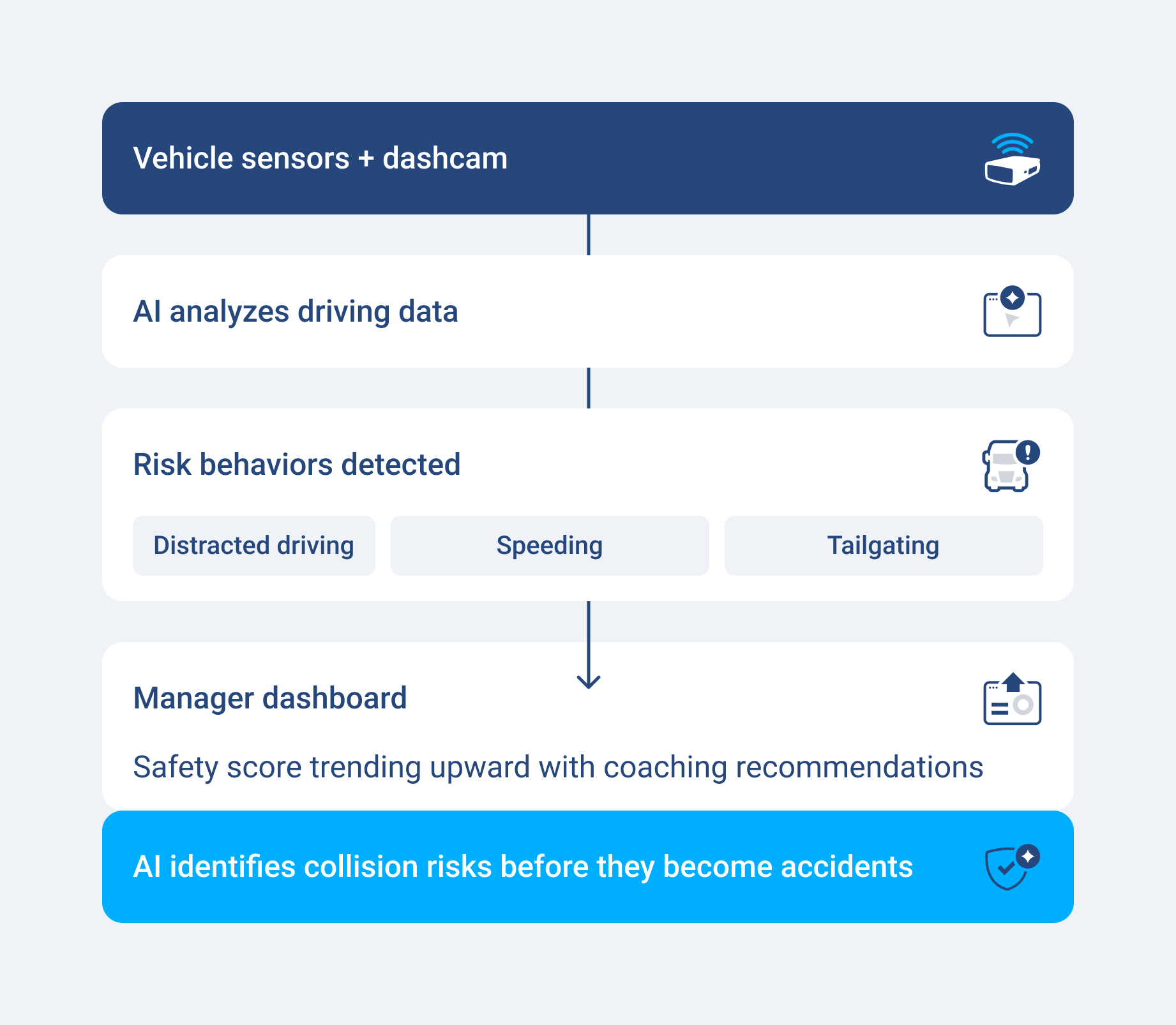
Real-time driver alerts provide coaching while risky behaviors are happening, allowing drivers to correct their actions before unsafe habits become routine. AI adds to this by continuously detecting behaviors, like distracted driving, speeding and tailgating, without requiring managers to manually review every trip.
Predictive analytics identify patterns that indicate elevated collision risk, allowing safety teams to intervene before an incident occurs.
Geotab’s AI-powered video analysis prioritizes the driving events that need attention, helping fleet managers review incidents without watching hours of footage. Paired with driver safety data, those clips give managers a clearer basis for personalized coaching that targets each driver’s recurring risks, while reducing the time spent on fleet video review.
Together, these capabilities are why AI fleet safety systems' accident prevention tools are quickly becoming a standard part of modern fleet programs.
Common fleet accident prevention challenges
Even with a strong fleet safety program, organizations face ongoing challenges that increase collision risk and make it difficult to improve driver performance over time. Several challenges can make it harder for fleets to maintain safe driving practices, including:
- Inconsistent driver behavior: Speeding, harsh braking, distracted driving, and other risky habits remain leading contributors to preventable collisions. Real-time alerts and consistent coaching help reinforce safer habits over time, rather than relying on drivers to self-correct.
- Limited visibility into safety risks: Manual reporting and reactive investigations make it difficult to identify trends before a collision occurs. Telematics, AI-powered cameras and predictive analytics provide continuous insight into driver performance instead of a single after-the-fact snapshot.
- Balancing safety with operational efficiency: Improving safety without adding administrative burden is an ongoing challenge for many fleets. Integrated software automates reporting, streamlines workflows and supports compliance while keeping day-to-day operations productive.
- Driver adoption and engagement: Drivers may be hesitant to adopt safety technology, particularly in-cab cameras. Geotab offers privacy options, including road-facing-only cameras and the ability to disable the in-cab camera or blur faces in GO Focus Plus footage. Explaining these choices upfront, then using consistent coaching and positive reinforcement, can help build trust and encourage adoption over time.
Fleet accident prevention software helps address these issues through real-time visibility, automation and data-driven coaching, but it should complement broader safety practices. Long-term results also depend on how consistently fleets apply these tools, review the data and adjust their safety programs.
Improve fleet safety with Geotab
Reducing collisions takes continuous visibility into driver behavior, AI-powered insights that catch risk early and a program built around preventive coaching.
Geotab fleet safety solutions combine driver safety reports, predictive analytics and a wide range of AI camera and Advanced Driver Assistance System (ADAS) integrations into one platform. These tools give fleets the data and insights they need to strengthen their safety programs.
Subscribe to get industry tips and insights
Frequently Asked Questions
Fleet safety software can lower insurance costs because of documented safety performance, lower incident frequency and video evidence for determining fault after a collision. Insurers increasingly reward fleets that can show consistent driver coaching and a measurable drop in risky behavior.
Fleet safety software commonly monitors speeding, harsh braking, rapid acceleration, hard cornering, seat belt violations, phone use, lane departures and signs of driver fatigue. Monitoring these behaviors helps fleet managers identify risk early and track if a safety program is improving driver performance over time.
Most fleets see measurable changes in driver behavior within the first 30 to 90 days of deployment. Results tend to appear faster when the software is paired with a structured coaching program, since drivers receive consistent feedback instead of data that often goes unreviewed.
Fleet accident prevention software is suitable for small fleets, and many platforms offer scalable pricing that works for fleets of fewer than 10 vehicles. The return-on-investment case is often stronger for smaller fleets, since a single serious collision has a proportionally larger financial impact.
Fleet tracking and fleet safety software differ in focus. Tracking centers on vehicle location and route history, while safety software centers on driver behavior, risk scoring and collision prevention. Many modern platforms combine both, giving fleet managers location visibility alongside the behavioral data needed to reduce collision risk.
Geotab team
Table of Contents
- Best fleet accident prevention software
- How fleet accident prevention software works
- Features to look for in fleet accident prevention software
- Benefits of fleet accident prevention software
- How AI improves fleet accident prevention software
- Common fleet accident prevention challenges
- Improve fleet safety with Geotab
Subscribe to get industry tips and insights
Related posts
OTR trucking: How to improve driver safety and fleet efficiency
October 29, 2026
7 minute read

Garbage truck safety: Three questions for your video review process
October 28, 2026
4 minute read


Fleet accident management: How to improve safety and reduce costs
September 4, 2026
5 minute read