Usage-based car insurance: What it is and how it works to lower premiums
Usage-based car insurance replaces broad risk assumptions with real driving data, rewarding safe habits and lower mileage with potentially significant savings. Learn how telematics-powered insurance works, who benefits more and what tradeoffs to consider before enrolling in a UBI program.

Aug 28, 2026

Key Insights
- Usage-based car insurance (UBI) sets premiums based on how you drive and how much you drive, rewarding safe, low-mileage drivers with lower rates.
- Insurers collect driving data through an OBD-II plug-in device or a smartphone app, tracking behaviors like speed, harsh braking and phone use.
- Two main programs exist: pay-as-you-drive (PAYD), which charges per mile, and pay-how-you-drive (PHYD), which rewards safe driving habits.
- UBI can reduce premiums by 10% to 40% for qualifying drivers, but poor scores can raise rates, making it important to understand the program before enrolling.
Everyone wants to pay less for insurance. There are different strategies to reduce insurance premiums, such as raising your deductible or buying an insurance package.
One strategy gaining attention is usage-based insurance (UBI), also known as Pay-How-You-Drive (PHYD) or telematics auto insurance. UBI offers a more advanced form of insurance, providing potential discounts plus other benefits such as driver behavior monitoring.
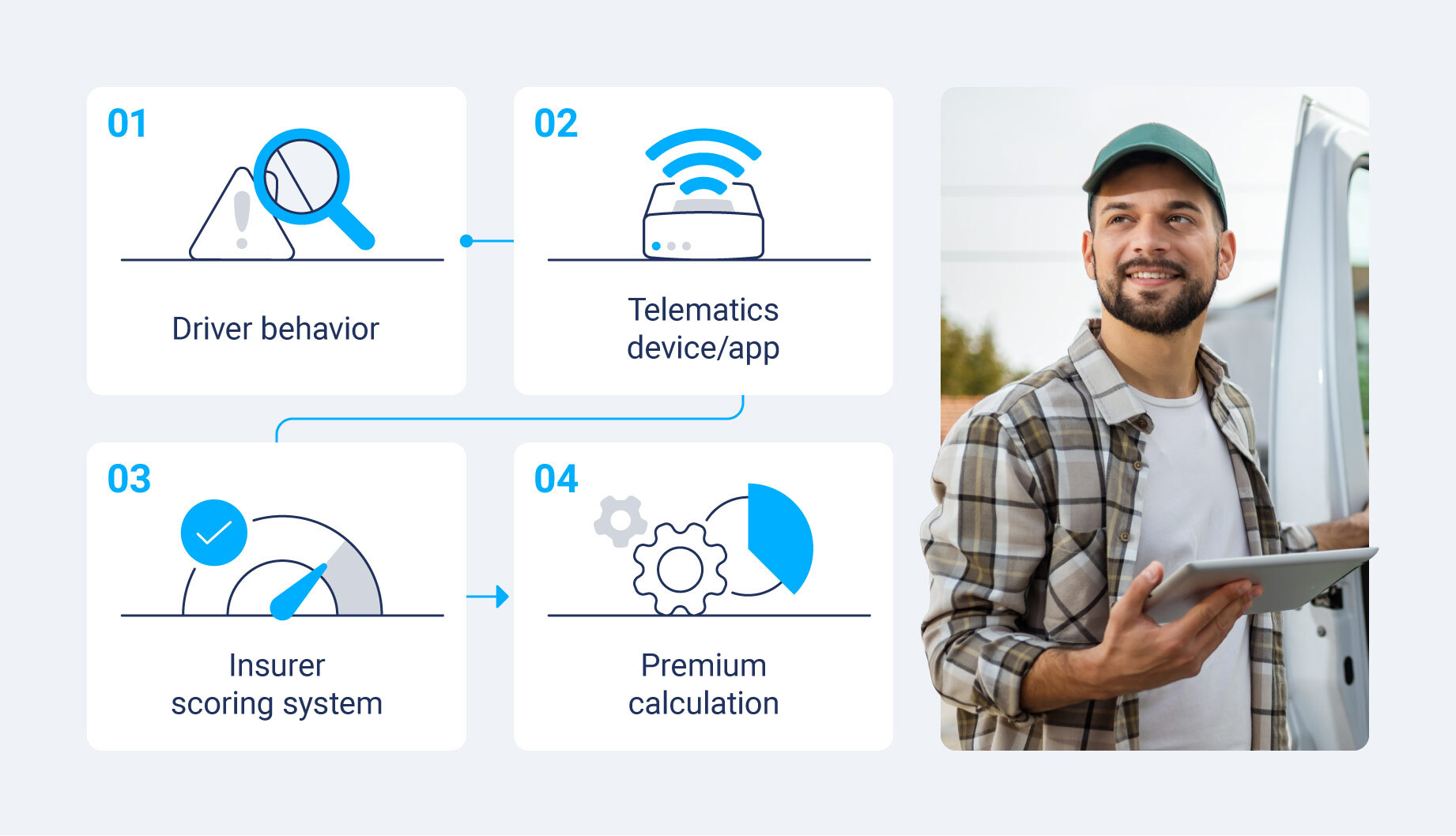
A telematics device like a smartphone app, tracks driving behavior and sends data to your insurer to set your rate. This article explains how usage-based auto insurance works, who benefits most and key considerations before signing up.
What is usage-based insurance?
With a usage-based insurance plan, you pay for the kind of driving you actually do instead of the driving that the insurance company thinks you do. Rather than calculating your premium using demographic proxies like age, ZIP code or credit score, insurers use actual driving data to price your policy.
UBI insurance goes by several names depending on the insurer and program structure. Pay-as-you-drive (PAYD) programs charge a rate based on how many miles you log. Pay-how-you-drive (PHYD) programs evaluate driving behavior regardless of distance. Some programs measure both. Major insurers like Progressive offer UBI programs built on this model.
To learn more about the technology behind these programs, see our overview of what telematics is and how it works.
How does usage-based insurance work?
UBI relies on telematics to collect data on driving behavior. Although, traditional parameters like vehicle type and driving record are still part of the equation. Telematics data provides greater accuracy in establishing fault when settling claims and also helps in tracking and recovering stolen vehicles.
Through a telematics device, the insurer can capture several types of information.
- Miles driven
- Where and when you drive
- Acceleration, braking and cornering
- Air bag deployment
- Speed
The insurer analyzes the data to determine your driving habits, such as hard accelerations, sudden stops and distance driven. From the data, the insurer can better assess risk and charge a more accurate amount. Most programs offer an enrollment discount just for signing up, separate from any performance-based savings.
Insurers offer two main ways to collect driving data:
- OBD-II plug-in device: A small device that plugs into your vehicle's on-board diagnostics port, which is usually located under the dashboard. Simple installation takes seconds, and no tools are needed. Some insurers may mail the device directly.
- Smartphone app: Many insurers now offer a mobile app alternative. The app uses your phone's GPS and accelerometer to record the same behaviors. Some programs offer both options.
Types of usage-based car insurance
UBI programs fall into two main categories. Understanding the difference helps drivers and fleet managers choose the program that fits their driving patterns.
Pay-as-you-drive
Pay-as-you-drive (PAYD), sometimes called pay-per-mile insurance, combines a fixed base rate with a smaller per-mile charge. If you drive fewer miles, you pay less. It is the simpler of the two models to understand.
This structure works best for:
- Remote workers
- Retirees
- Urban residents who drive fewer than 10,000 to 12,000 miles per year
Insurers like Milewise by Allstate and Metromile (now part of Lemonade) specialize in this model.
Mileage is typically tracked through a plug-in device or periodic odometer reporting, depending on the insurer. For fleets, this model pairs well with usage-based maintenance programs that also trigger service intervals based on actual miles driven rather than fixed schedules.
Pay-how-you-drive insurance
Pay-how-you-drive (PHYD) focuses on driving behavior instead of distance. Safe drivers earn better scores and lower premiums, regardless of how many miles they log. This model benefits regular commuters who drive carefully, including commercial drivers whose records reflect strong safety habits.
Behaviors that improve your score include:
- Smooth braking
- Moderate speeds
- Avoiding late-night driving
- Minimal phone use behind the wheel
Some programs measure both mileage and behavior, blending both structures into a single score. Understanding what factors your insurer weighs most heavily is a critical step before you enroll.
Benefits of usage-based car insurance
You understand what the usage-based car insurance market looks like now, so let us take a look at the usage-based insurance pros and cons. For the right driver profile, UBI offers concrete, measurable advantages, not just the promise of savings. Here are the most significant benefits to consider.
Lower premiums for low-mileage drivers
Safe, low-mileage drivers can save 5% to 15% on their premiums, depending on the program and their driving score. Results vary widely by provider, state and individual behavior.
UBI also removes the penalty of being grouped with high-risk demographic categories. A 25-year-old with excellent habits can pay less than a 45-year-old with poor ones. Some programs offer discounts immediately upon enrolling.
Fairer pricing based on actual behavior
Traditional auto insurance pricing relies on statistical proxies: age, gender, location and credit score. These factors reflect group averages, not your actual driving. UBI shifts pricing to individual behavior, so drivers who demonstrate they are low-risk can pay less, regardless of demographics.
This is especially relevant for young drivers, who typically face high premiums due to age-based risk assumptions. It also helps commercial fleets looking to tie fleet insurance costs to the actual risk profile of their drivers instead of broad actuarial categories.
Faster claims processing
Telematics data can help reconstruct what happened in a collision, providing information on speed at impact, braking patterns and GPS location at the time of the event. This accelerates claims investigations and reduces disputes about fault. For fleets managing multiple vehicles, the ability to pull collision reconstruction data is incredibly beneficial.
Encourages safer driving habits
Seeing a real-time driving score creates a feedback loop. Drivers become more aware of hard braking, speeding and phone use when those behaviors directly impact their rate. Some programs provide weekly or monthly reports showing where performance can improve.
This benefit goes beyond cost savings. Safer habits reduce the risk of incidents for the driver and everyone else on the road. For fleets, UBI telematics data can feed directly into coaching programs, helping managers identify drivers who need support before a preventable incident occurs.
Drawbacks of usage-based car insurance
UBI is not the right fit for everyone. Here is a clear-eyed breakdown of the downsides.
Privacy concerns and data sharing
Enrolling in UBI means sharing detailed driving data with your insurer and potentially third-party data partners. Tools continuously monitor location tracking, trip timing and behavioral data throughout the program period. Some drivers are uncomfortable with that level of visibility.
Before enrolling, review the insurer's data privacy policy carefully. Look at what data is stored, how long it is kept and if it is sold or shared with other parties. Data breaches are a real risk with any connected device or app.
Penalties for high-risk driving behavior
UBI can raise premiums, not just lower them. Drivers who score poorly may pay more at renewal than they would under a standard policy. Behaviors that typically hurt scores include hard braking, speeding, late-night driving (generally between 11 p.m. and 5 a.m.) and phone use behind the wheel.
Drivers whose typical driving patterns result in low telematics scores may be better served by a traditional policy. For fleet managers, understanding the full cost of commercial truck insurance, including how UBI can affect rates in both directions, is essential before adopting a program fleet-wide.
Inconsistent or biased data interpretation
Telematics devices are imperfect. A pothole, a sudden stop to avoid an animal or a passenger grabbing the wheel can register as hard braking. Different insurers weigh data differently, so a behavior penalized in one program may be neutral in another.
Understand exactly how your insurer scores data, including what triggers a penalty and how to handle edge cases, before you commit to a monitoring period.
App and device compatibility issues
Some OBD-II devices do not work with older vehicles. Some apps require a recent smartphone model or consistent cellular connectivity. Switching insurers mid-policy can also be complicated if your driving history is tied to a proprietary platform that does not transfer to a new provider.
How to save money with usage-based car insurance
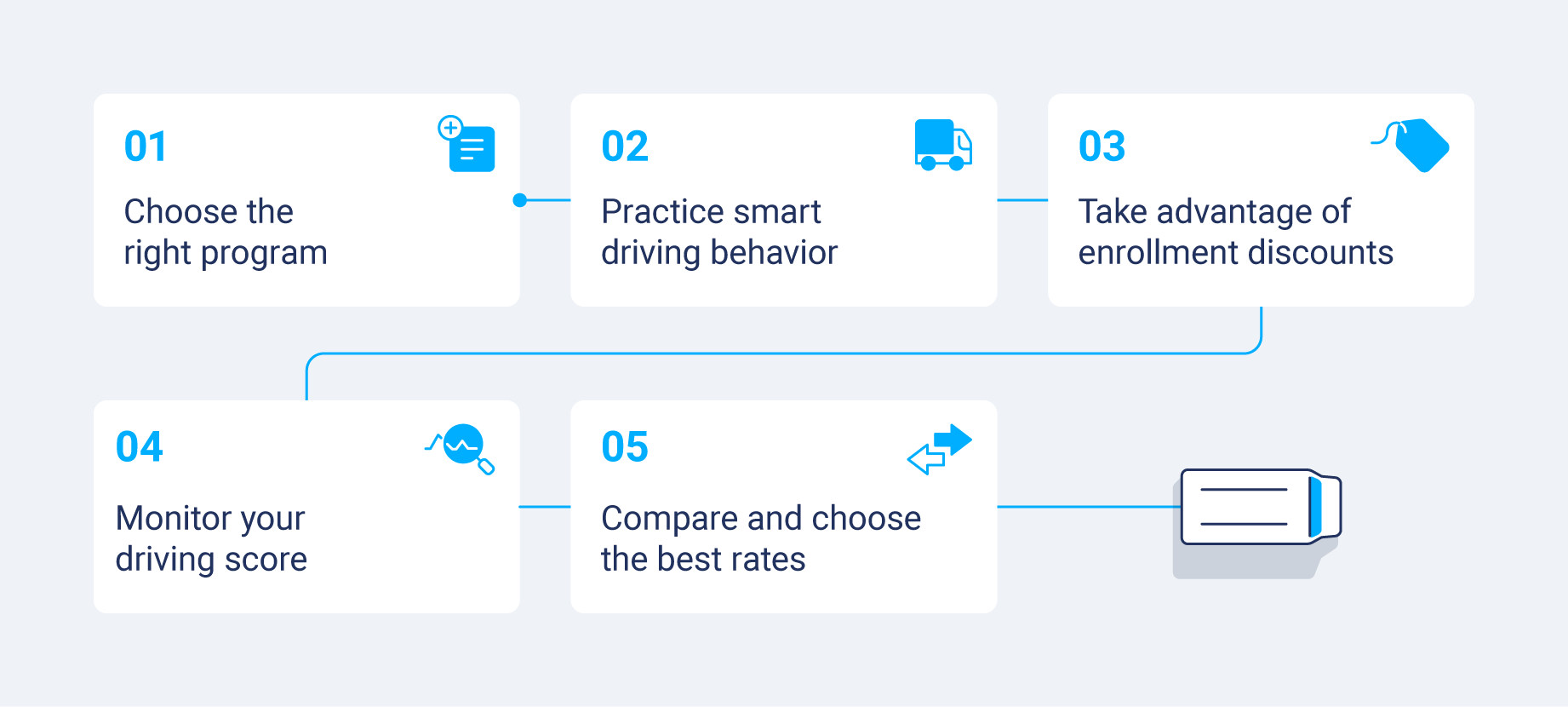
The chance for potential savings is real, but the range you can save is wide. Safe drivers can typically save between 10% and 40% compared to standard premiums, depending on the program, state and individual score. Some programs advertise up to 50% for the best-performing drivers.
Savings vary significantly by driver profile. Low-mileage drivers logging under 7,500 miles per year tend to see the largest reductions with PAYD programs. Young drivers with clean records benefit from PHYD programs that bypass age-based pricing. Experienced drivers who drive primarily during daylight hours also tend to score well.
The enrollment discount is available to most drivers regardless of performance during the monitoring period, making it a low-risk way to test a program. Get quotes from multiple usage-based insurance companies before committing, and ask specifically how the scoring model works in your state, since program availability and data use rules vary by market.
Is usage-based car insurance right for you?
The answer depends on your driving profile, comfort with data sharing and the insurer's specific program rules. Here is a straightforward breakdown to help you decide.
Drivers who benefit most from UBI
The following profiles tend to see the strongest results from UBI:
- Remote workers and retirees: Low annual mileage translates directly into lower costs under PAYD programs.
- Urban dwellers: If you use public transport most days and only drive occasionally, your low mileage works in your favor.
- College students with short commutes: PHYD programs can offset age-based rate penalties for young drivers who drive carefully.
- Drivers with clean records: Consistent safe behavior earns the best scores and the deepest discounts.
- Fleet operators: When UBI data flows into a broader fleet telematics platform, it supports both insurance savings and driver coaching, two goals that reinforce each other.
Drivers who may want to stick with traditional insurance
UBI may not help, but instead hurt, drivers who:
- Drive long distances regularly: PAYD programs may become more expensive as per-mile costs can add up quickly.
- Drive frequently at night: Late-night trips can carry higher risk scores in most programs.
- Operate in areas with poor app connectivity: Data collection gaps may skew results.
- Are uncomfortable with continuous location data tracking: Some drivers may also be uncomfortable sharing with third parties.
Being direct about this is not discouraging. It is how you make an informed choice instead of an expensive one.
Questions to ask before you enroll
Treat enrollment as a due diligence process, not an impulse decision. Ask your insurer:
- What specific behaviors are tracked, and how is each weighted in my score?
- Can my premium increase at renewal, and by how much if my score is poor?
- How long is the initial monitoring period?
- What happens to my data after the monitoring period ends? Is it stored, shared or sold?
- Is this device or app compatible with my vehicle and smartphone?
- Can I opt out mid-program, and what happens to my rate if I do?
Use telematics data to unlock insurance savings
Usage-based car insurance rewards drivers and fleets that can prove their safety record with data. Geotab's commercial fleet insurance solutions integrate UBI telematics into your workflow, helping lower premiums and support driver coaching.
Video telematics adds visual evidence of driver behavior. Forward-facing cameras combined with telematics data give insurers and fleet managers a clearer view of road risk. See how video telematics can improve your fleet risk visibility.
Subscribe to get industry tips and insights
Frequently Asked Questions
The difference between usage-based insurance markets and pay-per-mile insurance is that usage-based insurance is an umbrella term for insurance programs that use telematics to determine premiums. Pay-per-mile insurance is one type of UBI that charges a base rate plus a per-mile fee.
Yes, your premium can go up if you enroll in a UBI program. Most UBI programs can raise your premium at renewal if your driving score is poor. Behaviors like harsh braking, speeding and late-night driving typically result in lower scores.
Several major insurers offer usage-based insurance. Progressive offers Snapshot, Allstate offers Drivewise and Milewise, State Farm offers Drive Safe & Save and Lemonade (via the acquired Metromile platform) offers a pay-per-mile model.
Most UBI programs track GPS location as part of data collection. This helps insurers verify mileage and identify high-risk driving areas. Some programs retain location data after the monitoring period, while others delete it. Review your insurer's data policy before enrolling to understand exactly how location data is stored and used.
Most major insurers offer UBI programs in most U.S. states, but availability varies. Some states restrict how certain data types, like credit scores or location, can be used to set insurance rates, which affects how UBI programs operate.
The initial monitoring period typically lasts 90 days, though some programs run for six months. During this time, the insurer collects driving data and calculates your score. After the monitoring period ends, your premium is adjusted at renewal based on that score. Some programs continue monitoring indefinitely to keep adjusting rates each term.
Kanwaljit Basra is a Senior Embedded Systems Developer for Geotab.
Table of Contents
- What is usage-based insurance?
- How does usage-based insurance work?
- Types of usage-based car insurance
- Benefits of usage-based car insurance
- Drawbacks of usage-based car insurance
- How to save money with usage-based car insurance
- Is usage-based car insurance right for you?
- Use telematics data to unlock insurance savings
Subscribe to get industry tips and insights
Related posts

Fleet accident management: How to improve safety and reduce costs
September 4, 2026
5 minute read


Driver risk management: How public fleet managers save time with smarter video tools
September 2, 2026
3 minute read

How video telematics helps drivers trust the safety program
August 27, 2026
4 minute read

Lone worker safety for utility fleets: A checklist for the sites beyond cellular reach
August 24, 2026
3 minute read
Five data-driven strategies to optimize your utility fleet management
August 17, 2026
4 minute read