What roadside breakdowns really cost truck lessors
Truck breakdowns cost far more than towing alone. Geotab telematics helps lessors reduce roadside failures with earlier fault visibility.

Sep 2, 2026

Key Insights
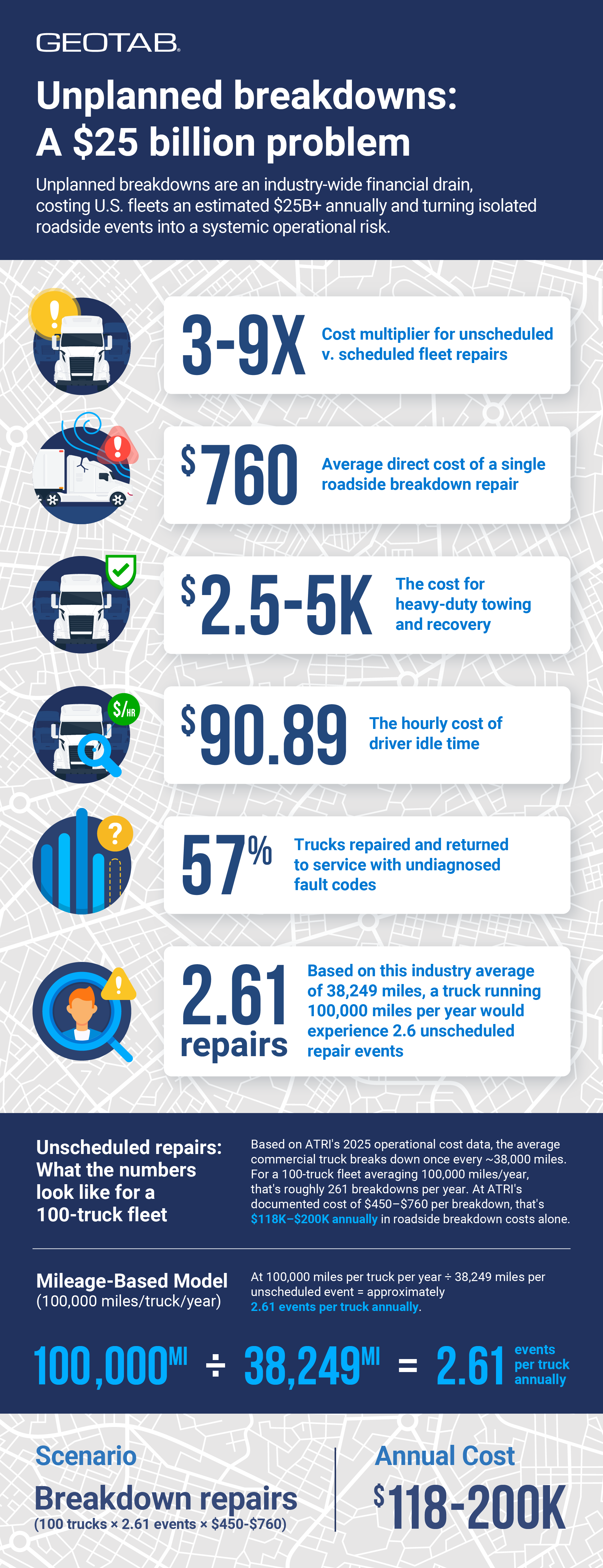
- A single breakdown extends far beyond the towing invoice. Heavy-duty towing and recovery alone can run $2,500 to $5,000+ per event, while lost operating time adds up quickly at $90.89 per hour of downtime.
- Unplanned breakdowns are an industry-wide financial drain, costing U.S. fleets an estimated $25B+ annually and turning isolated roadside events into a systemic operational risk.
- The lessors closing the gap between reacting and managing their assets more strategically are the ones using telematics to turn real-time fleet data into identifying problems before failure occurs.
It's 2 a.m. on Interstate 80. One of your leased trucks sits on the shoulder, hazards blinking. The driver called roadside an hour ago. Heavy-duty commercial towing for a Class 8 vehicle doesn't show up in 20 minutes; it can take hours depending on traffic and location. Meanwhile, the 14-hour Hours of Service (HOS) clock keeps running, the lessee's delivery window is closing and every idle minute is money you can't recover. The tow invoice alone will run in the thousands — and that's before driver idle time, emergency dispatch overhead, repair costs and lessee penalties are factored in.
Most fleet maintenance directors end their analysis at “What did this cost us?” but the question that determines whether this happens again is: “How much of this was avoidable?”
For truck lessors, distinguishing between avoidable and unavoidable maintenance is the difference between a controlled operating budget and an unpredictable emergency fund. Reactive maintenance can be a compounding financial drain.
The real impact of reactive maintenance
Escalated costs: Reactive roadside failures are typically far more expensive than planned maintenance because they combine repair costs with towing, downtime and operational disruption.
Damaged partnerships: Roadside failures lead to missed delivery windows, straining lessee relationships and risking lost business.
Diverted resources: Managing emergency dispatches locks up capital and operational focus that should be allocated to planned, scheduled maintenance.
To mitigate these risks, leading fleet operators can leverage advanced telematics and predictive analytics to monitor real-time vehicle performance and address potential failures before they result in a costly roadside event.
What does a single truck breakdown actually cost?
Most leasing operators calculate breakdown cost by looking at the tow invoice but that is not the only number that should be taken into consideration. The full cost of a roadside breakdown stacks across four distinct layers, each compounding the last.
1. Towing and roadside service
Heavy-duty commercial towing for a Class 8 truck runs $2,500–$5,000 or more depending on location, distance, time of day and recovery complexity. A rollover or mechanical failure requiring specialized equipment pushes costs significantly higher. This is the line item that appears on a ledger. The others often do not.
2. Driver idle time and HOS clock erosion
Under Federal Motor Carrier Safety Administration (FMCSA) HOS regulations, the 14-hour on-duty clock does not pause during a roadside breakdown. A driver waiting three hours for a tow has effectively lost three hours of legally available drive time — hours that cannot be recaptured that shift. According to the American Transportation Research Institute (ATRI), the fully loaded cost of a truck in operation was $90.89 per hour in 2024. Three idle hours on the side of I-80 represents over $270 in productive capacity lost before a single repair invoice is issued.
3. Lessee dissatisfaction and cargo delays
A breakdown does not stay contained to the truck. Missed delivery windows cascade into damaged lessee relationships, retailer chargebacks and, in contract-based fleets, potential penalty clauses. When a delivery arrives hours late, or not at all, the lessee's confidence in the leased asset erodes. Repeated incidents accelerate contract non-renewals. The financial damage of lessee attrition is rarely captured on a maintenance budget, but it belongs in the conversation.
4. Emergency dispatch and rescheduling overhead
Someone has to coordinate the tow, source a replacement vehicle, reroute the load and communicate with the end customer. Each of those tasks pulls staff time, burns phone hours and often involves premium freight rates for expedited alternatives. This administrative overhead is real, recurring and entirely invisible in a reactive maintenance ledger.
Add these layers together and the true cost of a single breakdown is significantly higher than most maintenance ledgers reflect. At the industry level, the scale of unplanned breakdown costs is substantial: The ATRI puts the industry-wide cost of unplanned commercial vehicle breakdowns at more than $25 billion annually, with a single roadside failure running between $450 and $760 in direct repair costs before towing and lost revenue enter the equation.
Why truck lessors default to the “wait and see” trap
Reactive maintenance persists not because leasing operators lack awareness, but because it feels systematic. Mileage-based service schedules create a sense of control. At 15,000 miles check the oil; at 25,000 miles do a complete inspection. Tick the boxes. Close the work order.
The problem is that breakdowns do not schedule themselves around service intervals.
A failing coolant sensor, a developing injector issue or early-stage brake wear does not wait for the next scheduled preventive maintenance (PM) visit. Drivers, under pressure to meet delivery windows, often minimize or delay reporting of early warning signs, like a rough idle, intermittent warning light or unusual vibration. Telematics makes early indicators more visible by continuously capturing vehicle health data, surfacing faults and abnormal patterns in real time, and alerting maintenance teams before those issues escalate into breakdowns.
The J.J. Keller 2026 State of Fleet Management survey of 500+ fleet managers found that asset maintenance was the top concern for 54% of fleet managers, with the report explicitly noting a “recalibration toward long-term vehicle reliability rather than reactive fixes.”
The cost penalty for that choice is substantial. Oxmaint’s fleet maintenance analysis states that unscheduled fleet maintenance costs three to nine times more than planned work and includes towing, emergency labor, downtime, missed delivery penalties and driver idle time in the total.
The frequency problem compounds this further. A truck averaging 100,000 miles per year would experience 2.6 unscheduled repair events annually, based on the industry average of one unscheduled repair per 38,249 miles. For a leasing company running 100 trucks, that translates to costs that stack well above the tow invoice alone.
From emergency response to controlled maintenance
The framing that matters most for leasing company executives is not “predictive maintenance vs. reactive maintenance.” It is: where does the cost land?
Without fault code monitoring and predictive alerts, the cost of every avoidable breakdown lands on unplanned emergency response that compounds across driver time, tow invoices, lessee relationships and dispatch overhead. There is no visibility before it hits and limited ability to manage it after.
With predictive maintenance, that same cost lands on a scheduled, budgetable maintenance line that the lessor controls. Instead of reactive scrambling at 2 a.m, greater lead time allows for planned parts procurement, scheduled labor and proactive communication with lessees.
How do truck lessors use telematics to close the gap?
The fleet maintenance directors and operations managers moving fastest on this shift are the ones closing the gap between what their vehicles are signaling and what their maintenance teams can act on. Geotab's fleet telematics platform gives truck lessors real-time visibility into vehicle health, location, driver behavior and fault code activity across the full fleet, helping turn early warning signs into faster action and measurable business value. For a deeper look at the financial impact, see The ROI of telematics for truck lessors: Turn data into profit.
The Geotab-Noregon Fault Code Enrichment integration takes that capability further. Noregon's diagnostic expertise enriches raw fault code data with actionable context by translating OBD fault codes into plain-language descriptions that help maintenance teams understand not just what is faulting, but how urgent it is and what repair is likely needed.
This matters more than it might initially appear. According to Noregon, 57% of trucks returned to service had undiagnosed fault codes at the time of roadside return. This means nearly six in 10 breakdown events that were “resolved” still had active, unaddressed diagnostic issues. Without fault code enrichment, those trucks re-enter service with hidden risk baked in.
Together, Geotab and Noregon provide truck lessors with:
- Real-time fault code alerts that surface developing issues before they become breakdowns
- Enriched diagnostic context that helps maintenance teams triage and prioritize effectively
- Fleet-wide health dashboards that replace guesswork with data-driven scheduling
- Historical fault data that supports smarter preventive maintenance intervals
- Lessee-facing reporting that demonstrates proactive asset stewardship, a genuine differentiator in competitive leasing markets
For even more information on how industry leaders are leveraging telematics to better predict and manage their fleets strategically download our comprehensive eBook Drive truck leasing success with telematics: The fleet manager’s roadmap to profitability.
Subscribe to get industry tips and insights
Christine is the Content Manager for the Commercial sector
Table of Contents
Subscribe to get industry tips and insights
Related posts


Top seven best fleet fuel cards: How to choose the right one for your business?
October 1, 2026
7 minute read

Fleet maintenance software for small business: 8 top tools and guide
September 29, 2026
7 minute read

Four ways to transform garbage fleet efficiency with data and video tools
September 28, 2026
4 minute read

Why the OEM versus device-level telematics debate misses the point for mixed-fleet operators
September 25, 2026
2 minute read