Five data-driven strategies to optimize your utility fleet management
Most utility fleets have data, but not a unified operational view across assets, safety and readiness. These five strategies show how a unified fleet view reduces fuel waste, protects uptime, tracks every asset and speeds storm response.

By Geotab Team
Aug 17, 2026
Key Insights
- Utility fleet idle time typically runs 25-35% of engine hours, most of it invisible without real-time monitoring.
- PTO and ePTO data turns maintenance from a calendar schedule into a decision based on actual equipment use.
- Non-powered assets such as trailers, generators and portable equipment often lack GPS tracking, so teams may not know where they are when a storm callout begins.
- Storm response speed is set before the storm hits, not during it; fleets with a unified operational view deploy faster when it matters.
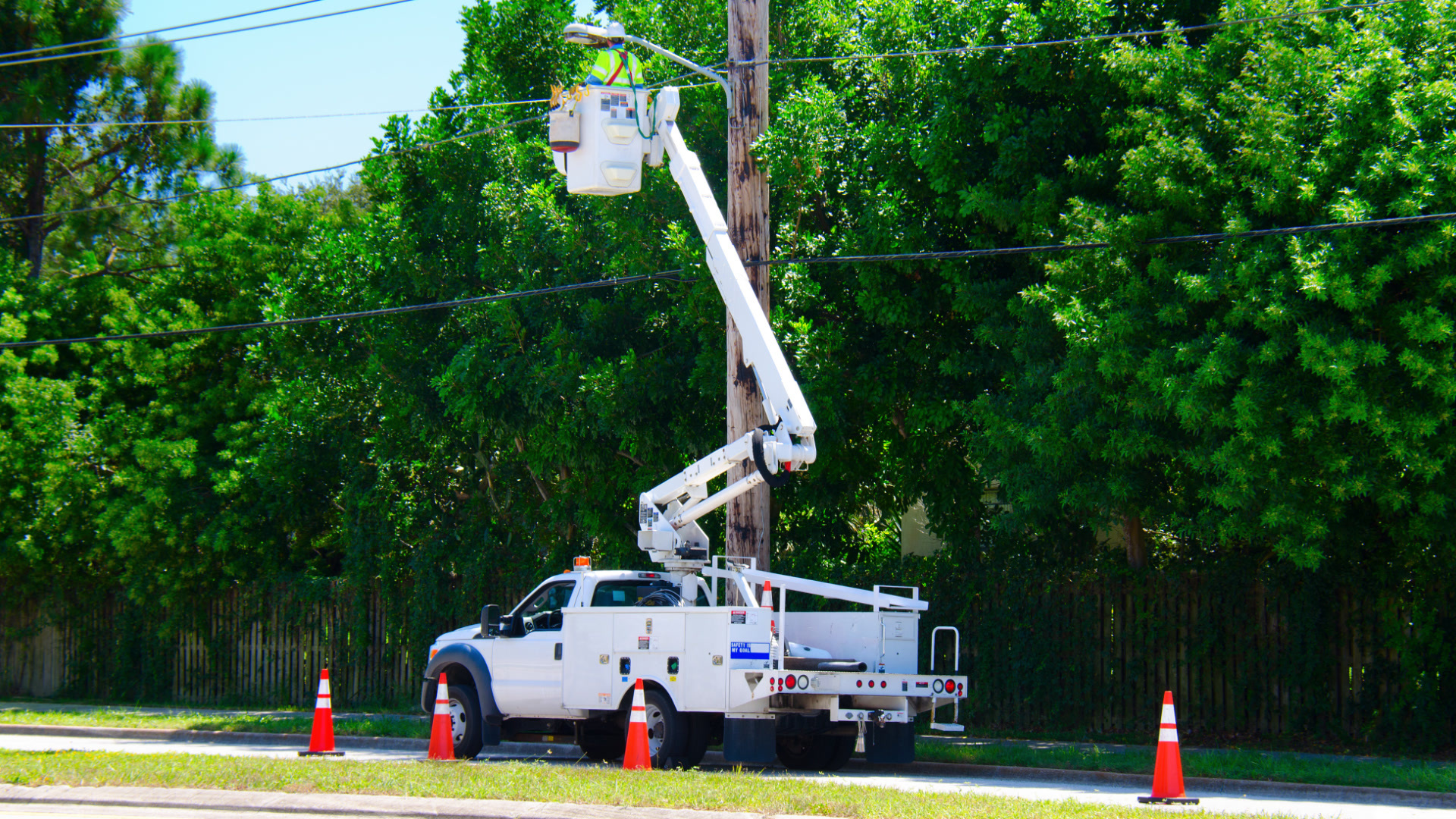
Utility fleet management involves running high-cost equipment across wide territory in high-risk conditions. When a storm hits, response speed is determined by how well the fleet is managed before the storm arrives.
Missing asset data, unplanned downtime and unmonitored fuel waste aren’t just operational inefficiencies. They’re the gaps that slow deployment when it matters most. The five strategies below show how to turn each into a management target: track every asset, service equipment based on actual use, deploy crews faster and cut unproductive idling.
1. Turn invisible fuel costs into a reduction target
Across a mid-to-large utility fleet, idle time typically runs 25-35% of total engine hours. Bucket trucks may run hydraulic systems at jobsites, while service vans warm up before shifts and pickups sit at staging areas between calls. Commercial vehicle operating costs run roughly $85 per vehicle per hour, according to the American Transportation Research Institute. For a 50-vehicle fleet running 25% idle time across eight-hour shifts, five days a week, that's roughly $2.2M in annual operating costs lost to unproductive idle. Without monitoring, there's no target to reduce it.
Not all idle time is equal: a bucket truck running hydraulics at a jobsite is doing work. The reduction target is unproductive idling: vehicles warming up before shifts, sitting at staging areas or waiting between calls. When that data is unavailable, no one knows which vehicles are idling unproductively, for how long or where. Scheduling runs on assumptions, and fuel costs eat into margins.
Geotab's fleet management platform, MyGeotab, flags excessive idling as it happens. Usage reports show which vehicles idle most, by site and by shift. With that data visible, idle time can have a reduction target.
2. Improve uptime with predictive maintenance and PTO data
Utility fleets don't schedule around the calendar the way most commercial fleets do. A bucket truck running its power take-off (PTO) system for six hours a day is doing different work than a service van covering 200 miles. Servicing both on the same calendar interval isn't a maintenance strategy. It ignores how each machine actually runs.
PTO and electric PTO monitoring lets fleet managers service equipment based on actual use, not elapsed time. The difference matters most when equipment breaks down mid-response. During a storm callout or a major outage, an unplanned vehicle outage doesn't just cost repair time.
United Utilities, a UK water utility running 2,300+ vehicles, discovered this directly. Before installing telematics, one truck suffered engine failure after running its water pump 5-10 hours daily. Engine hours were invisible to the maintenance team. The truck was off-road for 23 days, costing £60,000 ($74,670 USD) in repairs and outsourced contracts. After switching to engine hours-based service scheduling, United Utilities estimates every off-road day prevented saves approximately £2,000 ($2,489 USD) in combined hire, penalty and downtime costs.
Geotab's predictive analytics flag degradation patterns before a check-engine code appears, giving the fleet team time to schedule service rather than respond to a breakdown. For utilities, an unplanned vehicle outage carries two costs: repair and lost service time for customers waiting on it.
3. Gain real-time visibility into specialty assets
Bucket trucks and digger derricks are tracked because they have engine power and a GPS device. Trailers, portable generators and temporary lighting equipment typically don't. When those assets move between jobsites, substations or staging areas, they often move without a data trail.
A generator that left with a crew three weeks ago might be at a substation, a depot or a jobsite. The only way to find out is to call around. During normal operations, that's a scheduling drag. During storm deployment, it's a capability gap: you can't dispatch equipment you can't locate.
Geotab's GO Anywhere family of asset trackers attaches to trailers, generators and portable equipment. The trackers report location continuously with no wiring and no installation project. Vehicles and non-powered assets appear together in one dashboard. No separate system, no manual reconciliation.
For specialty powered assets such as bucket trucks and digger derricks, the issue is often usage rather than location. Some trucks run 60-hour weeks while others sit underworked at the same depot. Utilization reporting is essential to reveal that imbalance and gives fleet managers the data to redistribute work before underused assets become a budget question.
4. Use camera-based coaching to reduce the risk of backing incidents
Backing incidents are one of the costliest preventable risks for utility fleets. Most happen in the last 10 feet of a maneuver. Congested work zones, residential streets and staging areas create the exact conditions where mirrors fail and time pressure is highest.
Direct costs per incident can reach $30,000-$50,000 before factoring in insurance, litigation and service disruption. Coaching after the claim is too late. The only window for prevention is during the maneuver.
Fleets using video coaching see a 35% improvement in safety behaviors on average. GO Focus Plus with AI obstacle detection delivers real-time in-cab alerts before contact, and video footage that gives managers the evidence to coach behavior before the next shift.
5. Connect fleet data to faster storm response
In a storm response, preparation is the only variable still within a fleet manager's control.
A callout at 2 a.m. is not the time to determine which vehicles are ready, where the equipment is staged or which crews are clear. In most operations, those answers live in separate systems. A unified fleet view brings them together before the callout arrives: vehicle readiness, asset locations and crew availability in one dashboard, not three.
ENMAX Power Corporation runs utility crews around the clock across a wide service territory. When something unexpected happens in the field — a vehicle incident, a storm callout, a crew out of contact — response time is what counts. When a driver was involved in a collision, MyGeotab notified the fleet team right away. They alerted first responders and management in real time and got support to the driver immediately. That's the same capability that enables storm response: the right information reaches the right people before the situation gets worse.
"It has become our end-to-end solution. We really do use it end-to-end." — Ryan Greir, Manager, Mobile Fleet, ENMAX Power Corporation
The five strategies aren't independent improvements. Real-time location data without non-powered asset tracking still leaves a crew guessing where the generator is. PTO-based maintenance without idle monitoring controls one cost while another runs unchecked. The operational view that holds under pressure is the one where all five connect.
Read our new ebook, Five utility fleet risks to close before storm season, for a deeper look at the incidents, capital loss and compliance exposure behind each of these strategies.
Subscribe to get industry tips and insights
Frequently Asked Questions
Utility fleet management covers the vehicles, equipment and drivers that keep power, water and utility services running. It includes vehicle tracking, maintenance scheduling, fuel monitoring and non-powered asset management — ideally all coordinated through a single operational view like with MyGeotab. For utilities, that visibility is what determines how fast crews can respond when storm season or unplanned outages hit.
Utility fleet tracking makes idle time visible by vehicle, site and shift. That's where most fuel waste hides. Across a mid-to-large utility fleet, unproductive idling can account for 25-35% of total engine hours. Once the data is visible, dispatchers have a reduction target they can actually act on.
Battery-powered asset trackers attach directly to the equipment with no wiring required. In a platform like MyGeotab, assets report location continuously alongside vehicles in the same dashboard. That removes the manual locating calls that create gaps during storm deployment and slow operations the rest of the time.
Fleet management for utility companies improves storm response by making asset locations, vehicle readiness and crew availability visible before a callout arrives. When it does, crews deploy from known positions rather than spending the first 20-30 minutes locating equipment and confirming vehicle status.
The Geotab Team write about company news.
Table of Contents
Subscribe to get industry tips and insights
Related posts

Unlocking more jobs per day: How smart dispatch management improves tech performance
October 13, 2026
3 minute read

Top seven best fleet fuel cards: How to choose the right one for your business?
October 1, 2026
7 minute read

Four ways to transform garbage fleet efficiency with data and video tools
September 28, 2026
4 minute read

Why the OEM versus device-level telematics debate misses the point for mixed-fleet operators
September 25, 2026
2 minute read