What is condition-based maintenance? How it works, tools and how to start
Condition-based maintenance uses real-time vehicle data to determine repairs based on actual needs instead of fixed intervals, helping fleets reduce unplanned downtime and extend component life.

By Geotab Team
May 6, 2026

Key Insights
- Condition-based maintenance (CBM) monitors vehicle health in real time, triggering service based on actual wear instead of fixed schedules.
- Fleets can start with diagnostic trouble codes and basic telematics data, then expand to advanced sensors and oil analysis as programs mature.
- Moving from reactive or time-based maintenance to CBM reduces unplanned downtime and improves component life.
- Implementing CBM requires defining thresholds, aligning workflows and managing high-impact systems.
Fleet managers know that picking the optimal time to service a vehicle is crucial to successful operations. Traditional time-based maintenance schedules can lead to unnecessary work or missed problems, increasing the risk of breakdowns. Condition-based maintenance (CBM) is a more strategic approach, using real-time data to trigger service when components truly need it.
This guide explains what condition-based maintenance is, how it works and why it matters for commercial fleets. You will also learn practical monitoring techniques, why you should move away from reactive fleet maintenance and how to build a CBM program that fits your fleet's needs.
What is condition-based maintenance?
Condition-based maintenance is a maintenance strategy that monitors the actual condition of vehicles and equipment to determine when service is needed. Instead of servicing assets on a fixed schedule — such as every 5,000 miles or six months — CBM uses data from sensors to identify when components are worn out.
The methodology here is simple: Perform maintenance only when it is needed. This reduces unnecessary service intervals and breakdowns. In fleet management, CBM might involve monitoring engine fault codes and oil life indicators, or using vibration analysis, thermal imaging or fluid testing to assess component lifespan.
Condition-based maintenance vs. predictive maintenance
Though condition-based monitoring and predictive maintenance are often used interchangeably, they represent different levels of sophistication in maintenance strategy. Understanding the distinction can help fleet managers pick the best approach for their needs.
| Key considerations | Condition-based maintenance | Predictive maintenance |
| Trigger | Monitors current asset condition and initiates maintenance when predefined thresholds are crossed | Uses historical and real-time data to forecast failures before symptoms occur |
| Data requirements | Real-time sensor data, fault codes, usage metrics | Large historical real-time datasets, failure history |
| Technology | Telematics, basic sensors and rule-based alerts | Machine learning models, AI and advanced statistical analysis |
| Timing | Reactive to detected conditions | Proactive, based on predicted failure risk |
| Implementation complexity | Moderate, requires reliable data capture and threshold configuration | High, requires data science expertise and model training |
| Maintenance approach | Addresses issues once early warning signs appear | Schedules maintenance before issues appear |
| Scalability | Easier to deploy across smaller or more uniform fleets | Best suited for large, complex fleets with variable assets |
| Best for | Fleets with clear failure indicators and consistent operating conditions | Organizations with mature data infrastructure and long-term maintenance and operation goals |
The main difference between condition-based maintenance and predictive maintenance is their approach to equipment monitoring. CBM will tell you when something is currently wrong, while predictive maintenance forecasts when something will probably go wrong in the future. Most fleets start with CBM and move toward predictive capabilities as their data and analytics grow.
Typical tech stack for CBM
Implementing condition-based maintenance does not require a big technology investment upfront. Most fleets start with basic fault code monitoring and expand their tracking over time.
A typical CBM tech stack includes:
- Telematics devices and vehicle data access: This is hardware that connects to the vehicle's onboard diagnostics port and captures engine data, fault codes, odometer readings and operating conditions.
- Sensors: This includes OEM-installed or aftermarket sensors for tire pressure, brake wear, fluid levels, temperature and vibration.
- Condition-based maintenance software or CMMS: Fleets may use either a dedicated condition-based maintenance program or CMMS to log service history, schedule work orders and track asset performance over time.
- Alerting and reporting layer: This includes tools that trigger notifications when thresholds are crossed and provide dashboards for fleet management reporting.
- Data governance basics: These processes ensure asset IDs, odometer integrity and consistent fault code mapping.
How condition-based maintenance works
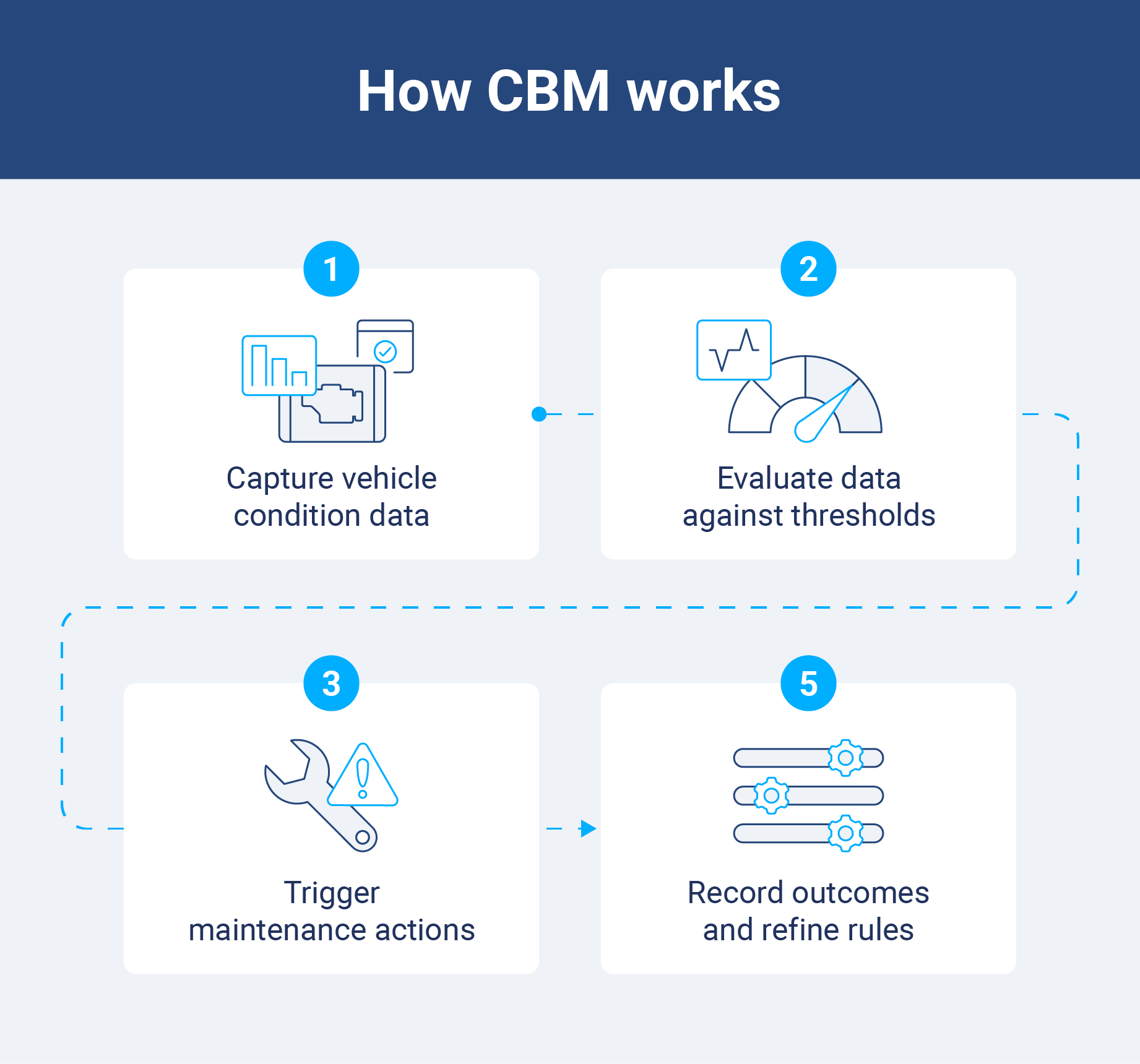
Condition-based maintenance operates as a conditional loop:
- Data flows from vehicles
- Rules evaluate that data against thresholds
- Alerts trigger maintenance actions
- Feedback from completed work refines future decisions
Understanding each step in this process helps fleets effectively implement CBM.
Step 1: Capture vehicle condition data
Reliable, real-time fleet data is the foundation of any CBM program. Vehicles generate a wealth of information through onboard diagnostics, telematics devices and sensors, including:
- Battery voltage
- Oil life percentage
- Tire pressure
- Coolant temperature
Step 2: Set thresholds and rules
Raw data alone will not tell you when to act. Fleets must define thresholds and rules that translate condition signals into maintenance triggers. These thresholds should be set based on manufacturer recommendations, historical failure patterns and operational priorities.
For example, a rule might state: "Generate an alert when oil life drops below 10%" or "Flag a vehicle when engine temperatures exceed 220°F for more than five minutes."
Step 3: Trigger maintenance actions
When a threshold is crossed, the system generates an alert and initiates a maintenance action. This might look like:
- A notification for a fleet manager
- An automatic work order in a maintenance system
- A driver alert to schedule service at the next available opportunity
Alerts should include enough context — vehicle ID, fault code, current condition, recommended action — to help technicians diagnose and address the situation effectively.
Step 4: Close the loop
The final step is to capture what was done and feed that information back into the system. Doing this supports root cause analysis and warranty recovery. Make sure to record:
- Completed maintenance
- Parts replaced
- Labor hours
- Any additional findings
Over time, this feedback helps you refine thresholds, identify recurring issues and validate that your CBM rules are working as intended.
Condition-based maintenance examples
Fleets use a variety of monitoring techniques to implement CBM. The right mix depends on vehicle type, operating conditions and the systems that drive the most downtime. Below are some common condition-based maintenance examples.
OBD and engine fault codes
On-board diagnostics (OBD) is a standard system built into most modern vehicles that generates and stores diagnostic trouble codes (DTCs). Fleet software and telematics tools can pull and log these codes to determine when any of these systems operate outside normal parameters, including:
- Engine
- Transmission
- Emissions
- Other systems
Monitoring this information in real time allows fleets to address issues before they escalate into breakdowns.
Telematics-based usage signals
Telematics devices provide insight beyond fault codes, pulling data like:
- Engine hours
- Idle time
- Harsh braking events
- Rapid acceleration
- Power take-off (PTO) usage
These signals help fleet managers identify vehicles that experience heavier use and might need more frequent servicing.
Oil analysis
Fleets often send oil samples to labs at regular intervals or use telematics data to flag abnormal engine behavior. Results can reveal bearing wear, coolant leaks or fuel dilution. Consider testing for:
- Viscosity
- Wear metals
- Contamination
Coolant analysis
Similar to oil analysis, coolant testing checks for additive depletion, pH levels and contamination. Because degraded coolant loses its ability to protect against corrosion and overheating, these tests act as engine-critical health exams.
Vibration monitoring
Accelerometers and vibration sensors detect abnormal movement in rotating equipment like driveshafts, wheel bearings and auxiliary components. Increased vibration often signals:
- Misalignment
- Imbalance
- Bearing wear
Thermal monitoring
Temperature sensors keep tabs on overheating patterns in the brakes, wheel ends and engine. Sustained high temperatures can indicate:
- Dragging brakes
- Failing bearings
- Cooling system problems
Early detection is key to preventing damage and reducing the risk of fires or wheel-off events.
Brake wear indicators and lining thickness checks
Electronic brake wear sensors or manual thickness measurements offer direct insight into brake condition. Monitoring brake health supports safety compliance and helps fleets avoid costly violations.
Tire pressure and temperature monitoring
Tire pressure monitoring systems (TPMS) alert fleets when tires are underinflated or overheated. This lowers the risk of a blowout and extends tire life. Maintaining proper pressure also improves fuel efficiency and reduces uneven wear.
Battery health
Prevent no-start events by monitoring these battery health metrics:
- Battery voltage
- Cranking performance
- Charge cycles
For electric vehicles, battery health monitoring tracks cell degradation, charge cycles and thermal management to optimize range and lifespan.
Visual inspections with standardized checklists
Though not sensor-based, digital checklists and Driver Vehicle Inspection Reports (DVIRs) can also help capture condition data that feeds into CBM programs. Consistent, structured inspections provide early warning signs that sensors might miss — like fluid leaks, worn tire tread or body damage — so it is important that your drivers keep an eye out.
Advantages of condition-based maintenance
By servicing vehicles based on actual need instead of a fixed schedule, fleets can optimize maintenance spending and minimize disruptions caused by unplanned repairs. Other advantages of condition-based maintenance include:
- Less unplanned downtime and fewer roadside events: CBM catches problems early — before they escalate into breakdowns — which also makes it much easier to schedule off-road equipment maintenance.
- Better parts planning and labor scheduling: When you know which components are approaching failure, you can order parts in advance and schedule technician time more efficiently.
- Longer component life when appropriate: Time-based maintenance often replaces still-functioning parts, while CBM allows components to run longer when conditions prove they are performing well.
- Improved compliance and inspection readiness: Fleets subject to DOT inspections or other regulatory oversights are better positioned to pass inspections and avoid costly violations or out-of-service orders.
- Stronger warranty recovery and root cause tracking: Detailed condition data and service records make it easier to identify root causes of component failures and substantiate warranty claims.
- More accurate maintenance budgeting: CBM provides visibility into fleet health trends, enabling finance teams to forecast maintenance costs more reliably.
How to get started with condition-based maintenance
Building a condition-based maintenance program does not require replacing your entire maintenance system overnight. Start small, focus on high-impact systems and expand as you gain experience and data.
Identify high-impact vehicle systems
Not every component has to have conditional monitoring. Start with systems that drive the most cost, safety risks or downtime. For many fleets, that means prioritizing the components often associated with the most breakdowns or compliance issues, such as:
- Engines
- Transmissions
- Brakes
- Tires
Once you identify the vehicle systems that need the most attention, review historical maintenance data to find:
- Systems with the highest repair frequency or cost
- Components that cause the most unplanned downtime
- Safety-critical systems subject to regulatory inspection
Focusing on high-impact systems ensures your early CBM efforts deliver the greatest impact and measurable value — which gets you more support for broader implementation.
Audit your current data and processes
Before you set up conditional monitoring, assess the data you have already captured and consider how maintenance decisions are being made. Review whether you have:
- Telematics devices installed
- Fault codes logged
- Centralized maintenance history
Look for gaps in data quality, asset tracking and work order documentation. If your odometer readings are unreliable or fault codes are not mapped to service actions, you will need to address those issues first to avoid building on a poor base. A CBM program is only as good as the data feeding it.
Define rules and thresholds
The next step is working with your technicians and equipment suppliers to establish thresholds and rules for each monitored system. Start conservatively using manufacturer recommendations, then adjust accordingly as you get real-world data.
Document each step of your rules carefully. Clear documentation keeps everything consistent and makes it easier to train new staff or scale the program.
Important questions to ask yourself include:
- What condition triggers an alert?
- What action should occur when the threshold is crossed?
- Who is responsible for responding to the alert?
- How quickly must action be taken?
Align maintenance workflows
Condition-based maintenance only functions properly if your workflow can respond to real-time alerts. Integrate your condition monitoring platform with your maintenance management system so alerts automatically generate work orders, assign tasks and track completion.
Technicians should also have access to the original condition data that triggered each alert so they can diagnose and repair efficiently.
If your current processes are manual or paper-based, consider investing in vehicle maintenance software that connects data capture, alerting and work order management in a single platform.
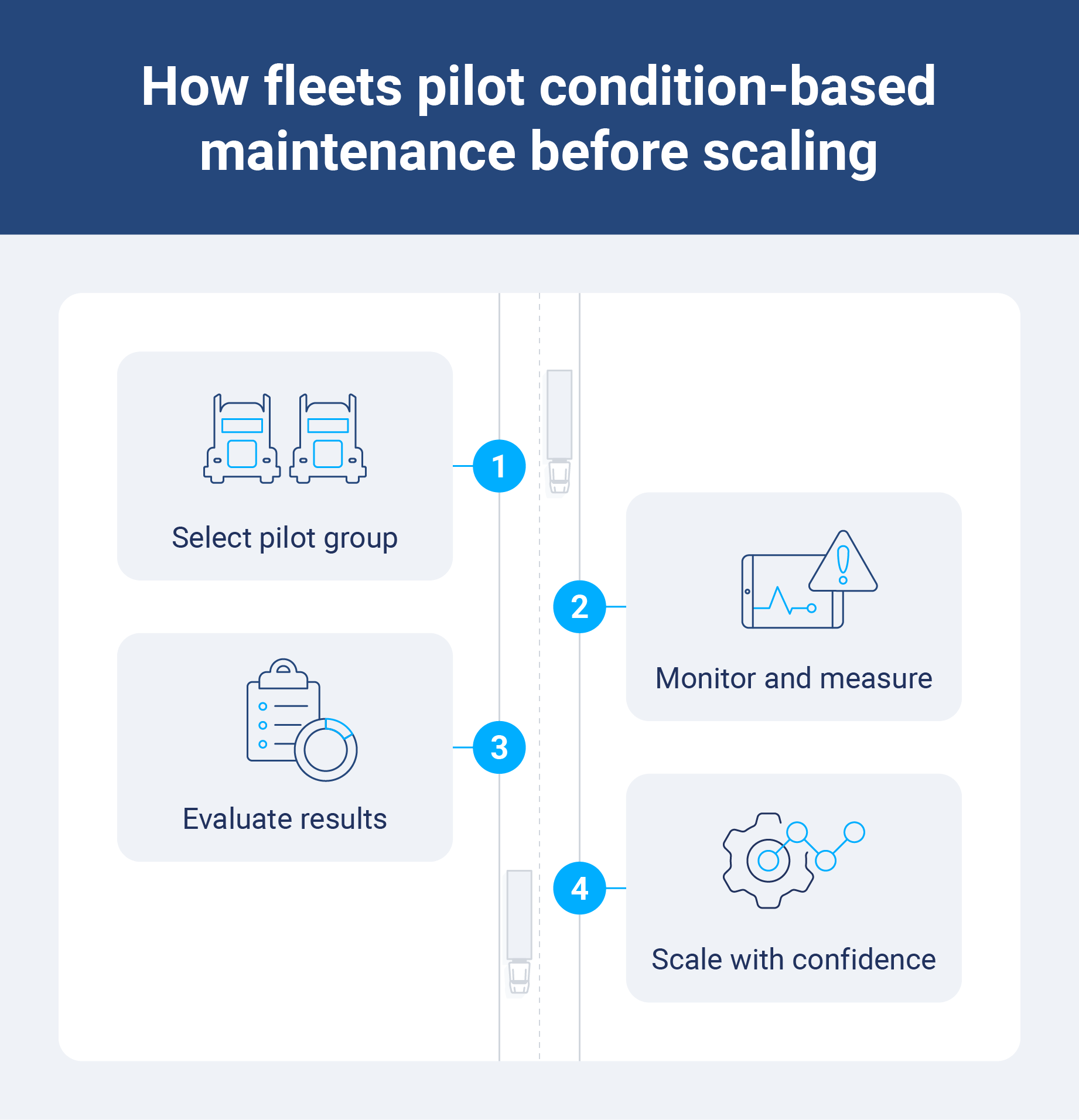
Pilot before scaling
Test your CBM program with a small subset of vehicles or a single high-priority system before rolling it out fleetwide. A pilot allows you to refine thresholds, troubleshoot and demonstrate stakeholder value without disrupting your entire system.
Key metrics to track during the pilot include:
- Number of alerts generated versus alerts that resulted in a service
- Reduction in unplanned downtime or roadside events
- Cost per vehicle compared to baseline
- Technician feedback on alert quality and actionability
Use pilot results to adjust your approach, secure a budget for expansion and build a roadmap for fleetwide implementation.
Turn vehicle data into smarter maintenance decisions
The real power of condition-based maintenance is its ability to turn raw vehicle data into actionable insights. As fleets mature their CBM programs, they often add capabilities like trend analysis, fleetwide benchmarking and integration with parts inventory systems for even greater optimization.
Condition-based maintenance also delivers insights beyond component health, including opportunities for route optimization, driver coaching and vehicle replacement planning. This data is key to helping fleets transition from reactive repairs to a cost-effective maintenance strategy.
Ready to implement condition-based maintenance in your fleet? Geotab's fleet maintenance solutions connect vehicle data, alerting and workflows in a single platform to support smarter decision-making.
Subscribe to get industry tips and insights
Frequently Asked Questions
The four main types of maintenance are:
- Reactive (run-to-failure)
- Preventive (scheduled based on time or mileage)
- Condition-based (monitoring real-time condition data to trigger service)
- Predictive (forecasting failures using advanced analytics)
Most fleets use a combination of these approaches, depending on asset criticality, data availability and other fleet needs.
Condition-based maintenance (CBM) initiates services based on real-time vehicle condition data like fault codes, sensor readings or fluid analysis. On the other hand, time-based maintenance (TMB) schedules services at fixed intervals — such as every 250 engine hours or once per year— regardless of vehicle condition.
CBM reduces unnecessary service and catches problems earlier. TBM is simpler to apply across the fleet but can lead toover-maintenance or missed issues.
Switching from preventive to condition-based maintenance cuts back on unnecessary services, extends component life and improves parts planning. Rather than replacing parts on a fixed schedule, CBM allows components to run longer when condition data shows they are still performing up to standard.
A well-implemented CBM program lowers fleet costs, reduces waste and minimizes downtime by addressing problems before they cause breakdowns and getting the full lifetime value from components.
Key sensors and metrics include:
- Diagnostic trouble codes (DTCs)
- Oil life indicators
- Tire pressure and temperature
- Brake wear sensors
- Coolant temperature
- Vibration levels
- Engine hours
- Idle time
Advanced fleets might also use oil analysis, thermal imaging and driver inspection reports. The best metrics for your organization depend on your fleet type, operating environment and the systems that drive the most cost or downtime.
The Geotab Team write about company news.
Table of Contents
Subscribe to get industry tips and insights
Related posts


Top seven best fleet fuel cards: How to choose the right one for your business?
October 1, 2026
7 minute read


Fleet maintenance software for small business: 8 top tools and guide
September 29, 2026
7 minute read


The failure you didn't predict is more than just a repair bill
August 18, 2026
1 minute read